


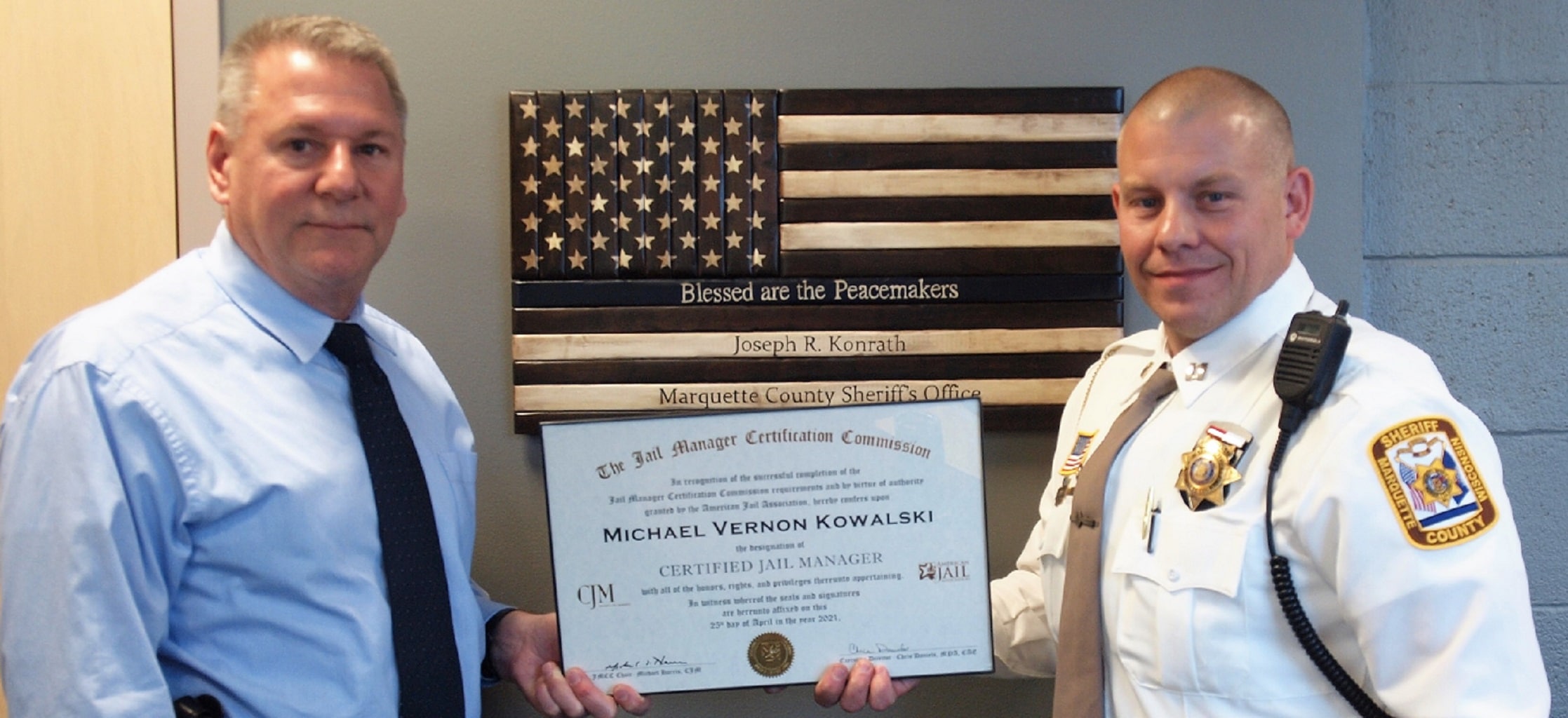
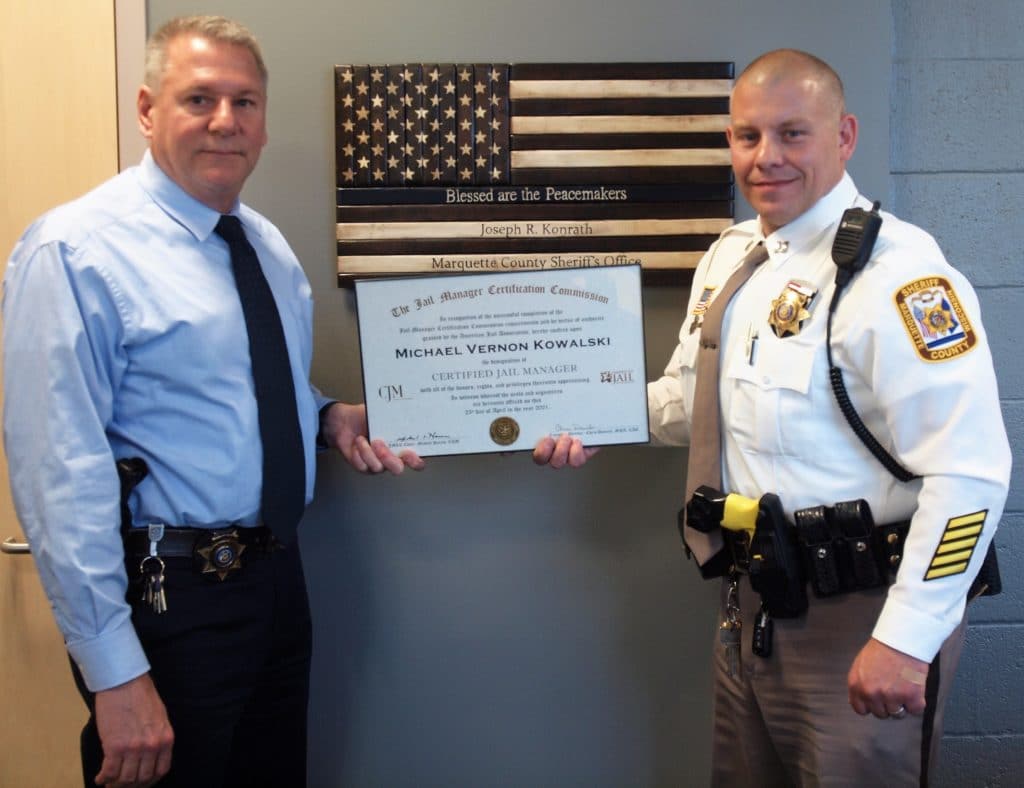
Marquette County Sheriff’s Deputy Captain Mike Kowalski earns Certified Jail Manager

Marquette County Sheriff Joe Konrath (Left) congratulated Captain Mike Kowalski who recently
earned Certified Jail Manager. He is the first and only Certified Jail Manager in Wisconsin.


(Submitted) Marquette County Sheriff’s deputy Captain Mike Kowalski can now add the letters CJM
behind his name, making him the first and only Certified Jail Manager in Wisconsin. It’s quite
the honor for Kowalski, for the Sheriff’s Department and for Marquette County and it didn’t
come easily.

The certification is bestowed by the American Jail Association. The American Jail
Association (AJA) was incorporated in 1981 through the merger of the National Jail Association
and the National Jail Managers’ Association. AJA is a nonprofit organization that focuses on
excellence in services, education, the publication of an award-winning magazine American Jails,
best practice, collaborative partnerships, and steadfast support of jail personnel. AJA “asks
every individual to recognize the American jail for what it is: a vital community agency which
renders superb service to the public 24 hours a day/7 days a week.”

AJA offers certification for Jail Officer, Jail Supervisor, Jail Manager, and Correctional
Trainers. The American Jail Association says, “The Certified Jail Manager (CJM) Program was
launched in 1997. This program focuses specifically on the individual jail manager and is an
indication of his or her competency in this specialized field. Jail managers who become CJMs
are distinguished as individuals who have reached one of the highest levels of achievements in
their field.”

Captain Kowalski met the stringent requirements for Certified Jail Manager and received
his certification in April of this year. He will be required to recertify every four years and meet
jail management, education, training and related leadership activities during that certification
period.

Kowalski grew up in Whitewater, Wisconsin and attended Blackhawk Technical College
doing a seven-week internship with the Rock County Sheriff’s Department in 2001. He worked
for the same department until taking a job with the Marquette County Sheriff’s Department in
2004.

In 2013 Kowalski became Patrol Sergeant and in 2016 Captain/Jail Administrator.
Asked what it is he likes about working in the jail, he said, “I like working with the staff of hardworking people and I enjoy working toward positive changes and improving policy and our custody manual.”

The Marquette County jail serves up to 40 inmates a day. During COVID they have had
25 to 30 inmates a day and have successfully prevented COVID infections in the jail population
in Marquette County. Sheriff Joe Konrath is working towards housing an additional up to 10
inmates from other county jails in the future. These would be low risk individuals on work
release detention and would utilize jail infrastructure while generating income for Marquette
County. Presently there are 20 fulltime Deputies in the jail supervised by Captain Kowalski.
Operating a quality jail takes leadership and high standards of performance. In 2020
Marquette County received a Gold award for excellence in law enforcement policy management
from Lexipol Connect. This award was given for the extensive work completed to improve the
custody manual in law enforcement and continued actions to maintain performance levels and
knowledge of staff.

Lexipol is a risk management company for public safety and local government. The
company saves Marquette County about $30,000 a year according to Sheriff Joe Konrath. It was
County Clerk/Administrative Coordinator Gary Sorenson who brought the services to the
attention of the Sheriff that led to policy changes and updates, saving money mostly through
insurance costs. Sheriff Konrath and Captain Kowalski are administrators of the custody policy
manual. Among other requirements, Sheriff department staff are required to take regular training
bulletin educational reviews from Lexipol and their scoring in the high 90s was one qualification
for being awarded the Gold level for excellence in law enforcement policy management.
Captain Kowalski follows the lead of Sheriff Konrath and is continually seeking
education and training that helps keep Marquette County Sheriff’s Department including the jail
operating under high standards. Sheriff Konrath attended the FBI National Academy in 2008,
becoming President of the Wisconsin Chapter of the National Academy from 2013 until 2017.
He sent Captain Kowalski to the National Academy in 2018.

In 2017 Captain Kowalski attended Wisconsin Command College with the Department of
Justice and became a Certified Public Manager. That made him eligible to apply for certification
with the American Jail Association.

There is a twist to the story here. In 2016 then Sheriff Kim Gaffney attended the
National Sheriff’s Association conference and won an application for Certified Jail Manager.
The cost of the application was the prize because all requirements still had to be met. He passed
it on to Kowalski who put it into an envelope and kept it in his desk.
Life circumstances including back surgery and the death of his father put the quest of
CJM on the back burner, but he never forgot that he had that letter that might mean his chance to
seek the certification. When it was the right time, he pulled it out and he and the Sheriff inquired
if it would still be honored. Since the letter hadn’t been dated, AJA said yes, they’d honor it and
Kowalski filled out the 20-page application. He scored well above the required 500 point
minimum and went on to take a 250-question test over four hours and received the honor of
Certified Jail Manager.

Captain Kowalski is also a State Firearms Instructor and a Canine Handler. His canine
partner Axel is now 11 years old. Sheriff Konrath said, “I appreciate Captain Kowalski’s hard work and determination to stay on top of his field.” That hard work brings some prestige to Marquette County. It now has the only Certified
Jail Manager in the state and Kowalski joins a professional list of people around the country who
have earned this high honor.

“If it wasn’t for the support of Joe and Kim (Gaffney), I wouldn’t have had these
opportunities,” said Captain Kowalski. “I also really have to thank my wife Sara. I wouldn’t
have been able to do this alone. She and my son Michael support me. It’s not easy being the
family of law enforcement especially a canine handler. I get called out at all hours.”

Adding that CJM after his name, Captain Kowalski really adds it to a list of honors and
achievements that make Marquette County special. The honor of having the only Certified Jail
Manager in the State of Wisconsin says something about how Marquette County sets standards
of professional performance.

Police Department Accreditation Assessment Team Invites Public Comment


(Police Dept. press release) – The Wisconsin Law Enforcement Accreditation Group (WILEAG) will be
making an assessment and examine all aspects of the Whitewater Police Department’s policy and procedures,
management, operation, and support service. The assessment will take place Tuesday, June 15, 2021 through
Thursday, June 17, 2021.

Verification by the WILEAG team is necessary for the Whitewater Police Department to meet the Board’s state-of-the-art standards as part of a voluntary process to gain accreditation.

“This is a highly prized recognition of law enforcement professional excellence,” Chief Aaron Raap said.

The public can provide comments to the assessment team by calling (262) 473-0109 on Wednesday, June 16th
between the hours of 10 a.m. and 12 p.m. Telephone comments are limited to 10 minutes and must address
the agency’s ability to comply with WILEAG’s standards. The current WILEAG accreditation standards can be
found at the WILEAG website located at http://www.wileag.info/full-accreditation.html.
Individuals can offer written comments about the Whitewater Police Department’s ability to meet the standards
for accreditation and send them to Wisconsin Law Enforcement Accreditation Group, WILEAG at WILEAG at
P.O. Box 528, Hartland, WI 53029.

“The Whitewater Police Department must comply with 233 standards in order to gain accredited status,” said
Raap. “The achievement and subsequent maintaining of accredited status are truly landmark accomplishments
for our department. It vividly represents our commitment to providing the highest quality law enforcement
services possible and is one important aspect of our commitment to organizational excellence.”

“The assessment team is composed of three law enforcement practitioners from other agencies within the
state,” said Deputy Chief Dan Meyer, Accreditation Manager for the Whitewater Police Department. “The
assessors will review department documents, interview employees, and view offices and the places where
compliance can be witnessed.”

Assessors for Whitewater will be Lieutenant Matthew Wagner (Team Leader), Assistant Chief Rob Abraham,
and Sergeant Brad Kurkiewicz.

“After completion of the assessment team’s review of the agency, the assessment team leader reports back to
the WILEAG Board so a determination can be made as to whether the agency will be granted accredited
status,” Meyer stated. Accreditation status is granted for three years during which time the agency must submit annual reports attesting continued compliance with those standards under which it was initially accredited.

For more information regarding the Wisconsin Law Enforcement Accreditation Group, citizens can email
executive.director@wileag.info or write to:

WILEAG
P.O. Box 528
Hartland, WI 53029

A copy of the standards is available at the Whitewater Police Department. Citizens can contact Deputy Chief
Dan Meyer at (262) 473-1371 for further information.
Whitewater Police Department
312 W. Whitewater St.
Whitewater, WI 53190

How Serving Students with Disabilities Became a Priority Mission at UW-W

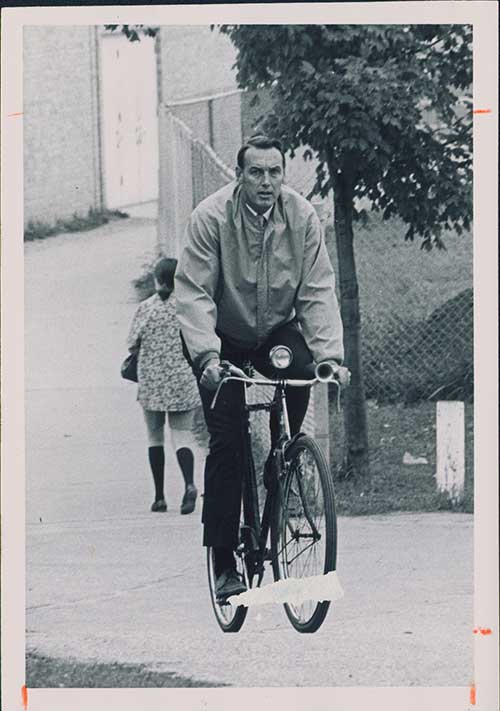
Paul Lauritzen rides a bike through campus.
The late professor Paul Lauritzen

(UW-W Press Release) After Paul Lauritzen arrived on the Whitewater State College campus in the fall of 1964 to start a special education program in its college of education, he soon found himself providing informal services for students with disabilities through the admissions office. 

One day he took a call: “I have a student who uses a wheelchair. Can I admit them?” 

Lauritzen said yes — mostly on determination and faith that the campus would make that student their own.

Lauritzen had kindred spirits in many places on campus.  

One of them was Patrick Monaghan, an assistant chancellor and budget manager who helped Lauritzen apply for grants, a principal source of funding for support services and staff. Also in the Chancellor’s Office was Chuck Morphew, a vice chancellor and advocate whose wife, Jane, used a wheelchair as her primary source of mobility from having contracted polio.

With their support, dedicated services for students with disabilities began in 1968.

Then, during the 1970-71 academic year, a force of nature rolled across campus. John Truesdale — by all accounts a “character,” “a tireless advocate” and “a wonderful human being” — arrived to work at Whitewater through a joint project with the state Division of Vocational Rehabilitation, which was founded the same year. He began the college’s Disabled Student Services office, which served about 10 students. 

“That’s something that I think this campus can be very proud of for a number of reasons,” said Truesdale. “Number one being that — well before there was any legal requirement to provide students with disabilities access to programs and services — UW-Whitewater had been doing for quite some time. And, in fewer than 30 years, the university was nationally recognized by student affairs professionals as one of the best programs of its kind in the nation.”

Truesdale and Monaghan succeeded at stitching inclusion for disabilities into the very fabric of the campus mission statement, which is the university’s spiritual governing principle. In 1973, campus administration adopted a mission for serving students with disabilities at UW-Whitewater, and the UW System Board of Regents approved it. That set the stage for new possibilities.

These days it isn’t uncommon to see a wheelchair user hop from their chair into the driver’s seat of a vehicle, disassemble their chair, toss it in the back and drive away. Truesdale promoted the teaching activities of daily living through physical therapy. 

“That’s where you learn to be as independent as you can,” he said. “It doesn’t make sense to get a degree and not be able to work. We were going to provide services to help you live and work in a community just like everyone else.”

Truesdale is also credited with starting adaptive sports, including wheelchair basketball, and even coaching the team for eight years. Curb cuts and ramps for wheelchairs began to appear on campus and around the city well before it was required by the Americans with Disabilities Act, which was signed into law by President George H.W. Bush in 1990. 

Wade James Fletcher, a business major who graduated in 1978, remembers how his wrestling coach, Willie Myers, worked with Truesdale to help keep the campus accessible. Myers had written his graduate thesis on how to prioritize removing architectural barriers to provide access to an institution.

“At UW-Whitewater, Willie was also the director of facilities management,” said Fletcher. In the winter, as part of a work-study project, Warhawk wrestlers worked to clear the snow and ice from sidewalks so that students with disabilities could safely and easily get around campus.

Truesdale’s department grew from a staff of one to more than eight professionals and 50 student employees. The mission to serve students with disabilities has been included in all updated campus mission statements and endorsed actively by every UW-Whitewater chancellor since 1973. 

Looking back, Truesdale credits the success of the Center for Students with Disabilities to colleagues across campus — from faculty who see that an accommodation for a disability can improve learning for all students to the facilities worker who shovels the sidewalks.

By the 1990s, UW-Whitewater was recognized as a best-practices campus and a national model. The program was serving more than 300 students when Truesdale left in the early 2000s. Elizabeth Watson, who served as the director of the Center for Students with Disabilities for the majority of the time since Truesdale retired, remembers her first day as director, when former Chancellor Richard Telfer walked into her office. Telfer then was in transition from provost to becoming chancellor, and he wanted to meet Watson.

“He walked into my office to say ‘hi’ and it was about 20 minutes into the conversation before I realized this was someone important,” she said. “He said, ‘Do you think you could recruit 50 more students (with disabilities) a year?’”

“We left our comfort zone,” said Watson, as her staff began making recruiting visits to secondary schools. Some of the students they met had been told they never would go to college. 

“These students became Warhawks. With CSD services and a campus-wide community, they went on to earn degrees.”

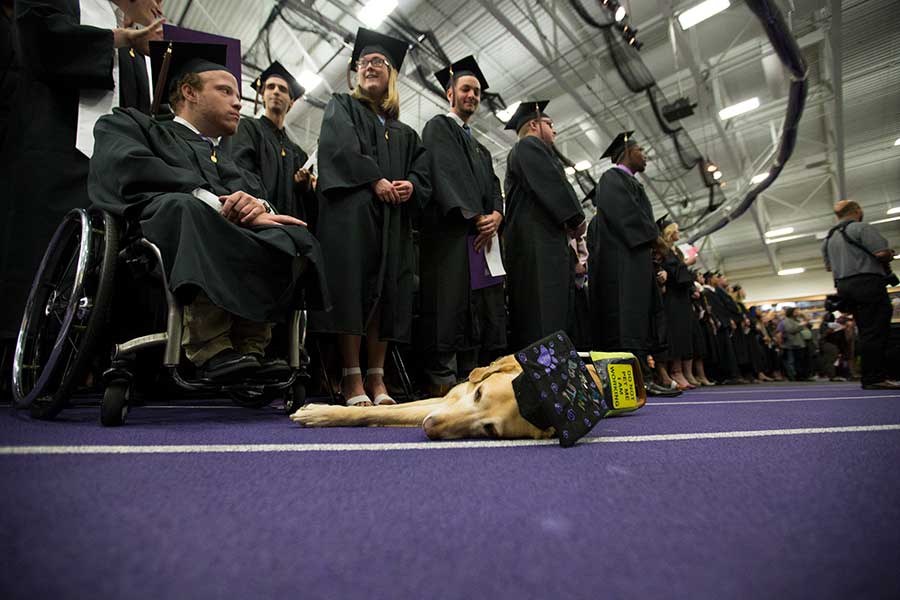
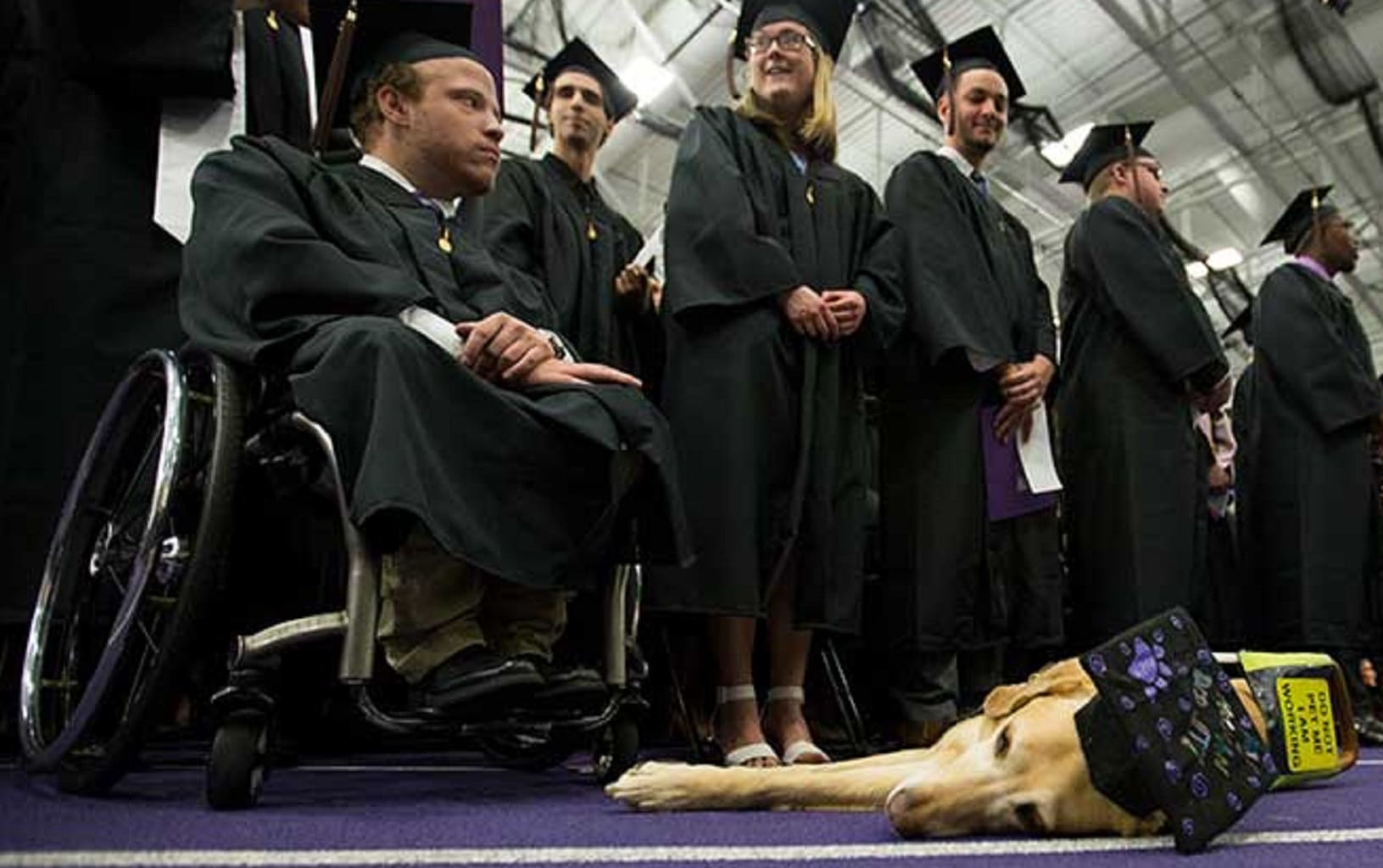
Victor, the service dog of communication major Elizabeth Fideler, enjoys a nap during commencement, held on Saturday, May 19, 2018.

Meanwhile, Telfer and other administrators supported CSD with funding and put Watson at the table during architectural and design decisions. This was a revelation for Watson, who had been used to fighting for the spoils before coming to Whitewater. Accessibility, she said, is expensive. But the commitment was there.

“The university is creating thousands of disability advocates as they translate their college experience into the working world,” said Watson.

Over the years, the scope of the CSD mission has expanded to include services for students who are Deaf and hard of hearing, as well as students who have learning, psychological, chronic health and vision disabilities. The connections around campus extend into each of the colleges and to Warhawk Athletics. The center serves more than 1,200 students a year. And, in 2021, UW-Whitewater was named a Top 5 Mobility Friendly Campus in the nation by Mobility Magazine.

“It’s amazing to think about how the program has given so many graduates who happen to have disabilities the opportunity to live and work in Wisconsin communities,” said Truesdale. “And how UW-Whitewater has succeeded in carrying out its unique mission to develop and provide services for students with disabilities.”

Seeing Stroke Symptoms, Michelle’s 911 Call Helped Save Jim’s Life (Do You Know the Symptoms?)

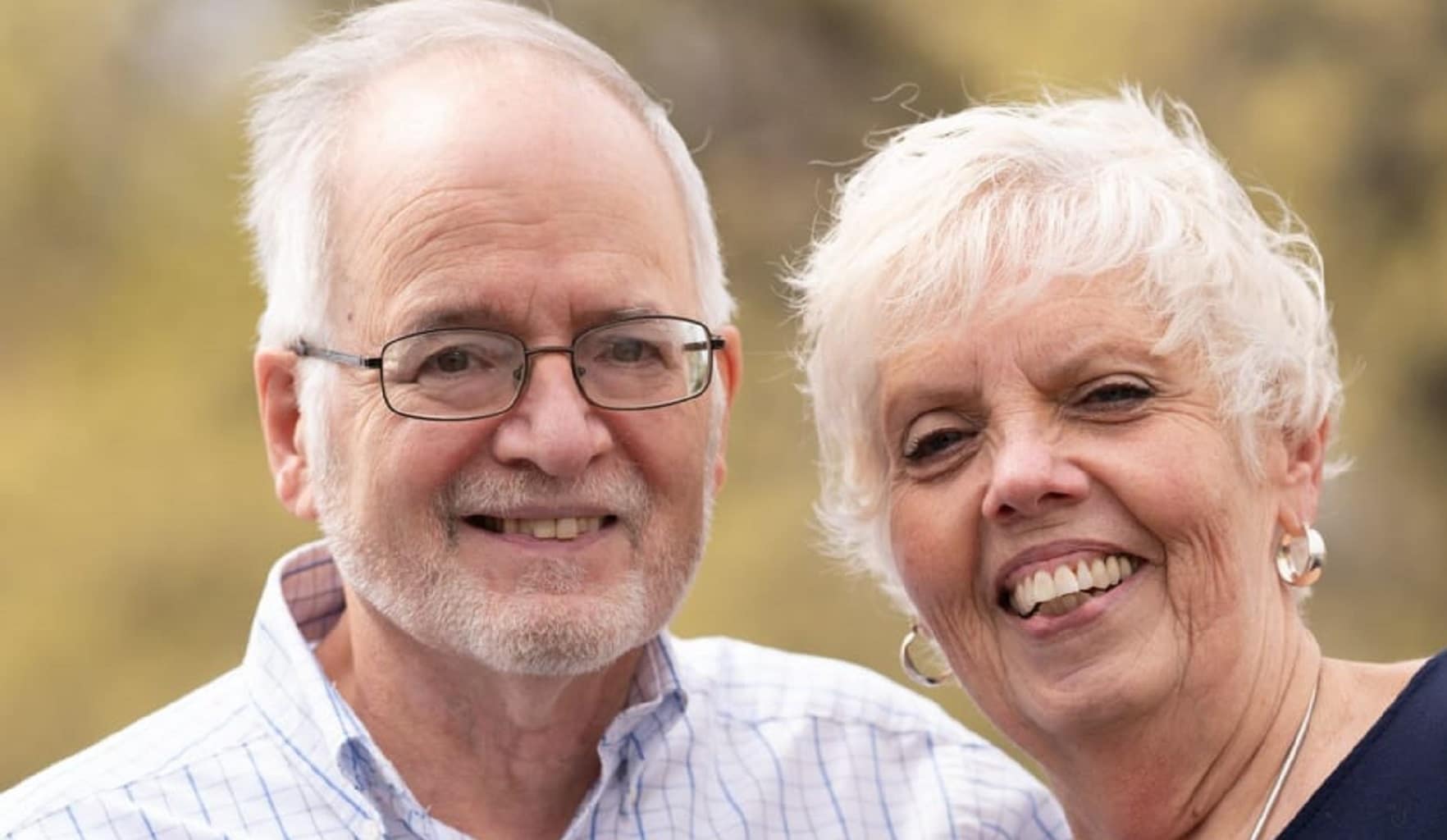
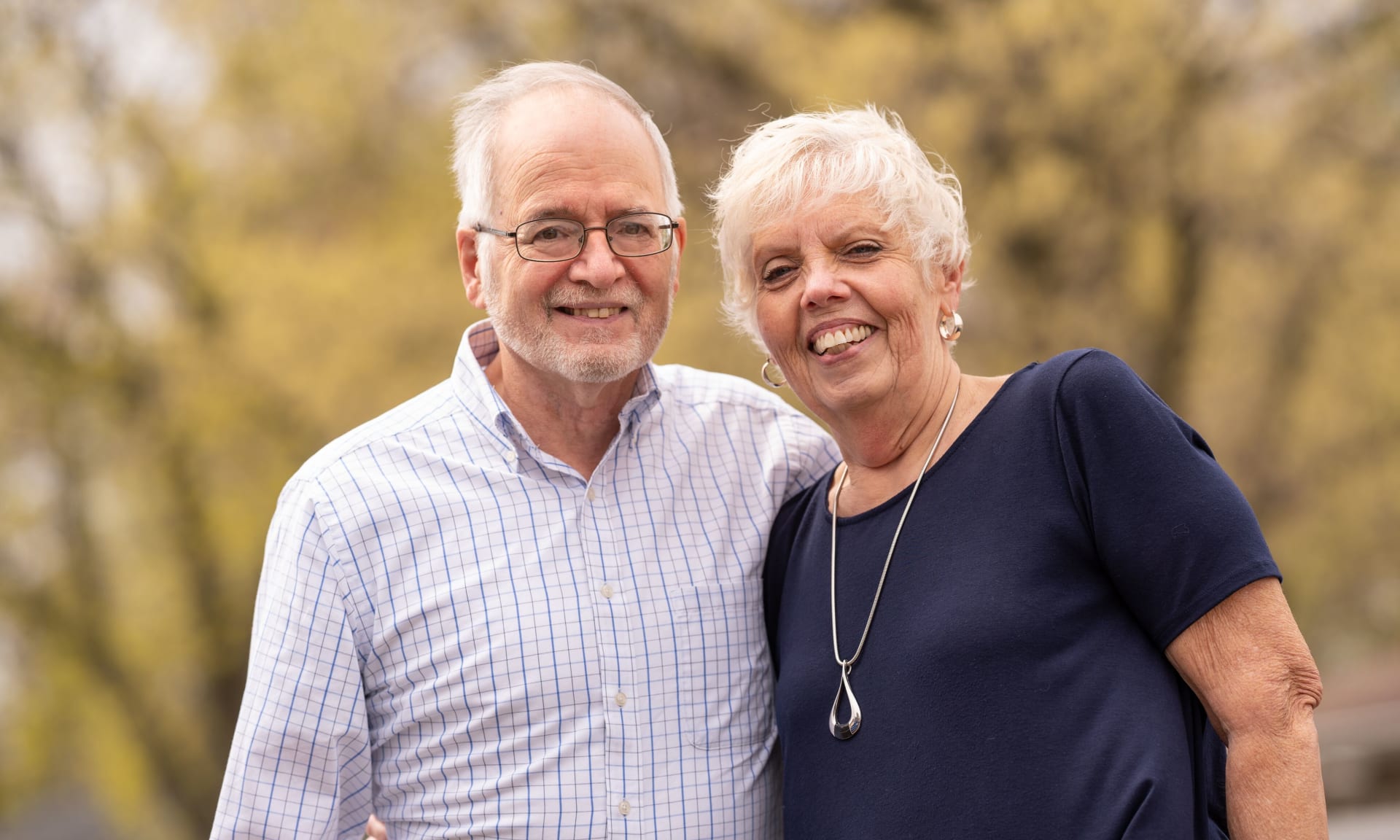
Jim Schmaling and his wife.
Jim and Michelle Schmaling

Article reproduced from UW Health, with permission of Jim Schmaling

A 50th wedding anniversary is a highly momentous occasion for any couple, but for Jim and Michelle Schmaling of Whitewater, WI, reaching their golden anniversary on April 13, 2021 was extraordinarily meaningful.

About five months earlier, Jim and Michelle were out walking their dogs one early November afternoon when Jim, now 73, suddenly started to lag behind his wife.

“Are you ok?” asked Michelle, after looking back at her husband.

“I’m not going to make it,” was Jim’s frightening reply. Michelle was further alarmed when Jim could not follow her directions to look to his left.

Michelle didn’t realize it right away, but Jim was having a stroke. A large clot in the back of his head was interrupting the flow of blood to the brain, killing millions of neurons each minute and putting Jim’s quality of his life in great jeopardy.

Instinctively, Michelle called 911 right away – a simple but life-saving act that set the stage for a series of events that ultimately led to Jim’s amazing recovery.

Nikki Storm, the Schmaling’s younger daughter, happened to be working that afternoon in the Emergency Room at Fort Memorial Hospital in Fort Atkinson, just 10 miles from Jim and Michelle’s home.

“My co-worker Carole handed me the phone, saying it was my mom,” says Nikki, a health unit coordinator in the ER. “Mom was frantic and out of breath and said my dad was coming to our hospital in an ambulance because he suddenly became disoriented and could not follow her instructions.”

Daughter immediately suspected a stroke

Working in an ER, Nikki immediately suspected a stroke, alerting everyone who needed to know that her dad’s ambulance would arrive shortly. Doctors, nurses, imaging technicians and other staff prepared accordingly to ensure no moment was wasted.

Fort Health Care emergency physician Eric Snell, D.O., met Jim at the door. After observing and examining Jim, Dr. Snell agreed that a Level I stroke was almost certainly the diagnosis. Due to COVID-19 hospital visitation restrictions, Michelle had been keeping in touch from home. (That very month, Jim and Michelle both tested positive for COVID about two weeks apart.)

Brain scans made Jim’s stroke diagnosis official. As not much time had elapsed since his first symptoms, Jim was eligible for a clot-busting intravenous treatment called alteplase or TPA.
Seeing how large Jim’s clot was, Dr. Snell called UW Med Flight, knowing that UW Health – one of just five comprehensive stroke centers in Wisconsin – offered the highest level of medical resources to treat Jim. With Med Flight on the way, Michelle and her other daughter, Laurie Wilson, hopped in the car for the short drive to Fort Atkinson so they could watch Jim’s flight take off for Madison.

Just before he was taken from the Emergency Room to the helipad, Jim looked at Nikki, who took her father’s hand.

“Dad, you’re in good hands,” she said. “They’re going to take good care of you.”

Jim’s speech was slurred, but three words came out in return: “I love you.” Nikki darted across the street to meet up with her mom and sister. All three had lumps in their throat as the Med Flight helicopter whisked Jim into the sky.

“I knew he’d get excellent care at UW”

“It wasn’t easy watching him go, because I’d no longer be with him,” Nikki says, “Still, I knew he’d get excellent care at UW.”

Another good sign, Nikki thought, was learning that the Med Flight physician flying with her dad, Dr. Wade Woelfle, was someone she knew through work.

“Dr. Woelfle works mostly for UW Med Flight, but he also works part-time at our ER here in Fort Atkinson,” Nikki says. “He and I have worked several night shifts together, which made the whole situation more comforting.”

Triggered by Dr. Snell’s call from Fort Atkinson to Madison, UW Health’s stroke team prepared immediately for the likelihood that Jim would undergo a mechanical thrombectomy, a minimally-invasive clot-removing procedure performed by a team consisting of a neurosurgeon, anesthesiologist and an endovascular physician, nurse and technician, among others.

Fortunately, Jim remained stable during the 13-minute flight to Madison, staying awake and lucid enough to understand everything Dr. Woelfle or the Med Flight nurse said. By 4 pm, the helicopter had landed at University Hospital, where Jim was wheeled into the Emergency Department.

Knowing that Jim had a large brain clot, UW Health physicians ordered CT perfusion imaging, which shows how much of the brain is damaged and how much can be saved.

“Most of Jim’s brain was still looking good,” says UW Health neurosurgeon Azam Ahmed, MD. “Given the size and location of his clot, we moved ahead with the mechanical thrombectomy. Similar to a cardiac catheterization, we go in through the femoral artery in the groin, guiding a small catheter and instruments through the arteries until we reach the brain,” says Dr. Ahmed. “Once we reach the right place, we ‘fish’ the clot out,” he says. “It’s like using a stent on a stick.”

The procedure was over shortly after 6 pm, and Michelle was back in Whitewater as the UW Health team repeatedly updated her by phone.

Great relief after clot was removed

“The nurses were awesome,” says Michelle. “Once they told me the clot was out and Jim was doing OK after the procedure, I felt a great sense of relief,” she says. “Once he was in a room, the nurses took all my calls and answered all my questions.”

Jim spent the next four days recovering at University Hospital. On Thanksgiving 2020, he was transferred to UW Health’s Rehabilitation Hospital in Madison for nine more days of physical, occupational and speech therapy. Aside from some vision disturbance in his left eye that ultimately resolved, Jim was doing quite well by the time he came home in early December. He has no memory of the stroke or the four days in the hospital, but nobody considers that a bad thing.

“Most patients improve after we perform a thrombectomy,” says Dr. Ahmed. “About half of them – including Jim – recover dramatically. They arrive in a bad way, unable to speak or move on one side. A few days later, they walk out of the hospital. It’s kind of a Lazarus-like procedure, and when you see people like Jim leave functionally independent, you know you’ve done some good for someone that day.”

Dr. Justin Sattin, a UW Health neurologist who took the original call from the Fort Atkinson hospital, says the entire process worked like a well-oiled machine.

Time is the greatest enemy

“When it comes to strokes, UW Health’s system of care really stands out,” says Dr. Sattin. “Time is out greatest enemy, and we are set up to jump into action on several fronts. Our Access Center, Med Flight team, Emergency Department, our ability to share images among hospitals and our ability to use video to observe and communicate with some of our distantly-located patients all contribute to this capability. Each piece is vital to the task of getting people like Jim here as safely and quickly as possible so Dr. Ahmed and his colleagues can do their amazing work.”

Jim’s case also illustrates how valuable people like his wife, Michelle, are to preserving a stroke victim’s quality of life. As soon as she knew something was wrong, she didn’t flinch.
“Sadly, some people don’t call 911 the way Michelle did,” says Dr. Sattin. With a stroke, there simply is no time to wait it out, sleep it off or even call your primary care doctor. Millions of brain cells die each minute and they cannot be brought back, so recognizing stroke signs and symptoms is absolutely critical to preserving the patient’s ability to function independently.”
Less than two months after coming home from the Rehabilitation Hospital, Jim returned to work. With his vision fully recovered, he also was able to resume driving by April 2021.

“He is back to his usual joking self,” says his daughter, Nikki. “To remember how he looked the day of the stroke and see him now, you really wouldn’t have a clue that anything happened.”

For a couple that just celebrated 50 years of marriage, no material gift could exceed the value of Jim’s remarkable recovery from a major scare just five months earlier.
“We are extremely lucky to reach this great milestone together, knowing that the outcome could have been very different,” says Michelle. “We have so many people both at Fort Memorial and UW Health to thank for making this such a happy occasion.”

BE-FAST: How to recognize stroke signs and symptoms

Each letter in “BE-FAST” stands for an important stroke sign or symptom. If a person shows even one of these symptoms, even if the symptoms go away, call 911 and get them to the hospital immediately.
B – Balance
E – Eyes
F – Face drooping
A – Arm weakness
S – Speech difficulty
T – Terrible headache

WAA Hosts 12th Annual Fran Achen Photography Competition/Exhibition

(WHITEWATER – May 31) The ever-popular Fran Achen show is back! Join us for our twelfth annual competition and exhibition. The exhibition will take place July 1-25th in both a physical and virtual format.

Amateur and professional artists are invited to exhibit their photography at the 12th Annual Fran Achen Photography Competition. This show is open to all photographers and will be broken down into two categories: “Youth/Teen” (under 18) and “Adult.”

The Whitewater Arts Alliance Board and staff are excited to announce that the 2021 Fran Achen Photography Competition will return to its traditional in-gallery display format. In addition, all of the photographs will appear in the online virtual show.

The Awards Presentation Program and Opening Reception for the Fran Achen Photography Contest will be held live and in-person in the Cultural Arts Center Gallery on Sunday, July 11 with awards to be announced at about 2 p.m.

KEY DATES

Entries & Fees Due: Thursday, June 17th by 11:59 p.m.
Photo Drop-Off: Monday, June 28th, and Tuesday June 29th from 4:00 – 6:00 p.m.
Awards Announcement: Sunday, July 11th at 2:00 p.m. in the Cultural Arts Center Gallery
Viewers’ Choice Award Announcement: Sunday, July 25
Photo Pick-Up: Sunday, July 25th from 3:00 – 5:00 p.m.

AWARDS

BEST of Show Award: ($125)
Second Place Award: ($100)
Third Place Award: ($75)
Outstanding Youth Award: ($50)
Local Interest Award: ($50)
Viewers’ Choice Award: ($50)

To fill out an entry form and/or to view more details about the show, please visit this link: www.whitewaterarts.org/fran-achen-2021.

Jeff McDonald, chair of the show and former Whitewater Arts Alliance Board Member, said,

“The Fran Achen show is truly one of the highlights of the year. Fran Achen was an exceptional photographer, and his catalog of images continues to inspire. This show, organized in his honor, is an excellent opportunity to showcase the outstanding work created by both established and aspiring area photographers. I am always excited to see the many ways these artists interpret the world through their images. Viewing each year’s collection is a real treat.”

A Note About Our New COVID-19 Policy:

In conjunction with the City of Whitewater and the Centers for Disease Prevention’s (CDC) guidelines, the WAA Board recently voted to lift the capacity limits which have been in place during the COVID pandemic. Masks are now optional for fully vaccinated persons; however, masks are still required for those that have not been fully vaccinated.

*We continue to request that persons who have symptoms of COVID-19, persons who have been a close contact of someone who tested positive for COVID-19, or persons who are waiting on test results not enter the gallery at all, even with a mask.

The mission of the Whitewater Arts Alliance is to promote the visual and performing arts through an alliance of artists, individuals, educational resources, and organizations to promote creativity and diversity that will serve to educate and enrich the lives of the residents of the Whitewater community and surrounding areas.

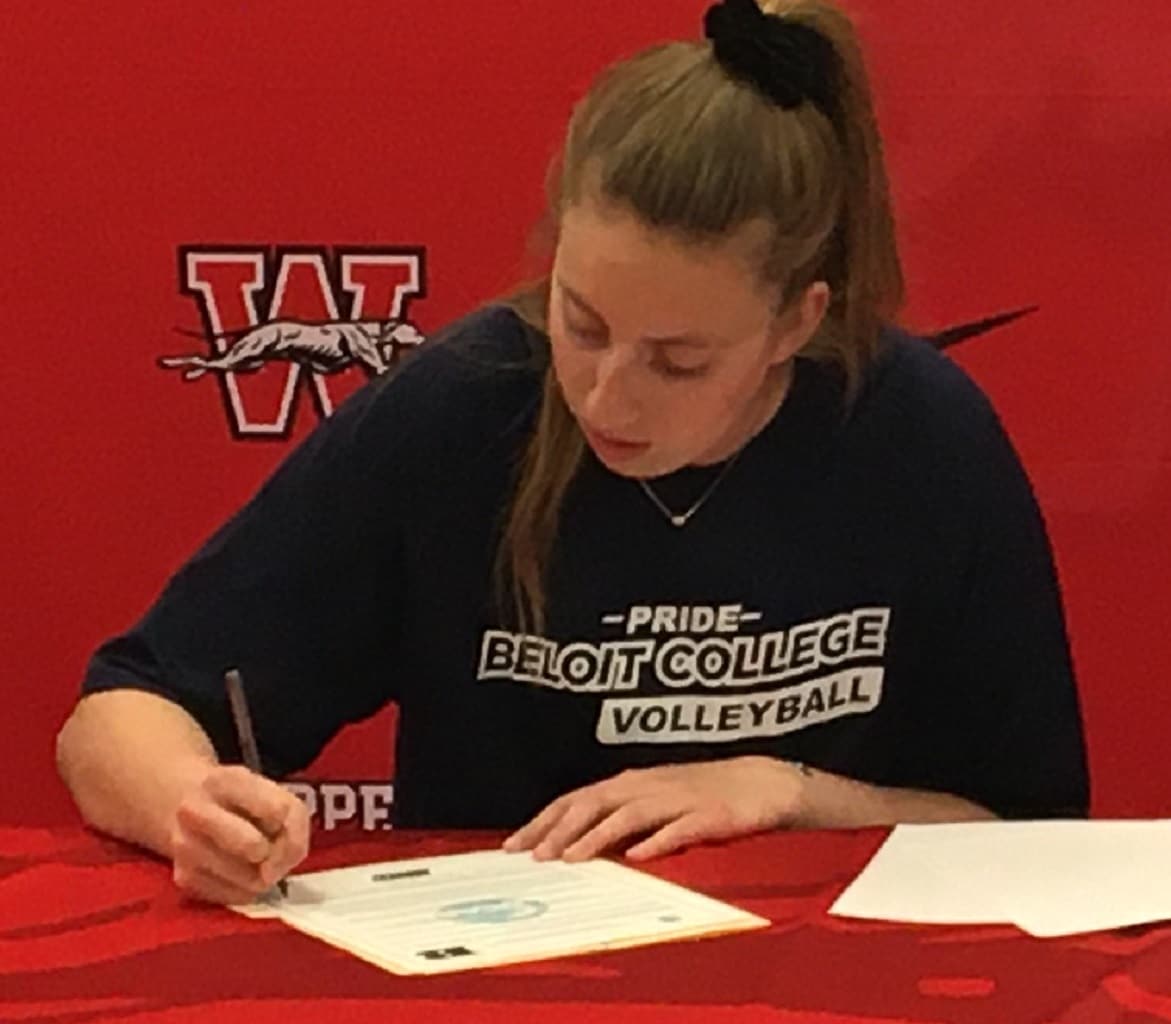
Cora Linos Signs Letter of Intent to Play Volleyball at Beloit College

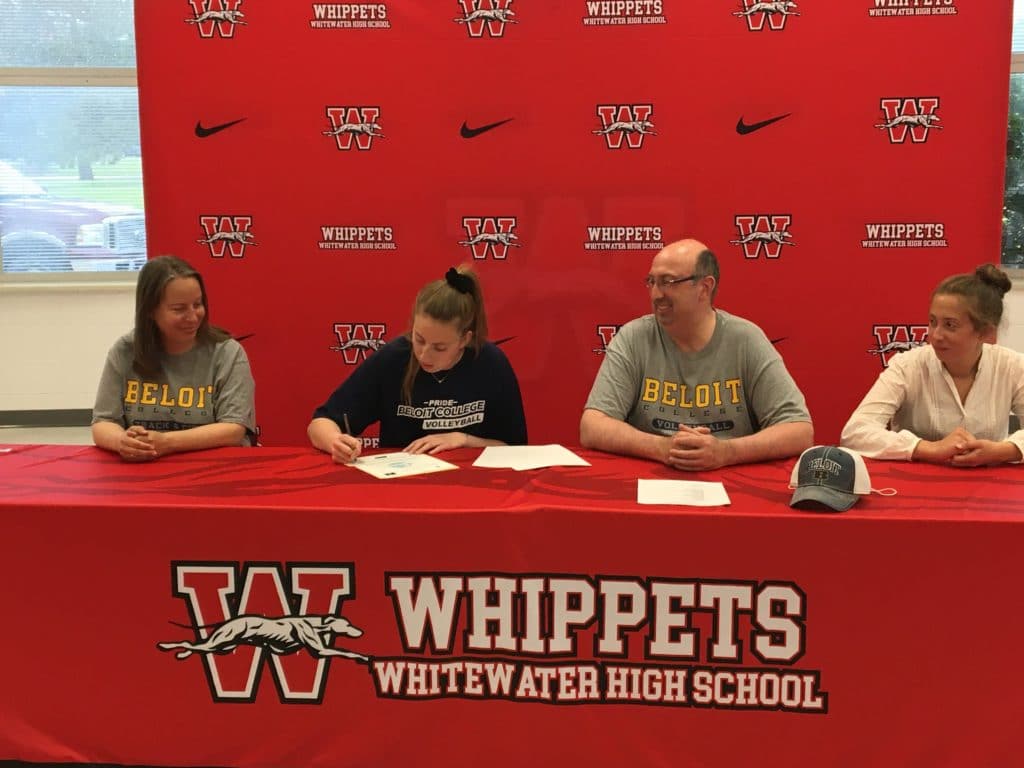
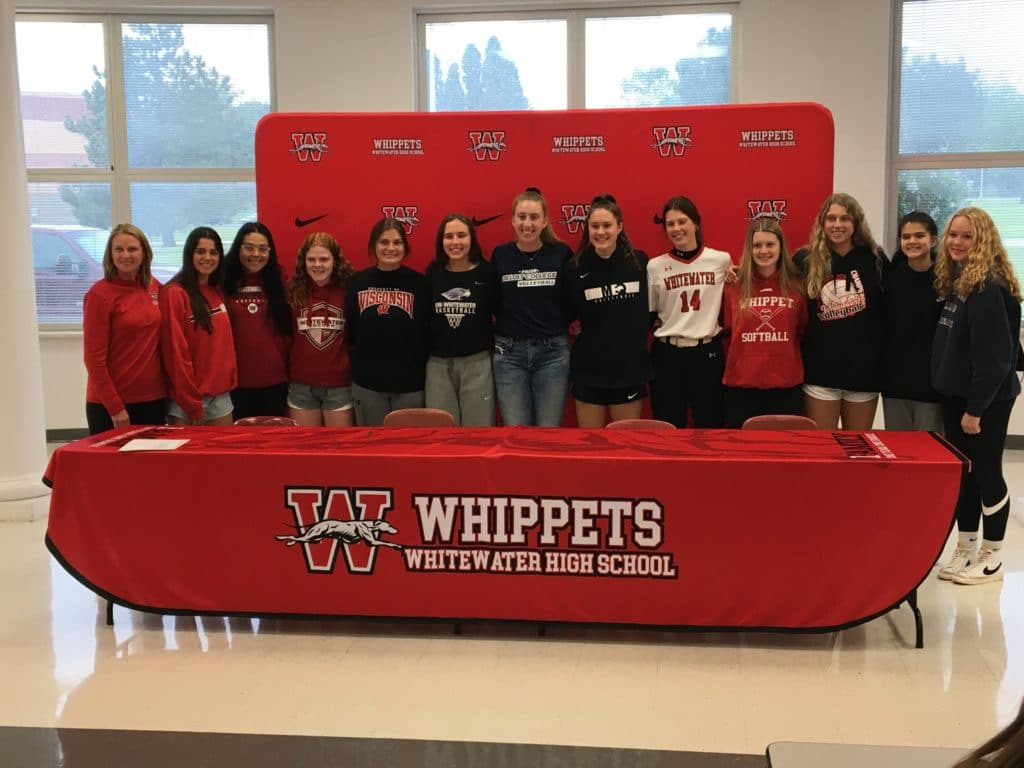
With her parents and sister looking on, Cora Linos signed her letter of intent

By Lynn Binnie
Whitewater Banner volunteer staff
whitewaterbanner@gmail.com

With about two dozen of her family, friends, teammates, and Whitewater High School staff looking on, Cora Takoda Linos on Thursday, May 27 signed her letter of intent to play collegiate volleyball at Beloit College. Linos is a varsity letter winner in volleyball, soccer, and basketball and a ’21 valedictorian.

In the 2020-21 volleyball season Linos was varsity captain and was selected Most Valuable Player on the team that was Conference and Regional Champion. She was also named to Rock Valley Conference First Team All-Conference as well as Honorable Mention All-State by the Wisconsin Volleyball Coaches Assocation. Her career ranks #1 for all-time assists (2038 assists), #1 all-time aces (184 aces), #4 all-time digs (841 digs), and #7 all-time blocks (111 blocks). In 2021 she was feated with the Joan Domitrz Above and Beyond Award and the WIAA Female Scholar Athlete.

Academic recognitions include Rock Valley Conference Top-10, Rock Valley Conference Academic Excellence Award, AP Honors Scholar, National School Choral Award, and she is a member of the National Honor Society. Beloit College has awarded her a Presidential Scholarship.

Both of Cora’s parents, James and Jean Linos, are graduates of Beloit College. Jim was her coach in various times in middle school, high school, and club volleyball. Cora already played club volleyball on campus at Beloit last season. She described Beloit’s DIII volleyball team as being in a rebuilding phase. She told the audience that she’s looking forward to making Beloit College her home for the next four years.

Cora with her volleyball teammates and coach Kathy Bullis (first on the left)

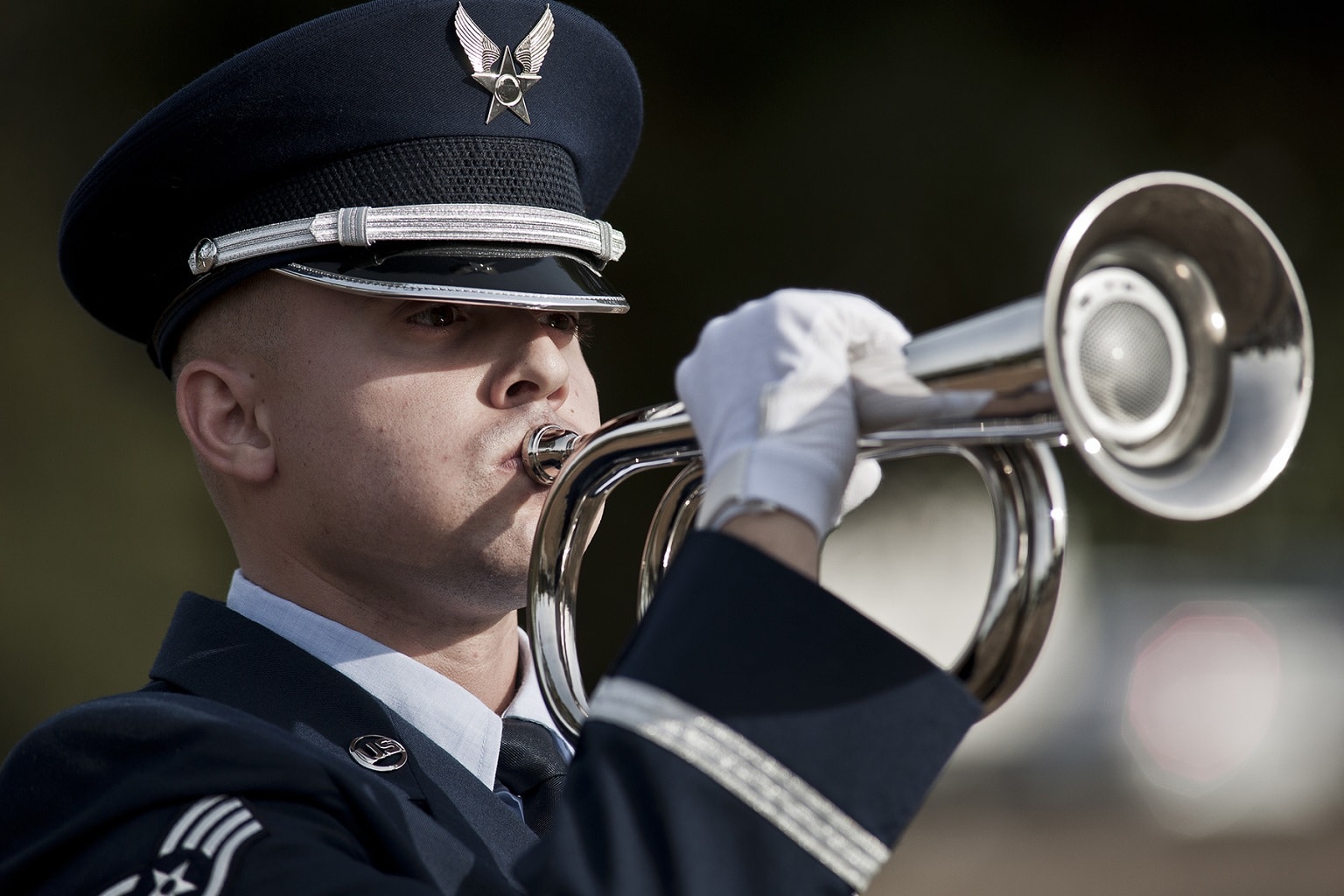
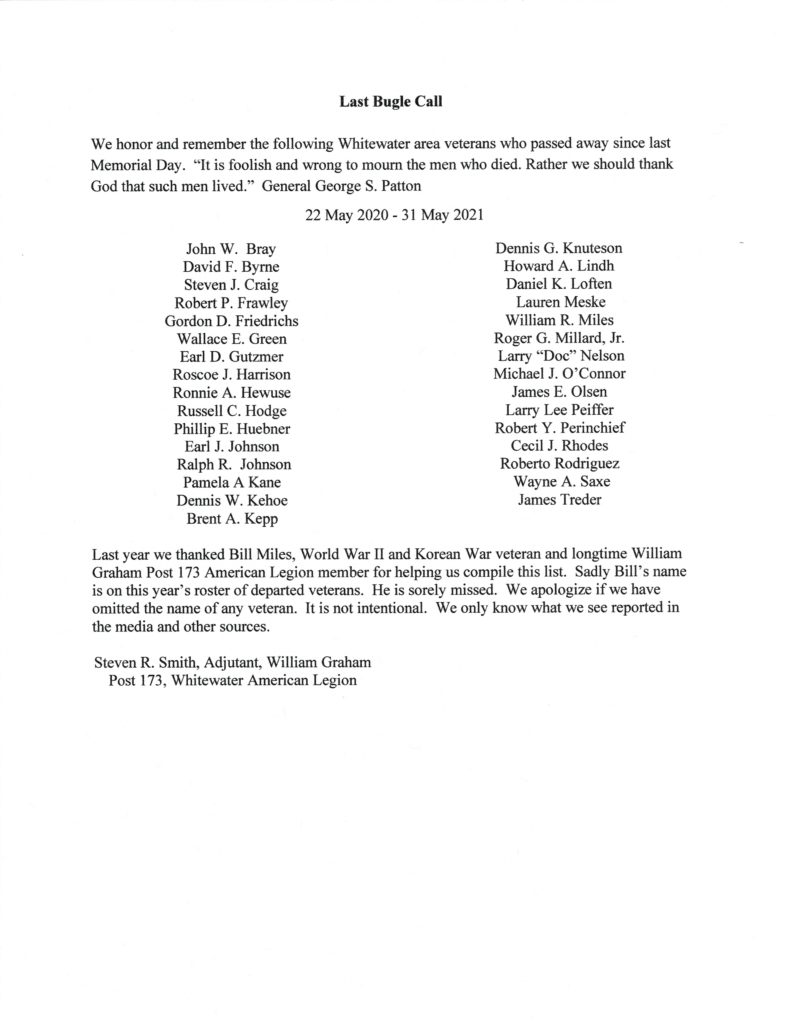
Last Bugle Call – Honoring Veterans Who Passed Away Since Last Memorial Day

Reminder: the American Legion is holding a short Memorial Day Observance in Hillside Cemetery on Memorial Day, 31 May, beginning at 11:00 a.m. The location will be in the vicinity of the flagpole in the southern section of the cemetery. Coincidentally this is the same area Memorial Day observances were held before the American Legion Building was constructed 51 years ago.

Home page photo: U.S. Air Force photo/Samuel King Jr.

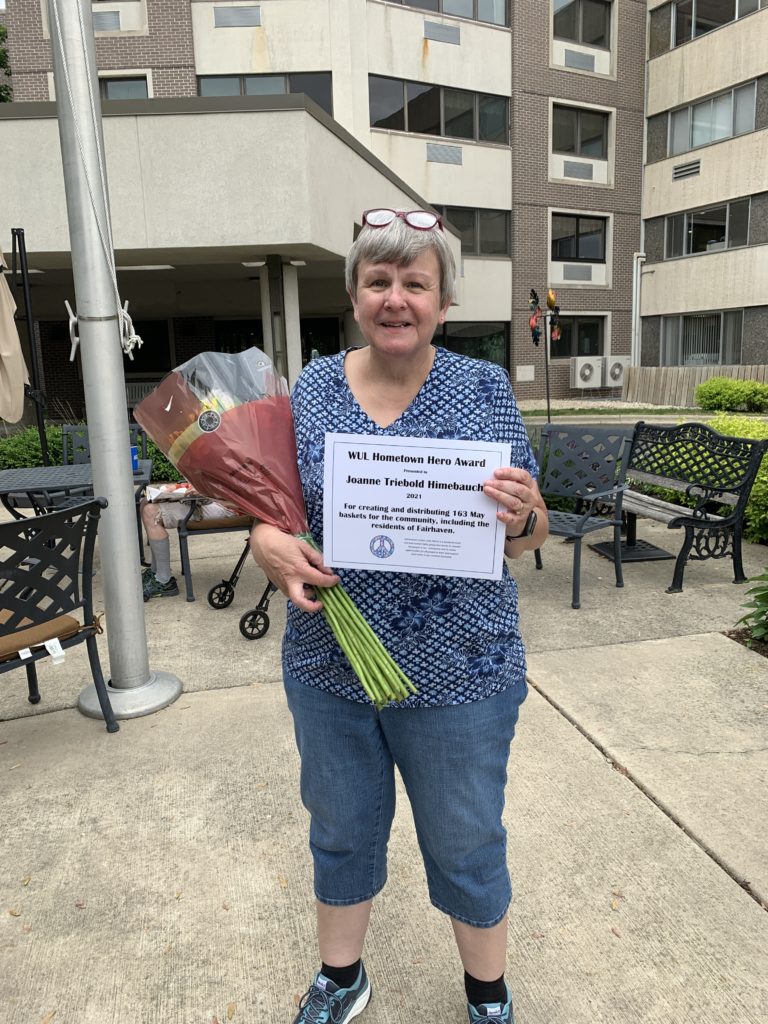
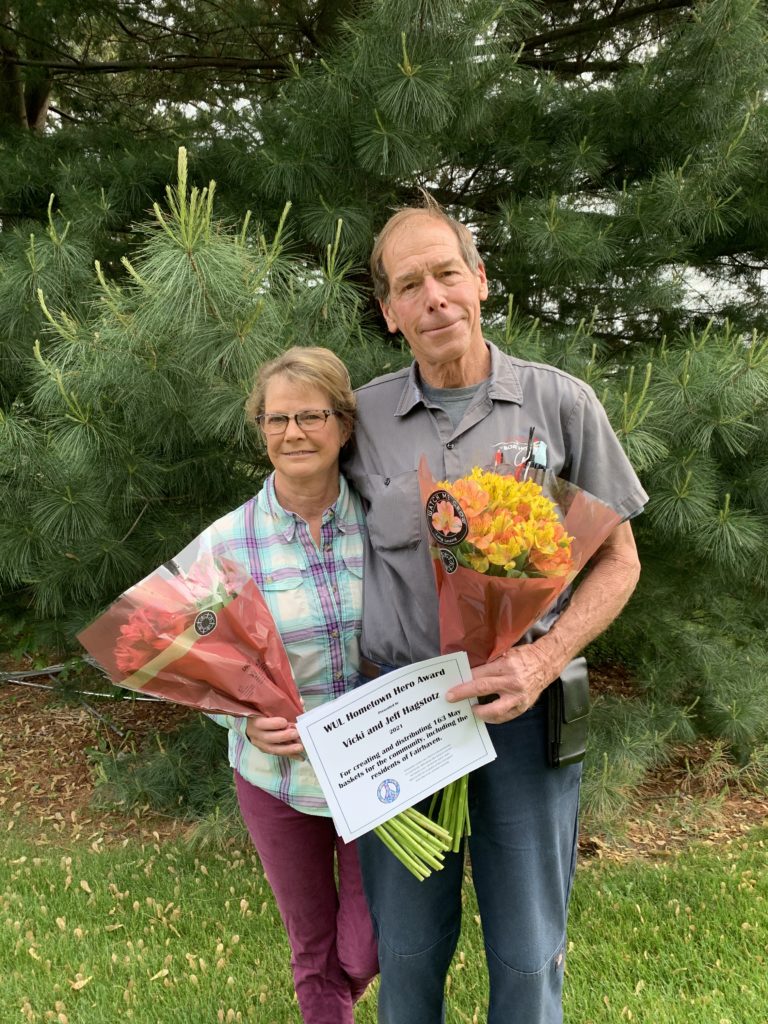
Joanne Triebold Himebauch and Vicki and Jeff Hagstotz are Hometown Heroes

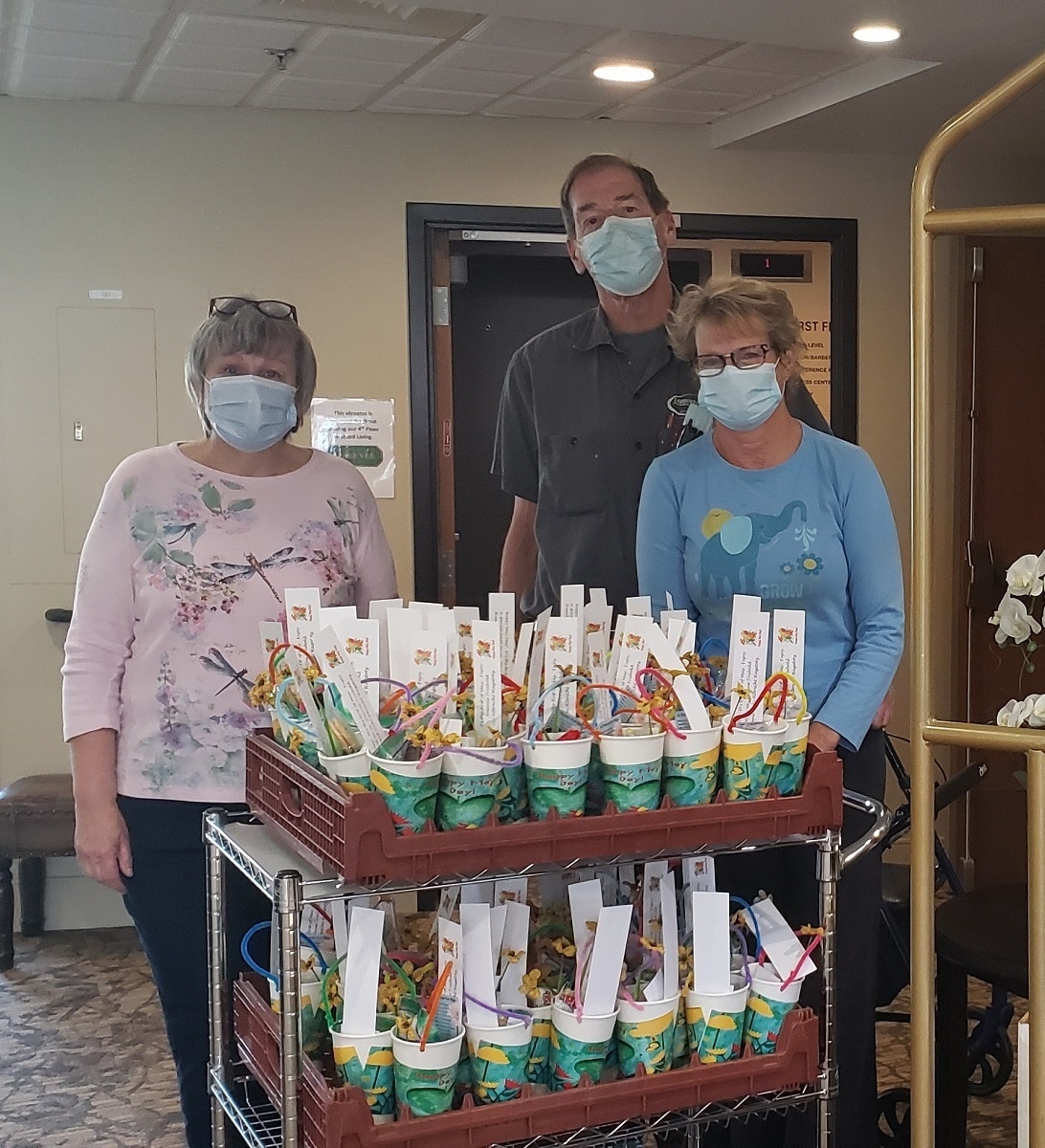
(Whitewater Unites Lives submission) Joanne Triebold Himebauch and Vicki and Jeff Hagstotz are WUL Hometown Heroes, “For creating and distributing 163 May baskets for the community, including the residents of Fairhaven.”

Joanne Triebold Himebauch is a Hometown Hero
Vicki and Jeff Hagstotz are Hometown Heroes

WUL (Whitewater Unites Lives) is a locally-focused civil and human rights group that works to connect the people in our community and to create opportunities for all people to learn and support each other in our common humanity.   

 Anyone who would like to nominate a local hero of any age should send their nomination, with a short description, to whitewaterunites@gmail.com 

No. 5 UW-Whitewater Baseball Earns Spot in Regional Title Game, Today @ 11

By Chris Lindeke
Assistant Athletic Director, Strategic Communications and Branding
University of Wisconsin-Whitewater

Sunday, May 30, 2021

Box Score

UW-Whitewater Regional Web Page

The No. 5 ranked University of Wisconsin-Whitewater baseball team will play for the NCAA Whitewater Regional championship, clinching its spot in the title game with a 9-4 victory Sunday against Texas Lutheran at Prucha Field at Miller Stadium.

The Warhawks (40-6 overall) will face No. 10 Adrian (Mich.), which defeated UW-W 3-2 earlier Sunday, at 11 a.m. Monday. The winner of Monday’s game will advance to the NCAA Division III World Series, which begins this week in Cedar Rapids, Iowa.

Against Texas Lutheran (30-14), UW-Whitewater jumped out to a 7-0 lead through 4 1/2 innings and held off the 24th-ranked Bulldogs, who drew to within 7-4 thanks to three runs in the bottom of the sixth inning and one more in the seventh.

Pinch hitter Ben Wilkins knocked a two-out, two-run triple to right center in the top of the ninth inning to give the Warhawks a pair of key insurance runs. Hayden Fox pitched around a one-out walk in the bottom of the frame to send UW-W to the regional championship game.

Starting pitcher Donovan Brandl earned the win, striking out four over five-plus innings to moe to 7-1 on the year. Connor Moroder tossed the next two innings, and Ben Muscatello pitched a scoreless eighth before giving way to Fox in the ninth.

The Warhawks started the scoring in the top of the second inning on a two-out, run-scoring single through the left side by catcher Ryan Norton. In the third, Brandl hit into a fielder’s choice with the bases loaded for an RBI, and left fielder Matt Korman hit a sacrifice fly for a 3-0 advantage.

In the fourth, second baseman Sam Vomhof hit an RBI double off the wall in left field, and third baseman Tucker Criswell drove a two-run homer deep out to left field to make it 6-0.

Centerfielder Zach Campbell added another run in the fifth with a run-scoring double down the left field line.

Texas Lutheran put a pair of runners on base with two outs trailing by three in the eighth, but Muscatello induced a flyout to end the threat.

In the first game of the day against Adrian (35-8), UW-Whitewater trailed 1-0 after the Bulldogs plated a run in the top of the fifth, but took the lead in the bottom of the eighth on a two-run single through the left side by shortstop Nick Santoro.

Adrian retook the lead in the top of the ninth with a pair of runs. In the bottom of the ninth, pinch runner Eric Hughes was thrown out on a close play at the plate trying to score on Norton’s fly ball to right field.

Connor Spear took the tough-luck loss on the mound, striking out seven over eight innings of work and falling to 6-1 on the year.

Santoro led the offense with three hits, and Korman tallied a pair of doubles and one run scored.Brandl and Wilkins also added hits.

Kyle Hunter Recognized for A “Best Book Cover of April”

Kyle Hunter

By Lynn Binnie
Whitewater Banner volunteer staff
whitewaterbanner@gmail.com

Kyle Hunter, son of Lyle and Dawn Hunter, is a free lance book cover designer. He often creates covers for Gray Wolf Press authors.

Literary Hub recognized Kyle’s design of the cover for Let Me Think, by author J. Robert Lennon, in an article titled, “The 11 Best Book Covers of April.” Literary Hub describes itself as follows, “Literary Hub is an organizing principle in the service of literary culture, a single, trusted, daily source for all the news, ideas and richness of contemporary literary life.” The winning cover is reproduced below, together with the comments from Literary Hub about Kyle’s work.

Two books featuring Kyle’s covers were also featured in an April article titled, “Here is Fiction as an Escape Room, Packed with Mysteries,” in The New York Times. Once again, Let Me Think was one of the featured books, together with Subdivision, also written by J. Robert Lennon. Both books are published by Graywolf Press. Kyle wrote to his parents, “Two of my all-time favorite covers just showed up in The New York Times! I worked on these right at the beginning of the lockdown. Maybe it shows.” The cover of Subdivision is also shown below.

This image has an empty alt attribute; its file name is let-me-think-683x1024.jpg
J. Robert Lennon, Let Me Think; cover design by Kyle G. Hunter (Graywolf, April 6)

Comments on Lit Hub: “It’s pretty rare to see a book cover with this much text on it, never mind the titles of all the stories in the collection, so this is worth including for that reason alone. What I want to know but cannot figure: what shape emerges when you connect all the dots?” A reader named John answers the question this way, “The let me think cover makes a rotary telephone. Thank you microsoft paint.”