Fred A Beck, 77, beloved husband, father, brother and grandfather, passed away peacefully at home on July 20, 2020.
Fred was born on June 11, 1943 to LeRoy Beck and Adaline (Schroeder) Boyce.
In his early years, Fred loved motorcycles, trap shooting, hunting, fishing and woodworking.
Fred is survived by his five children; Lisa (Tom) Meitzner, Julie (Peter) Urdahl, Doug (Amy) Root, Wade (Lisa) Root, and Tammy (Scott) Wiedenhoeft; sisters, Barb (Bob) Moore and Diane (Al) Thorman. He also has several grandchildren and great-grandchildren.
Fred is preceded in death by his wife, Judy, brother, Wayne Beck, and his parents.
In lieu of flowers, the family asks that you make a donation to the Jefferson County Humane Society.
Nitardy Funeral Home is assisting the family with arrangements.
Due to the increasing number of positive COVID-19 cases, the Irvin L. Young Library will be closing its doors again on Friday, July 24 at 5:30 p.m. Curbside pickup will resume on Monday, July 27. Please see the information below.
Sue and her husband Tom live in Prairie Village. Sue is known for volunteering in the community. As someone who has had both knees replaced, she gives back as a joint camp volunteer at Fort Memorial Hospital. She works with people who have had their knees replaced. Also, she volunteers at the Bassett House through her membership in the Minneiska women’s group. Finally, she organizes Bridge at the Real McCoy’s on Tuesdays where as many as four tables play after lunch.
Sue’s friend, Marcia James, has a son Griffin James who is a 1999 graduate of Whitewater High School and the band director for Baraboo Schools. Marcia learned that his students initiated a car parade so that students could say “we miss you” to their teachers. Griffin and his wife Katie–the choir director for Wisconsin Dells School District–greeted them by playing their euphoniums as the students drove by and honked their horns.
Therefore, Marcia contacted members of their Bridge group and other friends of Sue and the response was wonderful. Seventeen cars drove by Sue’s house and honked their horns. Many had decorated their vehicles with signs, flowers, and balloons. Participants included Evie and Magee Schneider, Karla Heimerl, Dottie Koenitzer, Nancy and Jerry Wendt, Mary Kenne, Janet Craft, Nelda Bergsten, Karin Campbell, Olive Crawley, Sue Mealy, Linda and Don Meyer, Kathy Ponyicsanyi, Barb Runnoe and her daughter Becky, Vicki Devitt and two of her granddaughters, Kathy and Jim Schumacher, Dee Simon, Jerri Stevenson, Annie Stinson, and Mike and Nancy Lindermuth.
Whitewater High School 2008 graduate Logan James got Sue to come out of her home and played Happy Birthday on his euphonium many times as the cars slowly drove by.
Sue will continue to celebrate No. 75 with her family this week!
Reminder to readers: The Banner staff wishes to extend the services of our publication by welcoming announcements from readers of what might be called “life events,” such as births/adoptions, engagements, weddings, special birthdays/anniversaries including quinceaneras, bar/bat mitzvahs, retirements, achieving citizenship, and the like. Consequently we have merged obituaries into a new category on our homepage called “life events.” Please consider sharing your or your family’s special events with the community in this way. Photos will, of course, be welcome.
Elizabeth Katzman is a WUL Hometown Hero, and has been nominated “For rallying support for the Wisconsin dairy industry through ‘Support Wisconsin Dairy’ yard signs, raising $10,000 by selling the signs, and using the funds to purchase dairy products for the Whitewater Community Food Pantry and The Community Space.”
Elizabeth Katzman (photo by Julie DuVal)
Elizabeth is a senior at Whitewater High School, and serves as president of the Stone School 4-H Club where she also made special deliveries of dairy products to members and leaders to celebrate June Dairy Month.
WUL (Whitewater Unites Lives) is a locally-focused civil and human rights group that works to connect the people in our community and to create opportunities for all people to learn and support each other in our common humanity.
Anyone who would like to nominate a local hero of any age should send their nomination, with a short description, to whitewaterunites@gmail.com
Recognizing the very challenging climate that Whitewater businesses have endured over the past several months, the Banner has decided to offer a very limited number of ads that will appear at the top of our homepage. Each ad will only be published once and will then be pushed down the page as more content is published, until it lands in the “Recent Posts” area. Each post will be clearly labeled as “ADVERTISEMENT.” Most of our posts feed to our Facebook page, which also has a considerable following. The Banner’s editorial board will have the right to approve ads. Cost will be $75, which goes towards support of the Banner and the Whitewater Community Foundation’s mission. Businesses interested in this opportunity should email whitewaterbanner@gmail.com.
Gordon “Doc” Donnelly Friedrichs, of Waukesha, Wisconsin, was born on June 10, 1929, and passed away on July 10, 2020, at the age of 91 at the Wisconsin Veterans Home at Union Grove, WI
Formerly of Whitewater and raised in Lake Geneva, Gordon graduated from Lake Geneva High School in 1947, having lettered three years each in football and basketball. After playing freshman basketball at Oberlin College during the 1947-’48 season, “Doc” joined the US Marine Corps and earned a berth on the Parris Island Basketball tour team. Between 1950 and 1952 the team won consecutive All-Marine championships on both East and West coasts, posting season records against collegiate and military teams of 55-6 and 41-8.
Entering UW-Whitewater in 1954, Doc was chosen President of his Sophomore class and won three letters in basketball, being honorably mentioned Little All-American his Senior year. Gordon received the Citizen of the Year award in 1961 from the Whitewater Chamber of Commerce. He received the Hall of Fame award in 1982 for Basketball at UW-Whitewater.
Upon graduation in 1957, Doc entered the insurance business and in his role as a Northwestern Mutual Life agent, he was named one of the company’s three Young Men of Distinction in 1959. Gordon is a past-present of the Whitewater Jaycees and was presented the Distinguished Service Award by that organization in 1965.
In 1967, Gordon joined a professional management consulting firm and moved to Brookfield, WI, where he coached three years in the Elmbrook Little League Baseball and Bucketeer Basketball recreation programs. He remained a partner in the firm for 31 years while serving as Vice President and retired in 1998.
He is survived by his wife, Dorothy (nee Torrent), of 58 years, of Waukesha, WI; his children, Elizabeth (Louie) Vasquez, Waukesha, WI; James (Elaine) Friedrichs, Weeki Wachee, FL; Heidi Friedrichs; Wauwatosa, WI; and John Friedrichs, Waukesha, WI. He was preceded in death by his parents, Hans and Gladys Friedrichs, brothers Donald (Esther) Friedrichs, Robert (Pauline) Friedrichs, and Edward (Lucy) Friedrichs; his son, Peter G. Friedrichs; and his brother-in-law, Frederick (Patricia) Torrent, Brooksville, FL. He is survived by 11 grandchildren and 6 great-grandchildren, and many more relatives throughout the country.
He wishes God’s blessings to you all. “Be not afraid – “Semper Fi.”
A private burial will be held at Oak Hill Cemetery in Lake Geneva, WI.
Church & Chapel Funeral Service Serving the Family Milw. 262-827-0659 Wauk. 262-549-0659 Online Obit, Condolences, Directions www.churchandchapel.com
I was one of a handful of black students at my high school. I didn’t have a black teacher until my third year of college; and in most of my classes, I was the only black student. Discussions about race were rare among my classmates and in my high school classes. I have very fond memories of those years and strong connections with many of my classmates and teachers. However, in many situations it felt as though conversations about race were too uncomfortable, taboo for the classroom, so they were mostly avoided. When race was brought up among my peers, it was usually coupled with some joke: “You don’t talk like you’re black.” “You’re black, you can dance, right?” “Of course you’re good at basketball, Myriama. Black people are so athletic!” These words were always said with a smile or a pat on the back, and they weren’t meant to upset me. I was too afraid of being labeled an angry black woman to speak up, but in truth I felt isolated.
When a joke or a comment did come up, it was often followed by “It’s just a joke” and then “I don’t see color.” These words were meant to be reassuring. They were supposed to make me feel included, as though there was no difference between me and my white classmates. The truth is, the words “I don’t see color” scared me. They only made me feel more invisible than ever, as if my struggles and my people’s history were unimportant.
I’ve been seeing color my whole life. I see it when I’m the only black person in the room. I see it when I’m the only black person in the store and the only one being followed by security. I saw my classmates glance over their shoulders to check if I was upset when we discussed slavery in our history classes, one of only two units about my people while the rest of the school year was spent learning about mostly-white American history. If I was the only person seeing these things, that meant I was completely alone. Nobody seemed to recognize my isolation. Nobody seemed to want to. If they didn’t see my color, did they see me at all?
What needs to be understood is that there’s nothing wrong with seeing color. In fact, I want you to see my color. People need to recognize that the struggles of a white man and a black man in this country are not the same, partly because society has perceived the black man as a threat his whole life. People must recognize that the way a white woman maneuvers through each day is not the same as the way a black woman has to. The black woman faces an intersectionality of oppressions based on being both a woman and a person of color. People need to recognize that when black people are included in conversations, they bring personal experience and knowledge about the depth of oppression in U.S. institutions–in the criminal justice system and in education, among other things. By really listening to what black people have to say and then working together, we can help make progress in relation to these issues.
You can recognize differences in experience without making assumptions about the black men and women you are seeing. Don’t assume that we love fried chicken, that we can’t swim or that we need tutoring. Don’t assume that a black man walking after dark is committing a crime. Don’t assume that a black woman is living in poverty. And if she is, don’t assume that you know how she got there.
Denying you see color is an attempt to protect yourself from being seen as part of the issue and to deflect potential criticism. How can you be racist if you don’t see a difference in races, right? The thing is, when you say you don’t see color, there are many components of race that you’re blinding yourself to. You’re refusing to see the racial disparities that are an unjust part of life in our country. You’re excusing yourself from the self-examination that is necessary in order to change racial biases. Instead of making yourself an advocate of black lives, you contribute to their oppression by ignoring their stories. How can you recognize that black drivers are 20% more likely to be pulled over than white drivers if all you see are drivers? How can you recognize that a black woman makes $0.67 to every $1.00 that a white man makes if all you see are employees? How can you recognize that black men serve 19.1% longer sentences than white men for committing similar crimes if all you see are inmates?
Denying you see color doesn’t keep you from being part of the problem, it keeps you from being part of the change. It’s impossible to fix a problem that you can’t see. The question is if you shouldn’t say that you’re color blind, what should you say? The answer is that it’s not really about what you say right now, it’s about listening and learning from the experiences and stories people of color have to share, and it’s about acting on what you learn. Don’t seek to be innocent of racism, seek to be actively anti-racist.
As a black teenager, I should have been taught about people like W.E.B Dubois, Maya Angelou, Sojourner Truth, and so many more. I should have been taught about black history and the current realities of the black community. I should have been taught to be proud of the skin I’m in and the history that comes with it, instead of being rendered invisible. The good news is that it’s not too late. Now is the right time to educate yourself on the reality of black lives and how you can become an effective advocate for racial justice. You can start by seeing color.
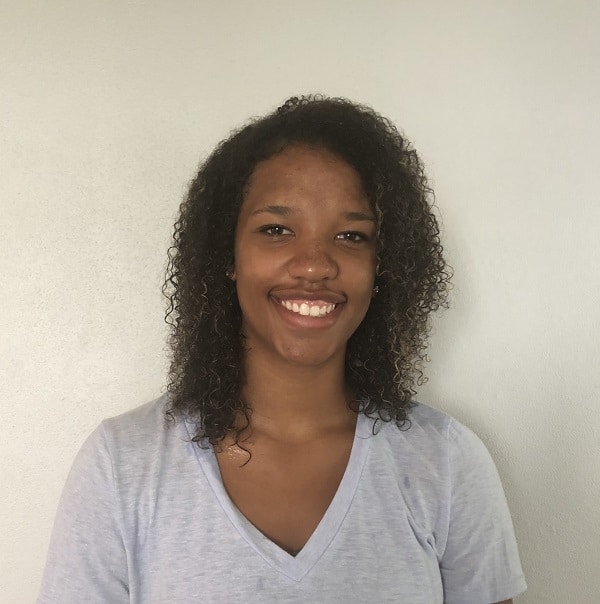
Myriama Smith-Traore is a 2017 graduate of Whitewater High School. A shorter version of this op-ed was published in The Gazette on July 10. The Banner appreciates Myriama providing this thought-provoking writing for our readers. She has completed her third year of college at Saint Louis University, where she plays basketball and is majoring in English. Myriama told the Banner that her intention is to be an English teacher.
(WHITEWATER – Whitewater Arts Alliance Press Release) Peter Jablokow’s art will be displayed at the Whitewater Arts Alliance’s Cultural Arts Center on 402 West Main Street on July 31 to August 23 from 2 p.m. to 4 p.m.: Fridays (for at risk individuals only – age 65 and over or with immunocompromised health conditions), and Saturdays and Sundays for all others. Visitors will be asked to participate in health and safety measures in light of COVID-19, to include wearing a mask at all times (masks will be provided), entering via the elevator and exiting via the front door (unless they require the elevator), and keeping six feet apart. There will be a ten-person maximum in the building at all times.
Artist Peter Jablokow
In his artist statement, Peter said, “I create watercolors of buildings, bridges and machinery with a messy, rusty, chaotic feel that comes with age and lack of use. The patterns, textures and colors of large, old, decaying equipment has a feel I don’t quite understand, but am attracted to, and have a desire to record before it’s gone.
I start my process by defining every line and detail in pencil. Perspective angles and vanishing points are refined with a ruler to line everything up cleanly, helping me feel my life is in control. Next, chaos ensues when, what feels to me like arbitrary layers of watercolor are thrown on the paper. While feeling lost, I add and delete many layers of color back and forth until the painting eventually comes back into focus. I hate the chaos, love the order, and feel gratified when I end up with a combination of both.
I paint with transparent watercolor in many layers on 300lb Arches paper and often splatter masking fluid or rip the surface to create a chaotic, weathered look.”
As the son of an artist growing up in Lagrange Park, Illinois, drawing and painting has always been part of Peter’s life. Frank Lloyd Wright’s houses close to his in nearby Oak Park, IL, influenced his decision to pursue a degree in architecture at Iowa State University.
A trained architect, Peter started migrating towards art by becoming an architectural illustrator, working with Rael Slutsky Associates, and later Manuel Avila associates. Peter loves the technical aspects of drawing perspective images and is drawn to its exactness of detail.
Peter’s full transition to artist came while taking classes with Peggy Macnamara at North Shore Art League in Winnetka, IL. Peggy activated his love for loose, fresh watercolor, igniting his current series of work, which overlays a looser, more colorful painting style on top of a tight drawing style.
Peter is a signature member of American Watercolor Society, National Watercolor Society and Transparent Watercolor Society and has won awards from the Transparent Watercolor Society, American Institute of Architectural Illustrators and Illinois Watercolor Society, among others. He is published in Splash 15, 16 and 17, an annual watercolor compilation, and has exhibited in numerous group and individual shows and fairs. He teaches watercolor in group and individual classes.
Peter received a Bachelor of Architecture degree from Iowa State University, and an associate’s degree in Illustration from the American Academy of art in Chicago.
Whitewater’s Cultural Arts Center is located on 402 West Main Street in the historic White building near the Birge Fountain. Parking is behind the building, with an elevator available from the parking lot entrance. Parking is also available on side streets.
The mission of the Whitewater Arts Alliance is to promote the visual and performing arts through an alliance of artists, individuals, educational resources, and organizations to promote creativity and diversity that will serve to educate and enrich the lives of the residents of the Whitewater community and surrounding areas.