


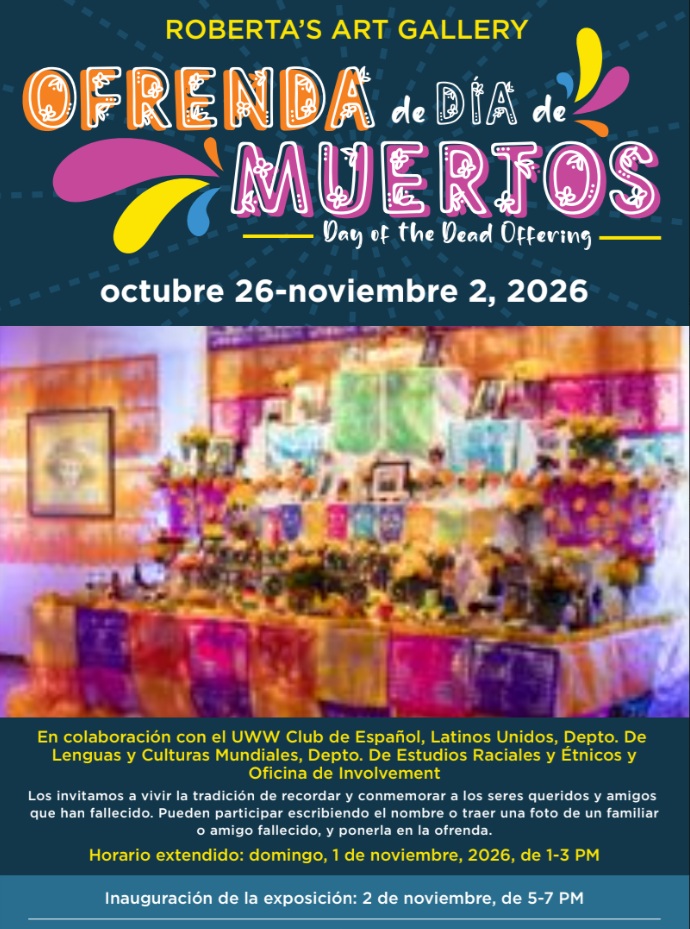
“Ofrenda de Día de Muertos” Tradition by UW-Whitewater’s Spanish Club and Latinos Unidos on Display at Roberta’s Art Gallery
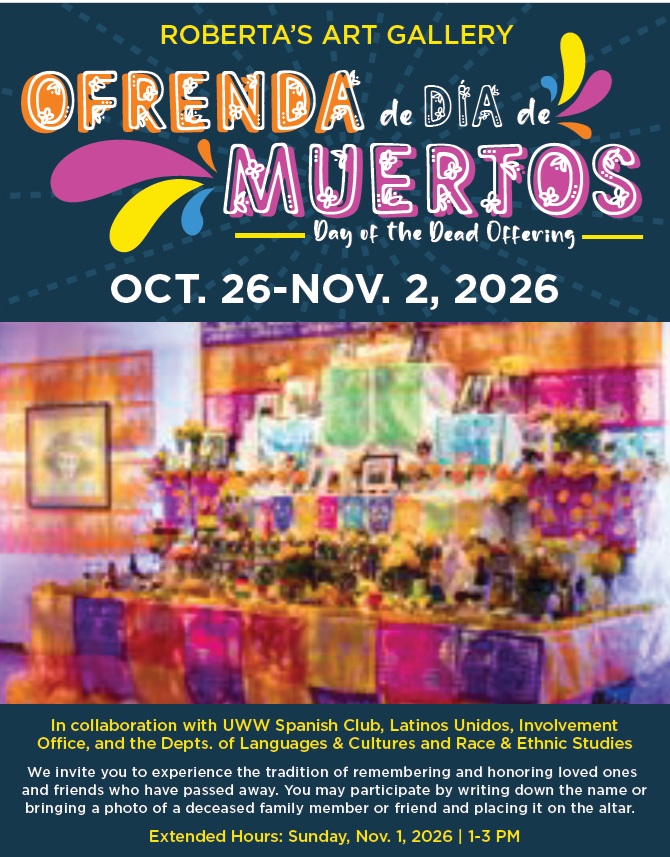
“Ofrenda de Día de Muertos” is a pop-up exhibit dedicated to honoring and remembering the souls of departed loved ones. This cultural display will be at Roberta’s Art Gallery from October 26 through November 2, 2026. Presented by UW-Whitewater’s Spanish Club and Latinos Unidos student organization, the exhibit will feature an interactive altar, or ofrenda, where Whitewater campus and community members can honor loved ones who have passed by writing their names and leaving meaningful items in remembrance. In Mexico, families celebrate this tradition with colorful displays and heartfelt offerings that invite the spirits of the departed to return and once again share in life’s joyful celebrations. The gallery will also be open for special weekend hours on Sunday, November 1, from 1 to 3 p.m., in honor of the Day of the Dead holiday.
The exhibit reception will be held on Monday, November 2, from 5 to 7 p.m., featuring an educational talk by UW-Whitewater’s Spanish Club and Latinos Unidos student organization. After the reception, an open house will take place from 7 to 8 p.m. We will provide traditional light refreshments, including hot chocolate and conchas (Mexican sweet bread). Guests are strongly encouraged to attend and interact.
UW-Whitewater’s Spanish Club, Latinos Unidos student organization, Involvement Office, and the Departments of World Languages & Cultures and Race & Ethnic Studies carefully curated this display.
About Collaborators
● UW-Whitewater’s Spanish Club is a student organization dedicated to promoting the value of the Spanish language and fostering a deeper appreciation for Latinx/e Americans/Hispanic culture.
● Latinos Unidos is a student organization focused on uniting and supporting students while advancing education and awareness of Latinx/e American culture on campus.
● The Involvement Office provides campus programs, student organizations, leadership development, and inclusive initiatives that help students build connections, discover interests, grow as leaders, and feel a sense of belonging in the Warhawk community.
● The Department of World Languages & Cultures offers instruction in French, German, Spanish (including Spanish as a Heritage Language), and additional courses in Arabic, Chinese, and Japanese. Their mission is to foster diverse perspectives, civic engagement, and cultural understanding, and to prepare students for lifelong learning and global citizenship.
● Race & Ethnic Studies is an interdisciplinary academic program that explores the histories, cultures, and experiences of African American, Asian/Asian American, First Nations, Indigenous, Latinx/e Americans, Latin American, and other Communities of Color in the United States.
About Roberta’s Art Gallery
Roberta’s Art Gallery is located on the first floor of the James R. Connor University Center (UC) at UW-Whitewater. The gallery hosts multiple exhibits each semester by collaborating with local and regional artists. Exhibit hours are Monday through Thursday, 10 a.m. to 4:30 p.m.; Friday, 10 a.m. to 2 p.m.
Roberta’s Art Gallery strives to make art accessible to all, offering free exhibits and receptions for everyone to enjoy. Whether you’re a student, a Whitewater community member, or someone who wants to support the artist, feel free to stop by. For questions or further information, contact Roberta’s Art Gallery at (262) 472-3193 or ucart@uww.edu, or visit our website.
Ofrenda de Día de Muertos by Dr. Luzma Hernandez
The Day of the Dead is an indigenous tradition blended with beliefs brought by the Spaniards
to Tenochtitlan, now called Mexico. It is a feast that takes place when the souls of the
deceased visit their living relatives and enjoy what is arranged in offerings made to them.
Traditionally, this feast takes place from October 28 to November 2. The core of this
celebration originates from the Indigenous communities who believe that the souls of dead
loved ones return at night to visit, sample the food and drinks, and take pleasure in the
flowers, decorations, and objects that their relatives arranged in the offering.
The offering, called ofrenda in Spanish, is set up ahead of time to be ready when the souls
arrive at the house or place where it is arranged. The belief is that on October 28, those who
died in tragic circumstances visit. On October 29, candles are lit for the departed who are less
remembered. On October 30-31, babies and children come to visit. On November 1, those who
had an exemplary life visit, and on November 2, the official Day of the Dead takes place,
where all souls make a visit. In some small Mexican towns, it is common that on the eve of
the Day of the Dead, family members go to the cemetery to bring flowers, food, and drinks or
play music during the night, early morning, and day to spend that time with the departed.
They believe their departed loved ones are present and sharing the bread with them, as it was
when they were alive. They eat on and around the gravestones of loved ones.
This display of the ofrenda is arranged in tiers, most commonly with two tiers. The top tier
symbolizes heaven, and the bottom tier symbolizes the Earth. Placed on the top tier are
photographs of those who had an exemplary life and so are revered. On the bottom tier, the
photographs of the deceased are arranged with food, drinks, candy, desserts, bread, and
objects related to the loved ones being remembered. Through all of the offerings, there are
flowers, candles, skulls, and colorful cut paper, called papel picado in Spanish, to add to the
sense of festivity and decoration.
A traditional ofrenda can have up to seven tiers. The seventh and topmost tier symbolizes
heaven. The sixth tier is for the souls who haven’t yet entered heaven, and the fifth tier
includes elements that purify the spirit, like salt, water, incense, and copal resin. The fourth
tier represents the bread that nurtures the souls. The third offers food, drinks, candy, and
anything the deceased enjoyed in life, the second displays pictures of the deceased, and
finally, the bottom tier contains a form constructed of flowers, fruit, or seeds that are meant
to remember the dead.
Some of the essential elements of an ofrenda are marigolds, or cempasúchil, in the
Indigenous language of Náhuatl, skulls, cut-patterned paper, and candles. Because of its
strong aroma, Cempaúcil, the flower for the dead, guides the souls to this world and to the
offering. The skulls can be made of sugar, clay, or gesso with colorful patterns painted on
them, which is a reference to the omnipresence of death. The skull was a commonly used
symbol in Indigenous culture. The papel picado represents festivity and wind, one of the four
elements of this Earth. The candles represent peace and hope for the spirits and the element
of light that guides us in our journey through the world.
The Day of the Dead is not a homogeneous fiesta in Mexico, and its expression depends on
the particular Indigenous community or social group that is present at each location.
______________________________________________________________________________________
El Día de Muertos y la Ofrenda by Dr. Luzma Hernandez
El Día de Muertos y la ofrenda del Día de muertos es una tradición indígena fusionada con las
creencias traídas por los españoles a lo que se llamó Mesoamérica. Es una fiesta en la que las
almas de los difuntos visitan a sus familiares y degustan lo que se les brinda en la ofrenda.
Esta fiesta se realiza del 28 de octubre al 2 de noviembre. La esencia de esta celebración proviene
de las comunidades indígenas cuya creencia es que las ánimas de los difuntos regresan durante la
noche de estos días para disfrutar la comida, bebidas, flores, objetos y adornos que sus parientes
les ofrecen.
La ofrenda se prepara con anticipación para que las ánimas visiten el hogar o lugar donde se
coloca. Se cree que el 28 de octubre, vienen los que murieron de forma trágica; el 29, se prenden
veladoras para los difuntos que ya nadie recuerda; el 30 y 31, visitan los bebés y niños; el 1 de
noviembre regresan todos los que tuvieron una vida ejemplar; y el 2, visitan todas las almas.
Es común en algunos poblados mexicanos que a la víspera del 2 de noviembre las familias vayan a
los panteones, lleven flores, comida, bebidas o música para pasar la noche, madrugada y parte del
día con sus familiares fallecidos. Se cree que las almas de sus familiares están presentes y
comparten como lo hacían en vida. Se come en la tumba o alrededor de ella.
La ofrenda del Día de Muertos se pone con la idea de que el espíritu de los difuntos regresa del
mundo de los muertos para visitar y confortar a sus familiares vivos. El arreglo de la ofrenda se
hace en niveles y cada nivel tiene un significado. Comúnmente, la ofrenda tiene dos niveles, el
primero simboliza el cielo y el segundo, el mundo terrenal. En el primer nivel se colocan
imágenes de personas ejemplares que están ya en el cielo, y en el segundo, se ponen las
fotografías de los seres queridos a quienes se les hace la ofrenda, las comidas, bebidas, dulces,
pan u otros objetos relacionados con los difuntos que se recuerdan. En toda la ofrenda se
distribuyen las flores, velas, calaveras y el papel picado colorido.
La ofrenda tradicional tiene siete niveles y cada uno tiene un significado. El primero simboliza el
cielo; el segundo es para las almas que todavía no han entrado al cielo; el tercero tiene lo que
purifica el espíritu como la sal, agua, incienso y copal; el cuarto contiene el pan que nutre a las
almas que vienen a visitar; el quinto ofrece los alimentos, bebidas, frutas, dulces y todo que
disfrutaba en vida el difunto; el sexto, es para indicar a quien se pone la ofrenda colocando las
fotografías de los fallecidos, y el séptimo muestra una figura en forma de cruz que puede ser
hecha de flores, semillas o frutas e indica la muerte y remembranza.
Algunos de los elementos esenciales que no deben faltar en una ofrenda son la flor de muerto/
cempasúchil, calaveras, papel picado y velas. El cempasúchil es la flor que por su fuerte aroma
sirve de guía a las almas para venir a este mundo y guiarlas a la ofrenda. Las calaveras de azúcar,
barro o yeso con adornos coloridos refieren a la muerte que siempre está presente. (Los cráneos o
calaveras son un símbolo de la cultura indígena.) El papel picado de colores representa la
festividad y el elemento del viento, uno de los cuatro elementos de la tierra. Y las velas, veladoras
o cirios representan la paz y esperanza para las almas, así como la luz que guía en este mundo.
El Día de Muertos no es una fiesta homogénea en México, depende del significado o
remembranzas del pueblo indígena o grupo social que la festeje.