



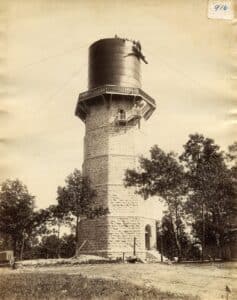
The Whitewater Water Tower
By Carol Cartwright
A question about the Starin Park Water Tower will be on the ballot on November 5. Here is some historical background about the water tower.
The Starin Park Water Tower was built in 1889 as part of the first water system built in Whitewater. It was one of the earliest water towers built in the area, has outstanding stone construction and an original tank, and it was the result of an effort to provide better fire protection and pure drinking water in the city.
In June of 1887, the city entertained a proposal from a private company to build a water system. At the time, most communities only considered a water system to provide water pressure for firefighting. In Whitewater, the Whitewater Register printed a lengthy article on the proposal for a water system and promoted an interesting view, citing sanitary reasons for a waterworks. The article stated that micro-organisms were readily found in water samples in town. As an afterthought, the article also mentioned that a water system was necessary for fighting fires and would result in a reduction of insurance rates.
In a second article in the Whitewater Register, the newspaper noted that private wells were the source of much “enfeebled health and shortened life.” Only a very deep artesian well assured pure water, and that “a careful examination of the subject has convinced the city officials that an artesian well is the best source of supply.”
In the spring of 1889, Gray Brothers of Milwaukee began construction on the waterworks system that included a well at the corner of Fremont Street and what is now Starin Road. At about 1000 feet, the workers hit a water supply with enough volume to fill a reservoir and to serve a city twice the size of Whitewater. The supply was submitted for testing at the University of Wisconsin in Madison and pronounced pure. The Gray Brothers then built a pumping works, a reservoir, a tower with elevated tank, water mains, hydrants, and fountains. Upon completion, the city paid the company to operate the system for 25 years.
On October 1, 1889, the waterworks components were completed and tested and found to be acceptable. One aspect of the test was to make sure that a stream of water could be thrown over the roof of the Normal School, located on a hill and the highest building in the city. The test showed that there was enough pressure to send water through 500 feet of hose onto the roof of the building.
The most impressive structure that was built for the water works was the water tower. The octagonal tower was built with limestone walls eight feet thick to a height of 80 feet. A steel tank, 30 feet in diameter and 32 feet tall, was built on top of the tower. The tank was built to hold 200,000 gallons of water, and with the 800,000 gallon capacity of the reservoir, the total supply on hand would equal 1,000,000 gallons, enough to provide excellent water pressure for both everyday usage and for emergency fire-fighting. After the private contract expired, Whitewater citizens voted to purchase and operate the system.
The water tower is an early and fine example of its type of structure. It is architecturally significant for its outstanding stone construction and intact metal tank, but it is also historically significant as the most intact resource related to the development of Whitewater’s waterworks, one of the most important city services ever developed in the community.
Editor’s note: Information regarding the non-binding water tower referendum that’s on the November 5 ballot may be found on the city website here.