

Many State Properties, Including Kettle Moraine Forest Southern Unit, Reopening this Friday; Annual Stickers Must be Purchased in Advance; Visiting before 10 a.m. or after 4 p.m. (except Wed.) encouraged due to capacity limits

April 28 – Gov. Tony Evers today directed the Department of Natural Resources to reopen several state parks, forests, and recreational areas originally closed due to unprecedented crowds and out of an abundance of caution to protect public health.

The DNR will reopen 34 state parks and forests on May 1, 2020 under special conditions to help minimize overcrowding, allow for social distancing requirements, and to promote a safe and enjoyable experience for staff and visitors.

“Outdoor recreation is important for both physical and mental health, and I know how important it is to Wisconsinites to get outside and enjoy Wisconsin’s natural resources and spring weather,” said Gov. Evers. “With a few adjustments, like closing one day a week for maintenance and reduced hours of operation, folks should be able to get outside and enjoy our parks safely and respectfully.”  


“Amid the immense uncertainty of this crisis, we are very fortunate to have such beautiful spaces in which to ease our minds and take care of ourselves,” Lt. Gov. Mandela Barnes said. “I am glad that we are able to reopen these spaces with new safety guidelines, so that people can enjoy our state parks and forests while we continue to prioritize public health and safety.”

Here are the latest Wisconsin state park property updates:
ADMISSION REQUIRED STARTING MAY 1
An annual park sticker and/or trail pass will be required to visit state parks and trails.
Annual stickers will be available for purchase with credit card by phone 8 a.m. – 3 p.m. seven days a week by calling toll free: 1-888-305-0398. We thank you in advance for your patience as we may be experiencing heavy call volumes.
Annual passes are NOT available for purchase at individual properties. Visitors must have an annual admission sticker adhered to their vehicle or proof of purchase for entry.
Once proof of purchase is shown, visitors must place proof of purchase on the dash of the windshield while parked within the boundary of the property.

The 2020 annual vehicle admission sticker is valid through Dec. 31, 2020.
 
HOURS OF OPERATION
State parks and forests will be open from 6 a.m. to 7 p.m. daily, a change from 6 a.m. to 11 p.m.
Properties will be closed to the public every Wednesday for maintenance and upkeep.

Northern Forests, Flowages, Lower Wisconsin Riverway, and Wild Rivers will be open 6 a.m. to 11 p.m. seven days a week.  Specific properties listed below.
Black River State Forest
Brule River State Forest
Chippewa Flowage
Flambeau River State Forest
Governor Earl Peshtigo River State Forest
Governor Knowles State Forest
Lower Wisconsin State Riverway
Northern Highland-American Legion State Forest
Pike Wild River
Pine-Popple Wild River
Turtle Flambeau Flowage
Willow Flowage
Hunting and fishing will be allowed on all open properties in accordance with legal season structure and hours. Access to some areas may be limited to walk-in or water access only.
The following properties will remain closed for the health and safety of the public, staff, and property integrity:
Gibraltar Rock state natural area
Pewit’s Nest state natural area
Parfrey’s Glen state natural area
Dells of The Wisconsin River state natural area

BOAT LAUNCHES
DNR boat launches are open at open state properties.
All anglers and recreational boaters should practice social distancing and keep travel to a minimum.
If individuals can lawfully access Wisconsin’s rivers and lakes, they are free to navigate upon them while engaging in outdoor recreation. 

TRAILS
All linear/rail trails are open to the public, which includes ATV trails.
The Ice Age Trail remains open.
An annual state trail pass is required for anyone age 16 or older biking, cross-country skiing, horseback riding or in-line skating on certain trails. A state trail pass is NOT required for walking or hiking. The annual trail passes are valid through Dec. 31 of the year they are issued.

RESTROOMS AND BUILDINGS
Restrooms at all state properties will be closed. This includes the closure of restrooms on properties currently open to the public.
All other facilities will remain closed, including towers, shelters, playgrounds, nature centers, headquarters, contact stations and concession buildings.
Attractions where social distancing cannot be achieved will be closed as needed at various properties.

PRE-DETERMINED SAFETY CAPACITY LIMITATIONS
At times, many properties will likely reach their pre-determined safety capacity. When this happens, visitors may be denied entry to the park until existing visitors leave. Visitors are encouraged to explore other DNR recreation areas or visit during non-peak hours before 10 a.m. and after 4 p.m.
State Parks likely to temporarily prohibit additional visitors include:

Copper Falls
Devil’s Lake
Governor Dodge
Governor Nelson
Harrington Beach
Hartman Creek
High Cliff
Interstate
Kinnickinnic
Kettle Moraine Southern Unit
Lapham Peak

Perrot, Rib Mountain
Roche-a-Cri
Whitefish Dunes
Willow River
 
CAMPING AND EVENTS
Camping, group camps and shelters will remain closed until May 26. Refunds will be issued to all customers.
Limited numbers of remote, backpack and boat-in campsites are available on a first-come first-serve basis. A list of some of the properties offering this type of camping include:
Brule River State Forest
Crex Meadows State Wildlife Area
Dunnville Wildlife Area
Flambeau River State Forest
Governor Earl Peshtigo River State Forest
Governor Knowles State Forest
Meadow Valley State Wildlife Area
Tiffany Wildlife Area
Van Loon State Wildlife Are
Willow Flowage
Volunteer activities remain suspended at DNR properties.
All events and special event permits are canceled until May 26.
The public should follow simple steps to prevent illness and avoid exposure to this virus including:
Avoid social gatherings with people of all ages (including playdates and sleepovers, parties, large family dinners, visitors in your home, non-essential workers in your house);
Frequent and thorough hand washing with soap and water;
Covering coughs and sneezes;
Avoiding touching your face; and
Staying home. 
This is a rapidly evolving situation and we encourage you and the public to frequently monitor the DHS website for updates, and to follow @DHSWI on Facebook and Twitter, or dhs.wi on Instagram. Additional information can be found on the CDC website.
 

Dr. Caroline Pate-Hefty Chosen to be WUSD District Administrator

Dr. Caroline Pate-Hefty


The Whitewater Unified School District School Board has selected Dr. Caroline Pate-Hefty to be the District administrator, effective July 1, 2020. This announcement is the culmination of a four-month process that began with soliciting the community’s feedback about the needs and priorities of the school district and the qualifications and
characteristics stakeholders wanted in their next leader.


From a field of approximately forty applicants, a slate of 10 potential candidates emerged as best matches to the search criteria. The Board selected five semi-finalists to interview and after two final interviews, Dr. Pate-Hefty emerged as the perfect fit for the students, staff, schools, and community of WUSD. School Board President Casey
Judd said, “Dr. Pate-Hefty’s focus on all students and obvious passion make her an excellent fit for the Whitewater Unified School District. The Board unanimously approved her, and we are confident that her leadership will serve our school and community exceptionally well.”


Dr. Pate-Hefty is a leader in supporting diverse school districts with a focus on equity and inclusion. She currently serves as the Executive Director of Student Services in Maywood, Melrose Park and Broadview Public Schools in Cook County Illinois, for over eight years. In Maywood, Dr. Pate-Hefty spearheaded legislation that allowed 125 students to return to their nine home school environments saving her district millions of dollars annually.


Dr. Pate-Hefty brings extensive experience in supporting campus security, Special Education, discipline, climate/culture and district-wide social and emotional learning models. She has been a selected presenter for Empowerment and Advocacy for Students with Challenging Behavior Conference, Illinois Association of Latino
Administrators and the Healthy Schools Campaign.


Dr. Pate-Hefty holds a Doctor of Education degree from National Louis University (2017), a Master of Arts degree from Concordia University (2007) and a Bachelor of Education degree from the University of Wisconsin Whitewater, UWW (2002). She is thrilled to be selected as WUSD’s District Administrator saying, “I am honored and proud to have been selected to serve as the District Administrator for Whitewater Unified School District and to support their mission to inspire and empower students to achieve excellence in a safe, innovative educational environment. Every student, every day, in a unified way.”

The School Board thanks the WUSD district and community members for their support and input throughout the process. We are especially thankful for participation in digital sessions during these unprecedented times. Additionally, the School Board thanks Dr. Jim Shaw for his unwavering professional and exceptional service as interim district administrator.


WUSD will soon be announcing an opportunity for the community to meet and welcome Dr. Pate-Hefty to Whitewater.

Gov. Evers Announces Expanded Opportunities for Certain Nonessential Businesses Starting Wed.; Curbside Drop-off/Pickup for All, Including Dog Groomers

….Unfortunately you can’t drop off your own hair.
 
MADISON, April 27 – Gov. Tony Evers today announced the another turn of the dial in expanding allowed operations for nonessential businesses, providing even more opportunities for businesses to get back to work in a safe and responsible way. 

The Emergency Order, signed today by Wisconsin Department of Health Services Secretary-designee Andrea Palm, allows nonessential businesses to do curbside drop-off of goods and animals. This will allow businesses like dog groomers, small engine repair shops, upholstery businesses, and others to safely open. Today’s order also allows outdoor recreational rentals, such as boats, golf carts, kayaks, ATVs, and other similar recreational vehicles. Additionally, automatic or self-service car washes would be able to operate. All of these businesses must operate free of contact with customers by providing payment options online or over the phone, enact proper disinfecting practices, and operations must be able to be performed by one staff member.

“No one wants to reopen our economy as much as I do, and we’re working to do everything we can to make sure we can do so as soon as we safely and responsibly can. That’s why today we announced a new order that, coupled with our Safer at Home order that went into effect last week, turns the dial a notch by allowing non-essential businesses to do more than they were able to do before,” said Gov. Evers. “This order means that every business across our state can do things like deliveries, mailings, curbside pick-up and drop-off, and it’s an important step in making sure that while folks are staying safer at home, they can also continue to support small businesses across our state.” 

Today’s order builds upon the last turn of the dial. When the Safer at Home order was extended last week, a number of additional options were made available for businesses to safely serve the public, including: Golf courses were opened this past weekend; All businesses are allowed to offer curbside pick-up, allowing customers to purchase goods online or over the phone from a local store; Construction businesses can do aesthetic or optional construction work so long as it is performed by a single person ;Public libraries can provide curbside pick-up of books and other library materials; Arts and crafts stores can offer expanded curbside pick-up of materials necessary to make face masks; and Landscaping businesses can do aesthetic or optional lawn care so long as it is done by a single employee. 

Emergency Order #34 is available here and goes into effect at 8 a.m. Wednesday, April 29, 2020. If you have questions regarding Emergency Order #34, please review the frequently asked questions document available here.

In addition to the requirements outlined above, all essential and nonessential businesses must continue to follow social distancing and safety practices required under the Safer at Home order, available here. A document summarizing these safe business practices by the Wisconsin Economic Development Corporation (WEDC) is available here. Businesses can visit WEDC.org for additional resources on taking the necessary steps to keep workers, businesses, and customers safe.

Our Readers Share – Carol Cartwright, Whitewater Historical Society: “Whitewater & the Last Pandemic–the 1918 Influenza” – CORRECTION: Information added about a second hospital

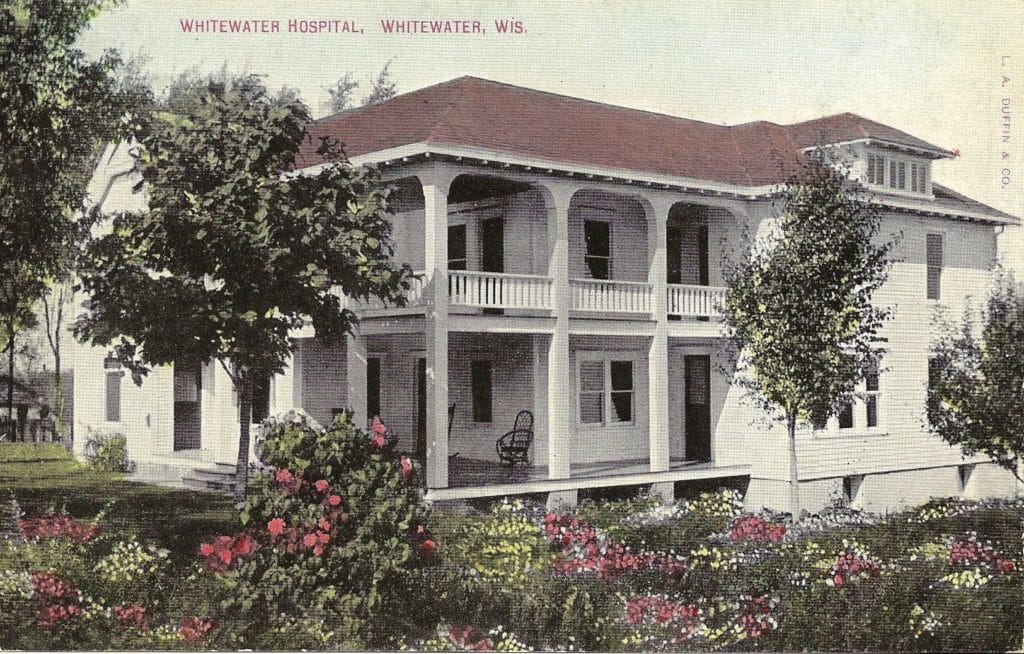
Old Whitewater Hospital (1909-1925) from around the time of the 1918 pandemic

Whitewater and the Last Pandemic—the 1918 Influenza

Carol Cartwright, Whitewater Historical Society

Whitewater’s citizens are going through a tough time right now. Most of us are staying home while some workers carry on so the rest of us have essential services while keeping safe. We, literally, have never seen anything like this. But, we were due.

While the United States had some health epidemics, like polio, in the last 100 years, nothing has hit like Covid-19 since the fall of 1918, when another severe, highly contagious, new strain of influenza raced through the country in a matter of weeks. People called it the “Spanish Flu,” because they thought it came from Spain. It did not. No one knew where it really started, but traveling World War I soldiers had a large role in the spread of the disease.

The 1918 influenza virus had many similarities to Covid-19. It was highly contagious and often developed into pneumonia. Some people died within a couple of days of getting sick. Others fought a long respiratory battle and eventually recovered, while others just had severe flu.

The 1918 influenza virus was most severe in people in the prime of life, ages 19-42.

Older people fared better, suggesting that the flu was related to a less severe virus that older people may have had in the past. Like today, young children were not severely affected.

The new virus swept through army camps in the spring of 1918 and in September, there were 4,500 cases (including two men from Whitewater) and 100 deaths at the Great Lakes Naval Station near Chicago. Historians have concluded that the sailors at the Great Lakes Naval Station were the “super spreaders” of the influenza in the Midwest.

On October 10, the Whitewater Register ran four articles on the epidemic. The paper reported that there were 200 cases among the 3,200 residents of the city. And, many cases were reported in the “local” columns from rural towns such as Cold Spring, LaGrange, and Lima.

Guidelines for flu prevention were similar to advice given today. Citizens were told to avoid sick people, keep their hands clean and away from faces, not to spit in public, cover their noses and mouths if they sneeze or cough, and use clean handkerchiefs frequently (“Kleenex” not being invented until 1924). Because the 1918 virus was transmitted just like COVID-19, wearing masks was recommended and people were encouraged to make their own. And this stern warning was issued: if you have any type of sickness, stay away from people, go to bed, and isolate yourself in your home.

Wisconsin officials, in one of the few states that had a strong public health department, ordered churches, theaters, and public amusements closed, but it is unclear whether everyone complied, and businesses remained open. It was never officially announced in Whitewater that these rules were in effect.

Throughout October and into November, the Register printed many illnesses and deaths from the 1918 influenza. Stories about entire families having the flu were common. And, like today, health care workers were hit hard. A Whitewater woman, Mrs. Anna Pester, attended the funeral of Miss Emma Wegner who was a trained nurse in Milwaukee and died of influenza herself.

By the middle of November of 1918, flu cases had decreased in the area and in early December citizens were encouraged to go Christmas shopping in downtown Whitewater. But, it was too soon for people to congregate.

On December 12, the Whitewater Register reported that cases had surged in Whitewater once again. Accounts were grim and included four young men who died within four days of each other in the local hospital and a young couple who died within 36 hours of one another, leaving children aged 3 and 18 months. Even the operator of the hospital, Mrs. Florence Wheeler, became sick, but, fortunately, she survived.

This second wave of the 1918 virus brought more stringent local public health measures. Houses with flu cases would be posted with “quarantine” signs, doctors were required to report all cases of flu within 24 hours, and theaters and churches could only have gatherings if they physically separated people. Dances, meetings, social events, and public entertainment were not allowed.

The peak of the second wave ended in January of 1919, but illnesses and deaths from the flu were reported into March. The pandemic in Wisconsin ended by April, but not before 103,000 had been infected and 8,459 died.

Footnote: The Whitewater hospital depicted in the photograph above was located near the modern water tower near Cravath and Wood Streets on the northeast side.  At the time it was founded in 1909, it was common to keep hospitals on very large lots more toward the edge of heavy residential neighborhoods due to contagious diseases.  The hospital burned in 1925 and no one was able to successfully start up another one due to the costs involved. Perhaps it was a factor that a 10-bed hospital had opened in Fort Atkinson in 1921. Additionally, the Great Depression started in 1929.

CORRECTION: Per Carol Cartwright, “after the hospital pictured burned, another small hospital operated at the corner of Main and Whiton Streets from 1925 to around 1940…The Historical Society has no photos of it.” This would have been at the southwest corner of Main and Whiton, apparently in the building that is still located at 907 W. Main Street. If anyone has any information about this hospital, please email whitewaterbanner@gmail.com.

— Our thanks to local historian Carol Cartwright, President of the Whitewater Historical Society, for this comprehensive report on the pandemic that occurred just over a century ago. As Ms. Cartwright stated, “That pandemic has a lot in common with today’s pandemic.” Surely, though, our current one will be curtailed with far less loss of life than the estimated 50 million deaths worldwide in 1918-19.

Note: The picture of a patient being loaded into an ambulance on the homepage, though taken during the pandemic, was not taken in Whitewater.

— Our Readers Share: We hope that you might have something that you’d be willing to share.  Anything that’s been created by someone else should, of course, be credited, and you should ask their permission if you’re able. We cannot post copyrighted material without permission. We can’t guarantee that we’ll have space for all submissions, and contributions will be subject to editorial board approval. The one definite exclusion is anything politically oriented. Please indicate whether you’re willing for us to include your name as the submitter or if you prefer to remain anonymous.  At least for now, no more than two submissions per person, please.  Send to whitewaterbanner@gmail.com or click on “submit a story” near the top right of our homepage.  Thanks for thinking about this!

Highlights of Virtual Plan Commission & Common Council Meetings, April 20-21

The Plan & Architectural Review Commission and the Common Council held their first-ever virtual meetings on April 20 and 21 respectively. Shown below are brief summaries of the highlights of their sessions.

PLAN COMMISSION: Request to rezone Mound Park Acres subdivision, located on Meadowview Court, behind the Burtness auto dealerships. The nearly 11 acre site was first approved for a single family development in 2000, with various plans having been discussed, and sometimes approved, since that time. The Planned Community Development under which the property had been zoned was no longer applicable, leaving the property in limbo. Craig Pope requested for the property to revert to R-1 zoning for 21 single family homes. The Commission recommended approval to the Common Council, with a stipulation that there be no blasting (if needed for construction of basements) without city approval.

COMMON COUNCIL:

  • Newly reelected members Jim Allen, Lynn Binnie, and Matthew Schulgit were sworn into office by Clerk Michele Smith.
  • Lynn Binnie was elected Council President, and Jim Allen, President Pro Tem. Patrick Singer was thanked for his twelve years of service as Council President.
  • Appointments to Commissions, Committees & Boards: Alcohol Licensing – McCormick, Palmer, Schulgit; Birge Fountain – Allen; CDA – Allen, Singer; Landmarks: Schulgit; Library: Brown; Parks & Rec: McCormick; Plan: Binnie (regular), Brown (alternate); Technology Park: Singer; Fire Dept: Binnie; Public Works: Binnie, McCormick, Schulgit; Finance: Allen, Palmer, Singer; Community Involvement: Brown
  • City Manager Report: Cameron Clapper reported on local matters pertaining to the COVID 19 pandemic. A number of staff continue to work from home. Those who are working on site are practicing social distancing. It was indicated that there have been confirmed cases in Whitewater, with community spread, but thus far there appear to be a fairly limited number.
  • Thanks was expressed to the poll workers and voters for the Presidential Preference and Spring Election on April 9, which took place during the Safer at Home order. Clerk Smith indicated that she has not been made aware of any suspected infections as a result of the election.
  • Rezoning of Mound Park Acres: The recommendation of the Plan Commission was approved, and the second reading was waived.
  • Award of Bid to RR Walton & Company: Walton, the low bidder, was awarded the $364,063 contract for an Industrial Drive watermain project and a stormwater project at Walworth Ave. and Court/Pleasant Streets.
  • After a closed session, sale of land to Kwik Trip at the roundabout for the appraised value of $229,000 was approved. No action was taken on the discussion of a possible property purchase south of Trippe Lake.

UW-Whitewater student awarded Goldwater Scholarship for research

Matthew Schulgit

University of Wisconsin-Whitewater student Matthew Schulgit is among only 396 students in the United States — and eight in Wisconsin — to have been awarded a prestigious Barry Goldwater Scholarship in 2020 from among 1,343 natural science, engineering and mathematics students competing for the honor.

A Brookfield native who will graduate from UW-Whitewater in May 2021 with degrees in biology and Spanish, Schulgit plans to become a family doctor and medical researcher.

Schulgit is one of four UW-Whitewater students to have earned the honor. Chemistry majors Marie Nider and Andrew Phillips won in 2012 and 2014, respectively, and geology major Melanie Sorman won in 2016.

To earn the award, students must be recommended by a faculty member, gather endorsements, write a research essay, assemble detailed applications and materials and, finally, be endorsed by a faculty committee.

“Through the application you have to write essays to explain what you want to do in a concise way that people outside of your discipline can understand,” said Schulgit. “It served as a very important learning and practice opportunity for when I apply for professional programs in the future.” 

The federally endowed scholarship was created to encourage students to pursue careers in natural sciences, engineering and mathematics. An individual scholarship bestows up to $7,500 to be used for tuition, books, fees and room and board. 

“The scholarship allows me to focus more on my research because it’s a very generous financial gift from the foundation,” said Schulgit. 

He describes UW-Whitewater as his first choice when it was time for college. For one, his brother Jimmy went to school here. He would be far enough from home to live on his own but not too far from family. He could talk directly with his professors and they would remember his name. He would be treated as a person, not a number. He would belong to a community. 

“I also wanted opportunities to do research,” he said, noting that UW-Whitewater encourages undergraduate research while many universities do not. “It is not easy for undergraduates to do research. UW-Whitewater allows undergraduates to do research and there are smaller class sizes.”

Schulgit first was recommended to apply for a Goldwater Scholarship by Associate Professor of Biology Kirsten Crossgrove, who has been his faculty mentor on a project, with global health implications, through the university’s Undergraduate Research Project.

“One of the great things about UW-Whitewater is that we get students like Matthew who come here when they easily could have gone to bigger-name schools,” said Crossgrove. “They benefit from the individual attention, and we benefit from getting to work with amazing students.”

Crossgrove and Shulgit’s research focuses on a protein, a parasite and a debilitating sickness the parasite causes in millions of people in south and southeast Asia. The cellular protein they are studying works like an on/off switch in the growth of Brugiamalayi, a kind of roundworm that uses both mosquitoes and humans in its life cycle. If the protein can be switched off, the parasite will not be able to develop enough to infect people.

Schulgit said past scholarships have given him freedom and time to focus on school and family instead of outside jobs to pay the bills. He has received UW-Whitewater Foundation and Chancellor Scholarships. He also received a year of funding for his research through the Research Apprenticeship Program at UW-Whitewater. 

For Schulgit, there is inspiration at home for a career in medicine. His brother Jimmy, older by two years, graduated from UW-Whitewater in 2019 with a degree in Spanish and a minor in biology. Now, Jimmy is in medical school in Missouri. Their mother, Sandra, is a retired registered nurse and their father, James, is a cardiologist at Aurora St. Luke’s Medical Center in Milwaukee.

The many-faceted Schulgit served in Whitewater Student Government before being named in August to fill a vacant seat on the Whitewater City Council. He ran unopposed for a full term in the April election. In high school, he began volunteering at Aurora St. Luke’s, assisting the admissions office with gathering information and generally being a friendly face for families of patients. He also has volunteered as an English-as-a-Second-Language tutor through the Milwaukee Archdiocese at Prince of Peace, a church on the south side of the city. 

Schulgit paints a picture of his future as a family doctor in a Wisconsin community near a research hospital. He wants to be a part of a community as a doctor, an elected official, a volunteer and, most of all, a servant. More than a career, he wants a life. He calls it “giving back.”

Great News! Outdoor Pickup is Now Available at Irvin L. Young Library

Even though the building is closed, the Irvin L. Young Memorial Library in Whitewater is committed to providing patrons expanded access to online resources and safe access to physical materials.

Beginning Monday, April 27, there will be limited access to materials currently inside the library building.  Pickups will be scheduled between 9:00 a.m. and 5:00 p.m., Monday-Friday.

To support social distancing efforts, we are operating with very limited staff. Staff will fill your holds placed online as quickly as possible; however, wait times may be longer than usual. Thanks for your patience.

Follow three easy steps to pick up materials at the Irvin L. Young Memorial Library.

Step one: Place your items on hold.

Already have an item on hold at a curbside location and you’ve been notified it’s ready? Skip to step two.

  • Go to www.whitewaterlibrary.org.  Click on “Browse Our Catalog.” At the top of the CAFÉ catalog page, use the dropdown menu under “Library” to choose Irvin L. Young Memorial Library to narrow your search to items that are available from our library only.  Be sure to choose our library as your pickup location as well.
  • We are currently limiting the number of items for each patron to 10.  Since we must still limit the number of staff in the building, we want to be able to provide something for as many people as we can.  Thank you for your understanding.
  • You will be notified via phone when your hold is ready. Staff will fill your holds placed online as quickly as possible; however, wait times may be longer than usual.

Step two: Call the library (262-473-0530) and tell us you’re ready to pick up.

  • When you receive notification that your holds are ready, schedule a time to pick up your holds.  Be sure to have your library card barcode number available to give us over the phone.
  • Staff will check out your items at that time, put them in a plastic bag, and place the bag on a cart outside of the building at the south entrance (parking lot) doors.
  • You will have a 15-minute scheduled time to pick them up.  This keeps the number of people at the library picking up their holds at any one time low to help with social distancing.  It also helps to make sure that your items do not remain outside for an extended time.

Step three: Pick up your items.

  • Bagged holds will be on a cart outside of the building for contactless pickup.
  • Outdoor signage at the library will guide you to the pickup cart.
  • Your bag will be labeled with the last four digits of your library card.
  • Grab your bag and enjoy!

Remember, Irvin L. Young Memorial Library remains closed to the public. Lobbies, restrooms, computers, and other spaces will not be accessible. Due dates have been extended to June 1 and may be automatically extended should the Safer at Home order be extended a second time. By the way, we have to quarantine all returned materials for 72 hours before they can be released to the public again, and we have limited space in which to do this. Consequently, unless you have checked out newer/popular materials that are likely to be sought by other patrons, we encourage you to hold any items until the library has reopened.

Browse the FAQs below for further information or call 262-473-0530.

Frequently asked questions
Your online catalog says I need a PIN. I’ve never used the online catalog before/I’ve forgotten what my
PIN is. What do I do?

● Call us at 262-473-0530 and a staff member will set up a PIN for you.
How will I know when my items are ready for pickup?
● You will receive a phone notification. To support social distancing efforts, we are operating with very limited staff. Staff will fill your holds placed online as quickly as possible; however, wait times may be longer than usual.
Thanks for your patience.
How do I return materials?
● At this time, all items have a due date of June 1. Due dates will be auto-extended for the
duration of the Safer at Home order. Please do not attempt to return items using the exterior
cart at curbside pickup locations. We have to quarantine all returned materials for 72 hours before they can be released to the public again, and we have limited space in which to do this. Consequently, unless you have checked out newer/popular materials that are likely to be sought by other patrons, we encourage you to hold any items rather than using the book drop until the library has reopened.
What if the item I want isn’t available at the Whitewater library?
● Unfortunately, transfer of materials between libraries is still prohibited by the Safer at Home
order. Only items physically present in the Irvin L. Young Memorial Library building are available
for holds and curbside pickup at this time.
Do I need a library card?
● Yes, patrons must have a library card to use curbside pickup. Please note that temporary e-cards can only be used for online services.
What if I have mobility issues and it is difficult to leave my vehicle?
● If a patron experiences mobility issues, we can provide an accommodation such as placing
bagged items on the hood or in the trunk of your vehicle. Please request this when you call.
What materials are available for pickup?
● All physical materials currently on the shelf in our building are available, including books, DVDs,
magazines, etc.
What if I have fines or I’m over the checkout limit?
● Library staff can override fine restrictions and checkout limits during the pandemic response. If
you would like to pay your fines, our online payment system is still available.
Can I place a hold via telephone?
● Yes, please call 262-473-0530. You may have to leave a message if we experience a large
number of calls.
What are you doing to protect the safety of patrons and library staff?
● The contactless curbside pickup model we are using provides maximum social distancing for the
safety of our patrons and our staff. Staff will use gloves and cloth face coverings in accordance
with CDC guidelines. All physical materials will be quarantined for a minimum of three days before being made
available to the public again. Patrons and staff should not approach one another and respect the need for social distancing. This may feel uncomfortable but is necessary to provide a safe, contactless pickup service. If you
notice patrons at the pickup cart, please remain in your vehicle until the previous patron has
departed.
Why are you using plastic bags for pickup items?
● Plastic bags are a temporary measure to protect patron privacy, protect physical materials, and
limit unnecessary contact. Bags help separate materials to avoid the need for patrons to sort
through items on the pickup cart

Whitewater FFA Selling “Support Wisconsin Dairy” Yard Signs – Proceeds to Purchase Dairy Products for Food Pantry & Community Space

Elizabeth Katzman showing off one of the FFA signs

Whitewater FFA Selling ‘Support Wisconsin Dairy’ Yard Signs

Proceeds to Be Used to Purchase Dairy Products For Food Pantry, Community Space

To rally support for Wisconsin’s dairy industry – crippled by the coronavirus pandemic – Whitewater FFA is selling ‘Support Wisconsin Dairy’ yard signs. All proceeds, plus welcomed donations, will be used to purchase Wisconsin cheese and other dairy products for the Whitewater Food Pantry and The Community Space. Each sign costs $10.

Following the lead of other FFA chapters from around the state, Whitewater FFA Vice President Elizabeth Katzman felt compelled to bring the idea to Whitewater.

“Being from a dairy farm family, I know firsthand how much work – and passion – goes into producing milk,” states Katzman, whose family milks cows in the Whitewater area. “To watch farmers dump thousands of gallons of milk – due to the shift in demand when schools and restaurants were forced to close – breaks my heart, especially knowing that our farm could be next.”

Through the sale of the signs, Whitewater FFA hopes to show support for the community’s dairy farmers – many of whom are Whitewater FFA alumni – and create awareness for the vital role Wisconsin’s dairy industry plays in feeding our hungry world.

“And, with an excess of dairy products on the market, it made sense for us to use the proceeds from the sale of the signs to buy Wisconsin dairy products for those in need in our own backyard,” Katzman concludes.

To purchase a sign, email your name and address to katela04@whippets.wwusd.org. Katzman will arrange for contactless delivery to homes and businesses.

For more information, contact Katzman at 262-903-5525 or katela04@whippets.wwusd.org.

Spring Marches On

In a seemingly topsy turvy world the sights of city crews continuing their efforts is oddly comforting. Thank you to Tom Ganser for capturing these images, and thank you to every member of the city’s streets crews diligently continuing their work throughout the city.

Our Readers Share – Jim Winship: “Nighttime Gratitude”

Jim Winship

Dr. Jim Winship has taught social work classes at UW-W for over thirty years. He shared these words with Banner readers to introduce his “Nightime Gratitude” thoughts: “Anxiety and its older sibling Fear and its first cousin Stressed Out—they are violating our social distance these days. They get close; they close in on us. Now, I am fortunate not to suffer chronic anxiety or panic attacks. I am just someone who gets really anxious at times, and those “anxious at times” moments have gotten more frequent since the advent of the pandemic.”

Nighttime Gratitude 19 April

I have been reading Sarah Wilson’s Book: First We Make the Beast Beautiful: A New Conversation about Anxiety. It’s worth reading, and one of the things that she suggests is before you go to bed every night, you think of four or five things that you are grateful for.

For more than a week, I have been following this practice. Two nights ago, these were the things for which I was grateful.

I was grateful that when I looked in the freezer I found some Italian sausage. I put that together with other veggies that we had, making sausage and peppers over pasta—good comfort food. Thinking about it, having the Italian sausage in the freezer is representative of a kitchen with lots of food in a comfortable house. We are fortunate and privileged.

I am grateful for our dog Virgil, a twelve-year-old greyhound. When Virgil runs, he is fast and graceful, and much of the time he is very content spending time with us and lying around. When I am reading and he comes close to get his head scratched, I smile.

I am grateful that our daughter Hope calls us at night as she is driving home after a twelve-hour shift at the Operation Center of California’s Office of Emergency Services. She is part of a team working to obtain medical supplies for this pandemic and to prepare for the next crisis. We ask her about her day. The work is often frustrating, as they are setting up new procedures and helping long-term employees see the benefit of doing things differently than how they are used to— and sometimes there are small victories.

She asks us about how our day has been, and I tell her about my online teaching. We talk of taking hikes in the nearby nature preserve, of making food, books, a jigsaw puzzle, Netflix. Our days in many ways resemble pre-COVID-19 life, and I think she finds this reassuring. Talking to us also keeps her alert on the twenty-minute drive back to her apartment.

I am not sure that this gratefulness practice is reducing my anxiety, but it does seem that my dreams have been more pleasant since I began.

–Our thanks to Jim Winship for generously sharing one night’s expressions of gratitude with us. If you’ve been having more “anxious at times” moments, might nighttime gratitude be a practice you’d like to try?

Our Readers Share: Have You Created (or Seen) a Timely Poem/Photo/Short Story/Drawing, Etc. That You’d Like to Share with Banner Readers?

Those of us who spend time on social media (Facebook, etc.) have had plenty of opportunities to contribute and/or view all sorts of expressions that have been inspired by the COVID-19 pandemic and the resulting isolation and “free time.”  There have been thoughts shared about positive ways that our life might be changed going forward, suggestions for good ways to spend time at home alone or with family, ideas for things for children to do, online learning resources, or online arts resources – virtual museum visits, ballet, etc. There have also been some beautiful photographs of scenes and wildlife in our area. Those who aren’t on social media may not have had much opportunity to see this sort of thing, and they might appreciate seeing some of the “gems” without having to put up with the ads, the clutter, and the negativity that sometimes comes with social media.


We hope that you might have something that you’d be willing to share.  Anything that’s been created by someone else should, of course, be credited, and you should ask their permission if you’re able. We cannot post copyrighted material without permission. We can’t guarantee that we’ll have space for all submissions, and contributions will be subject to editorial board approval. The one definite exclusion is anything politically oriented. Please indicate whether you’re willing for us to include your name as the submitter or if you prefer to remain anonymous.  At least for now, no more than two submissions per person, please.  Send to whitewaterbanner@gmail.com or click on “submit a story” near the top right of our homepage.  Thanks for thinking about this!  Share This