Welcome back to #FlashbackFriday with the Whitewater Historical Society!

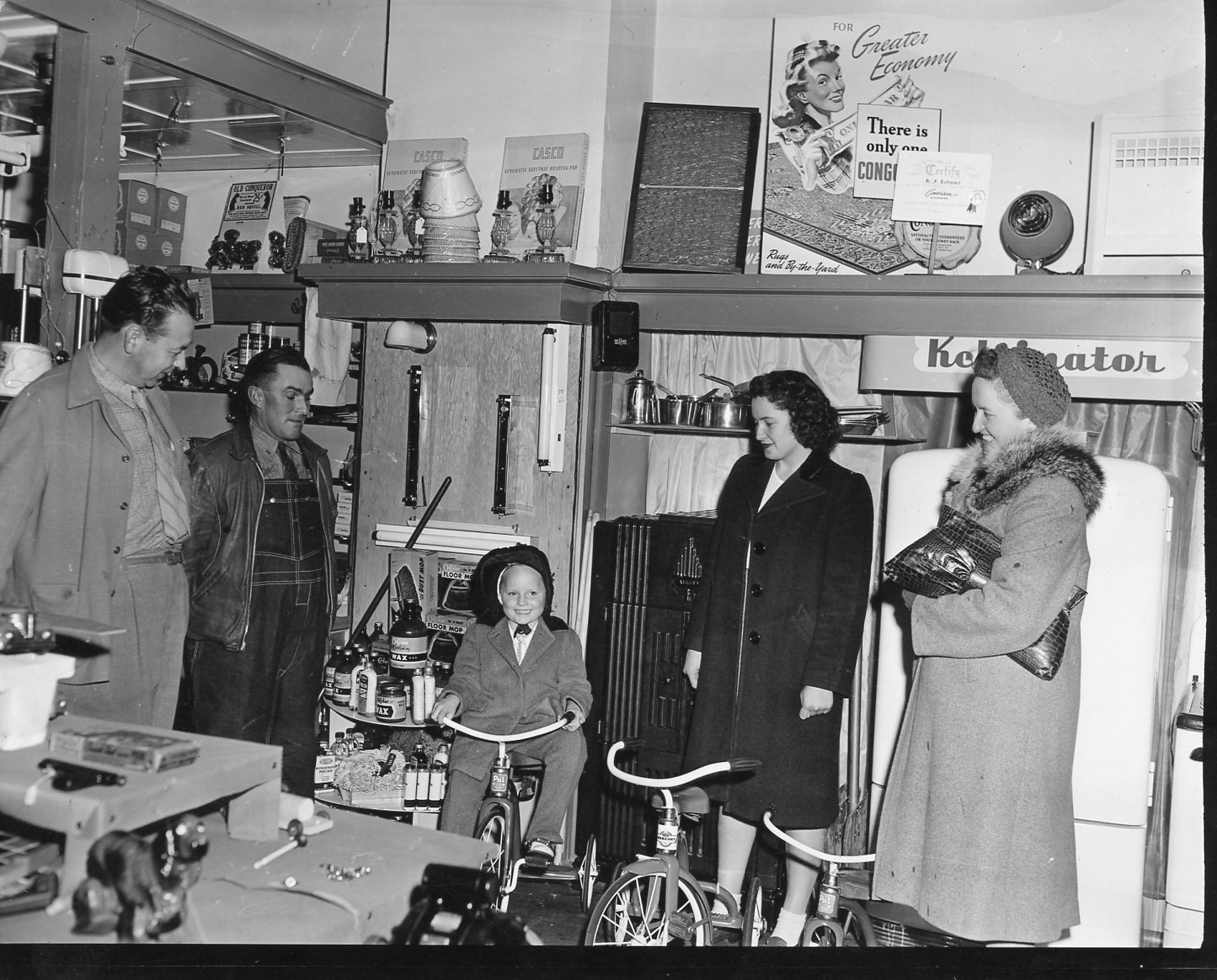
(Whitewater Historical Society submission) In November 1946, the Whitewater Register featured a promotion following the Uglow family of Heart Prairie on their Saturday Shopping Tour of Stores in the Business District.”

Let’s check out some of the stores that Ellis and Dorothy, along with their children, Charlotte, Thane, and Bonnie, visited on their trip into town!

In the photo below, Ellis, Charlotte, and Dorothy watch as Bonnie tries out a new tricycle at Ledman’s Western Auto store, located at 88 West Main Street. Western Auto stores were all-purpose hardware and household goods stores that specialized especially in toys during the holiday season.

Over the years, Whitewater was home to many different Western Auto franchise locations:

1940-1941: Roy Crouch opens the first Western Auto Store.

1941-1942: Elmer Lubbers takes over from Crouch, yet ends up selling “everything but the store cat” by late 1942.

1945-1947: Hal Ledman opens up a new Western Auto store, pictured here.

1947-1948: Bill Swendsen buys out Ledman, but goes out of business himself just over a year later.

1955-1960: Eddie O’Donnell opens a new store in the space formerly home to Burns Electrical.

1960-1963: O’Donnell and Tony Willegal sell out to Tom and Ruth Burns in early 1960, however, the business only lasted a couple years beyond that as the space was transformed into a pool hall in 1963.

1969-1974: Jack Forrest opens a new Western Auto Store at 125 West Whitewater Street, closing down in late 1974. On Christmas Eve 1974, a fire raged through the building for several hours. Arson was suspected, but the culprit was never caught.

Join us next week for more from the Whitewater Historical Society collections!

Making Democracy Work Award – League of Women Voters honors city poll workers

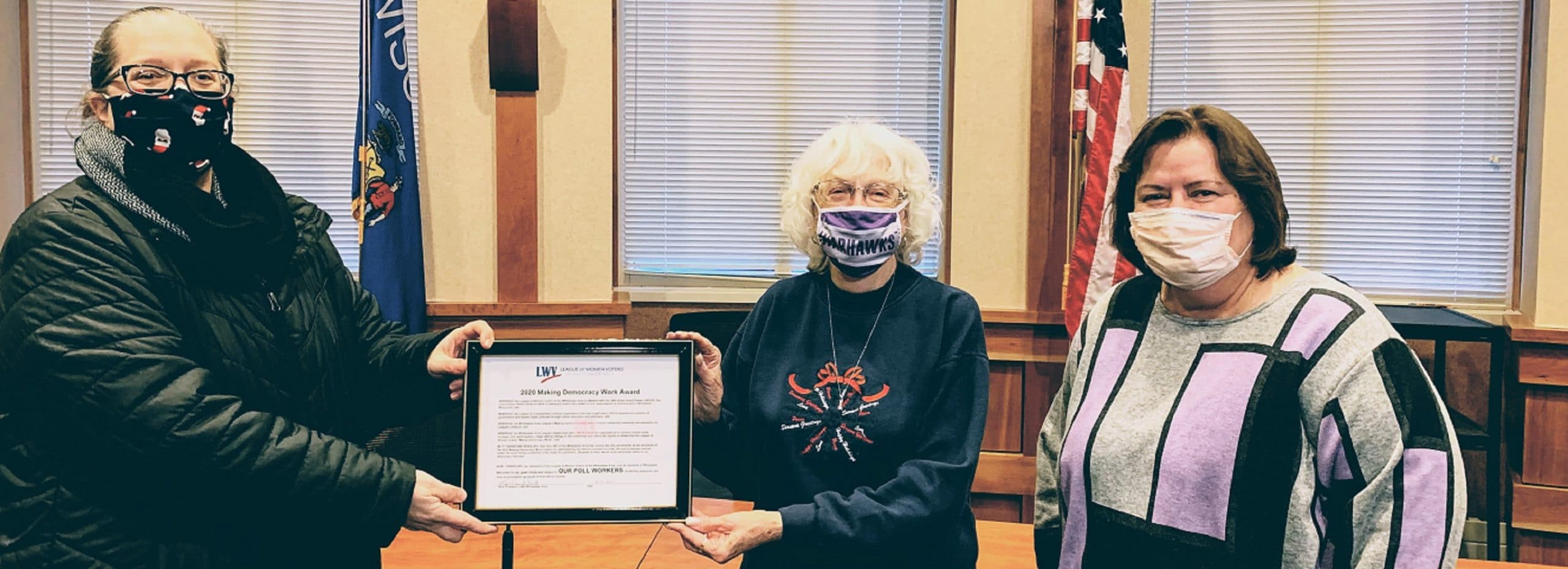
Lisa Dawsey Smith, Vice President of the local league, presents the award to Chief Election Inspector Joyce Follis and City Clerk Michele Smith

League of Women Voters – Whitewater Area Honors City Poll Workers

(LWV-Whitewater Area press release) The League of Women Voters-Whitewater Area is delighted to announce that the 2020 Making Democracy Work Award honors City Poll Workers for their work administering three election cycles during an unprecedented pandemic. In the face of potential health risks to themselves, poll workers in the April, August and November elections helped make democracy work in the City of Whitewater by ensuring that each election was appropriately executed, accessible and as safe as possible. 

During long hours on Election Day, these dedicated poll workers guided voters through the voting process and maintained a safe poll environment by social distancing, wearing face masks and frequently disinfecting all surfaces. We are grateful to each of them for stepping up so all eligible voting citizens in our community could safely participate in democracy during a challenging time.

Whitewater City Clerk, Michele Smith (2012 Making Democracy Work Award recipient), and Whitewater Chief Election Inspector, Joyce Follis, graciously accepted this award on behalf of all City Poll Workers.

The League of Women Voters is a nonpartisan political organization that encourages informed and active participation in government, works to increase understanding of major public policy issues and influences public policy through education and advocacy. The League’s annual Making Democracy Work Award was established in 2010 for the purpose of honoring the civic work of individuals or groups that make our community a safer and fairer place in which to live. Visit our website at lwvwhitewater.org and like us on Facebook!

Statement from UW-W Chancellor Dwight C. Watson on the Faculty Senate press release

Statement from UW-Whitewater Chancellor Dwight C. Watson

“As we look at potential changes to our university budget and curricular offerings, shared governance is a vital part of the process. In fact, shared governance is one of our university’s core values — that we make decisions based on strategy, evidence, and transparent, collegial dialogue and we hold one another accountable.”

“Of course, we have been and will continue to work with faculty members and the Faculty Senate on these important matters. As chancellor, it is ultimately my responsibility to make the final decisions that will impact the long-term future of UW-Whitewater.”

“I would not consciously do anything that would harm the growth potential of this university or would have adverse effects on the community or region. Decisions are viewed through multiple lenses, and the impacts of those decisions are thoroughly considered to ensure that UW-Whitewater — and the community — remain strong and vibrant.”

Banner note: This article in The Gazette includes additional comments by Chancellor Watson.

Local residents graduating from UW-Milwaukee

(UWM press release) – The following individuals from your area are among the 2,050 prospective candidates for degree attending University of Wisconsin-Milwaukee virtual commencement exercises Sunday, December 20, 2020 in Milwaukee.

UWM is the second largest university in the State of Wisconsin, with over 23,000 undergraduate and graduate students.


Whitewater, WI

 Sophie Dern, College of General Studies, Associate of Arts and Sciences
 Abigail King, College of Nursing, Bachelor of Science

Seniors in the Park Film: “Love Actually” – Tues. Dec. 22

Film Title: Love Actually. Copyright: © 2003 Universal Studios. ALL RIGHTS RESERVED.

“Love Actually”(Romance/Comedy/Holiday) – Tuesday, December 22, 1 p.m. only; Rated R (Sex/Language)2 hours, 15 minutes (2003) – Back by Popular Demand, our favorite holiday “rom/com”! Romance and relationships in an all-star ensemble comedy that tells ten separate but intertwining love stories from London to Milwaukee (yes, that is correct), leading up to a spirited climax on Christmas Eve. We’ll all be singing Mariah Carey’s “All I Want for Christmas is You,” made even more popular by this film! Starring Hugh Grant, Liam Neeson, Laura Linney, Colin Firth, Emma Thompson, and Bill Nighy.

There is a capacity limit, and COVID-19 precautions, including facial mask, are required. Please register in advance online, by email (dweberpal@whitewater-wi.gov), or phone (473-0535).

Common Council Extends COVID-19 Emergency Declaration and Facial Coverings Ordinance

By Al Stanek
Whitewater Banner volunteer staff
whitewaterbanner@gmail.com
December 16, 2020

A Whitewater citywide ordinance requiring face coverings in all interior public and business spaces that had originally been set to expire at the end of the year has been extended through March 31, 2021 by Common Council action at the body’s last meeting of 2020. It was one of three actions related to COVID. The other actions include an extension of a citywide COVID-19 Emergency Declaration and a decision to continue holding city meetings “virtually” as opposed to allowing for in person participation.

The actions took place with little debate compared to the initial July Common Council discussion of the ordinance that lasted over three hours and featured a dozen public participants and petitions that supporters claimed were signed by over 1000 residents and petitions from opponents that reportedly had over 200 signatures.

Discussion at the July 21 Common Council meeting referenced the fact that, at the time, an analysis of just the Walworth County portions of the City of Whitewater reported 70 active cases in the roughly 4-month period between March and early July. That compares with recently released state data that indicates 74 new active Whitewater COVID-19 cases in the most recent week. Fourteen of last week’s 74 City of Whitewater COVID-19 cases were attributed to UW-W students and staff according to the state’s most recent data.

COVID-19, a flu like virus that has reached worldwide proportions, is reported to have been at least partially responsible for over 300,000 American deaths so far. Hundreds of thousands of others have been treated in intensive care units (ICUs) across the country. The long-term effects of the virus have yet to be documented. A Whitewater Common Council briefing paper on the COVID-19 situation quotes the WI Department of Health Services (DHS) indicating that 87.8% of statewide ICU beds were in use as of the morning of December 11.

The City of Whitewater COVID-19 Ordinance requiring face coverings was one of the first in the State of Wisconsin. It states that “… wearing a mask is one of the most effective ways to reduce person to person transmission of COVID-19.” The ordinance goes on to state that masks “…when combined with other preventative measures, including physical distancing and proper hygiene practices, is a simple and effective way to reduce the risk of COVID-19 transmission.” It was extended Tuesday night after waiving a generally required “second reading” because the Common Council will not meet again until after the first of the year.

The Emergency Declaration, which was originally issued in March and ratified by Common Council resolution in June is a viewed as a potential requirement for current and future financial assistance. It can be rescinded at any time. The decision to hold all City of Whitewater public meetings virtually began in April.

UW-W Faculty Senate Responds to Chancellor’s Plan for Layoffs and Program Closures

(UW-W Faculty Senate press release) At its Dec. 15 meeting, the Faculty Senate Executive Committee rescinded a compromise plan to collect budget information from academic programs in response to statements made by Chancellor Dwight Watson asserting he would not permit the faculty to make curricular decisions based on that information. Chancellor Watson stated at a previous Faculty Senate meeting on Dec. 8 that he would instead receive the Senate’s work and make decisions himself about what programs would be offered going forward.

In August 2020, Chancellor Watson began a “Program Optimization” process in which up to 40 percent of UW-Whitewater’s programs would be identified for possible reduction or elimination by May 2021. The timeline called for this process to take place during a pandemic, and with an Interim Provost who is leaving the role in June 2021. This process was met with immediate opposition from the faculty, based on the rationale that the entire Program Optimization plan is a short-sighted response to budget shortfalls caused by recent enrollment declines exacerbated by COVID-19. The faculty contends that such drastic decisions should not be made so quickly and during such an unprecedented year.

If Chancellor Watson goes forward with Program Optimization on his own, the resulting cuts would permanently eliminate some programs (meaning fewer major and minor choices for students and limited course offerings), which would likely accelerate the decline in enrollment. This plan would also result in employee layoffs, which would harm the city of Whitewater and surrounding areas.

The Faculty Senate opposes any hasty decisions that would have long-term and widespread impacts, instead opting for sacrifices that can get UW-Whitewater through this difficult time while protecting its ability to be successful for decades to come. Furthermore, the return to stability is already on the horizon: COVID-19 vaccines are becoming available; applications for Fall 2021 are up, and universities will be in high demand as workers seek new skills in response to the changes caused by a year of remote business. If UW-Whitewater plans to remain as successful in the next ten years as it has been in the previous 20, closing programs and laying off instructors is not the way forward.

The Faculty Senate will meet Tuesday Feb. 2 from 2-5 p.m. to discuss institutional direction. Interim UW System President Tommy Thompson has been invited to attend this meeting, which will be streamed via Facebook Live. For more information, contact: Faculty Senate Chair Tracy Hawkins at facsenate@uww.edu or 262-472-1975.

Pauquette Center for Psychological Services welcomed to Innovation Center


(City of Whitewater press release) Whitewater is excited to welcome an organization that will bring psychological services, family and mental health counseling, and addictions treatment to the community.

The Pauquette Center for Psychological Services offers a range of state-licensed mental health services to meet every need, including psychotherapy, AODA Treatment/Services, Dialectical Behavior Therapy, group therapy, and more. Pauquette is currently providing telehealth services, including groups during the pandemic to offer safe treatment to those in need.

The company signed a 7-year long-term lease commitment to work out of the Whitewater University Innovation Center, Suite #221 starting January 2021. The Innovation Center will offer ample meeting and office space surrounded by a serene, peaceful environment with abundant nature and nearby walking paths which will benefit employees and clients.

As the cornerstone facility to the 130-acre technology park, the 38,000 square-foot Whitewater University Innovation Center operates primarily as a mixed-use business incubator strategically built with support from the City of Whitewater, the Whitewater Community Development Authority and the University of Wisconsin Whitewater. With the support of their partners, the Whitewater University Innovation Center’s Mission is to create and foster durable businesses and jobs through a close alignment of UW-Whitewater’s research and
educational competencies and the resources of the City of Whitewater. The Technology Park serves as afoundation for a diversified and robust regional economy through the attraction of new residents, utilization of UW-Whitewater faculty, staff and student expertise and the retention of alumni talent.

”We are very pleased that Pauquette Center has chosen the Innovation Center to expand their business operations and look forward to supporting them as they grow their company in Whitewater,” said Mark Johnson, Whitewater University Innovation Center Executive Director.

Pauquette is currently located in Richland Center, Reedsburg, Baraboo, Columbus, Prairie du Sac, Portage and Madison. The decision to open an eighth facility in Whitewater made sense to help a growing need in the rural area of Walworth, Rock and Jefferson counties.

“Our decision to move to Whitewater was an easy one as our organization actually has fairly strong ties to this community,” said Lesley Chapin, Pauquette Vice President and Executive Director. “Our President, Thomas Hayes, along with our Director of Business Operations, Peter Schuster, both graduated from UW-Whitewater in different areas of study. Also, I was born and raised in Fort Atkinson and my family still resides there. This community invested in my education throughout my undergraduate and graduate programs of study so
bringing my education full circle and bringing services to Whitewater is very meaningful.”

COVID-19 has presented the needs for services in communities around the world, services Pauquette will be available to offer to Whitewater. “The timing for this clinic could not be better,” said Chapin. “I am well aware of the impact COVID has had on our communities and I am so thrilled to be able to bring some much-needed service back to an area that has invested so much in me over the years.”

Pauquette plans to collaborate with the UW-Whitewater two masters program, social work and counseling education, to provide services to create internships for students.

“We look forward to building a strong relationship with Pauquette Center,” said Sarah Hessenauer, Professor and Chair for the University of Wisconsin-Whitewater. “Finding clinical internships in the Whitewater area can be difficult for the programs, so having this opportunity for interdisciplinary teamwork to address mental health
concerns will benefit both the UW-Whitewater masters students and the community.”

“Whitewater is the next perfect location to not only help those with a need, but also a great opportunity to partner with the university while working with students in this field,” said Chapin.

The Community Development Authority is proactive in its search of businesses who want to call Whitewater their home. Whitewater is a rural, vibrant community. People come for jobs and stay for the lifestyle.

“Creating internship opportunities for students while they are attending school in Whitewater is an asset which may lead to potentially keeping them in the Whitewater area to work and live is a success for everyone,” said Cathy Anderson, Economic Director for the City of Whitewater.

If you or someone you know needs mental health assistance, contact Pauquette at 262-473-0670 or visit their website https://pauquette.com/ to learn more.

Pauquette Center for Psychological Services
Whitewater University Technology Park
1221 Innovation Dr. Suite #221
Whitewater, WI 53190

Children’s Center tops $100,000 in grants as UW-W takes care of “youngest Warhawks” during pandemic

(UW-W press release) The laugh of a child brought back the joy and excitement for Erica Schepp.

The director of child care at the UW-Whitewater Children’s Center, Schepp recalled that first day, re-opening the doors to the center in late May, three months after the facility in the Roseman Building had closed due to the COVID-19 pandemic.

“Being shut down was surreal,” said Schepp, who, during those three months worked from home serving families and preparing to return safely. “Preparing to come back, I remember being excited, being worried, hoping we had prepared enough and we were doing enough.”

“My office overlooks the playground,” Schepp recalled. “The moment they (children) came out, I heard the laughter and joy in those young voices and I knew, ‘This is it.’ It was the joy and the energy coming back.”

Schepp said the Children’s Center was the first program to return to in-person activities after learning and instruction went online midway through the spring semester. Not only was it vital to re-open safely, but others on the campus would be learning from the Children’s Center’s example. Schepp said the staff of the center met the challenge.

“We were the front runners,” said Schepp. “We learned a lot from being the first ones to reopen. I am proud and thankful for that.”

Others think so, too. The center recently topped $100,000 in awards from a series of grants administered by the Wisconsin Department of Children and Families from $50 million in the federal CARES Act to keep safe, high-quality childcare going in the United States. Schepp credits the National Association for the Education of Young Children and its “nonstop work and support” for advocating for that funding in the CARES Act.

She said the grants help because the Children’s Center is largely self-sustaining. When the center closed in mid-March, it returned 75 percent of tuition to its families. Schepp said the grants are earmarked for centers that had to shut down; retention and retaining of teachers; personal protective equipment and other defenses from COVID-19; and other pandemic-related needs.

During the closure, the Children’s Center’s professional teachers kept working with their families online. Schepp said those relationships between teachers and families are key to supporting the children and keeping trust. And at UW-Whitewater, Schepp said trust matters.

“We say we have ‘the youngest Warhawks’ in our program,” said Schepp. “The work we do supports so many others on campus and through the Whitewater community. Childcare is essential to the workforce, to the community and to the campus.”

And to the 54 UW-Whitewater students who work as paid part-time teaching assistants, the Children’s Center has become an essential part of their training for careers in elementary education, early childhood education, social work, communications disorders and related fields involving children. The center accepts children from infancy through 4-year-old kindergarten.

Students learn to become careful observers of children, to notice what questions children ask and to discover individual curiosities that can be built upon. Students experience language development and early literacy. They even see basic sign language taught to infants, who are known to sign before speaking their first word.

“If a child’s interests are engaged more, they want to go deeper,” said Schepp. “That’s how our classrooms are designed. You might look at a class and say ‘Well, they’re just playing.’ But the play is our children’s work. There’s meaning and value in that play.”

“What a difference those first four years make,” added Schepp, an urgency rising in her voice. “I know that the first five years are critical years in their lifelong development.”

The university students at the center chart every detail of each child’s day for reports, which go to the parents. Students change diapers, feed children, eat with children, play outside with children and assist the professional teaching staff. And now, during the pandemic, there are cleaning protocols and health screening tasks to be done.

Schepp said the center reopened at 50 percent of capacity in late May and now is up to about 70 percent. She will keep writing those grant applications.

“This is not something you leave on a desk at the end of the day, and I see it in our student employees,” said Schepp. “With some of them who struggle with coursework, grades, even thoughts of leaving school, this is what keeps them going. The challenging moments they work through with children make their relationships stronger.”

“This is a place of humanity. What you receive from it often feels like it’s tenfold what you give.”


Whitewater Grocery Co. 2020 update (Updated with hyperlinks)

(Whitewater Grocery Co. press release)

As this crazy year of 2020 comes to an end, Whitewater Grocery Co. wants to share some joy and update Whitewater on this year’s activities. The GroCo volunteers have been busy!

First, this year saw a change in leadership when Lacey Reichwald, our founding president stepped down from her role. Katy Wimer was voted in by unanimous consent by the Board to replace her in October. Like Lacey, Katy is an entrepreneur, experienced in marketing and social media and has devoted many years of dedicated volunteerism to the GroCo’s Ownership & Outreach Committee. Lacey remains on the board until the end of her term.

Second, the GroCo moved its office to the UWW Community Engagement Center (CEC) in the old Sentry building. We can’t wait until we can fully utilize this amazing space and see our owners.

Third, during the pandemic, the GroCo Ownership Committee ran a successful food drive during the 4th of July, and is currently wrapping up another initiative called 31 Days of Sharing with the UWW Warhawk Pantry, Whitewater Community Food Pantry, and The Community Space. The GroCo is asking all those who are able to put together a box of 31 thoughtful items to help our struggling families. There are a few days left to put together your box of goodies. The list of recommended supplies can also be found on Facebook or on Instagram. If you’re strapped for time, the GroCo will also take monetary donations that can be split among the pantries. Checks can be made payable to Whitewater Grocery Co. and mailed to: CEC – Whitewater Grocery Co., 1260 W. Main St., Whitewater, WI 53190.

Fourth, the pandemic has demonstrated the fine line that a lot of our families navigate to be able to pay their bills and find affordable food, and the GroCo has redoubled its efforts to make grocery shopping accessible for all. The GroCo is offering scholarships (paid for with donations from current owners and from the UWW student government) for members of the community who want to help build a grocery store but would consider it a financial hardship to buy a full-priced ownership. A community-owned grocery store must be accessible for everyone in the community and be culturally sensitive to the needs of our neighbors. Essentially, the $150 ownership is a crowdfunding tool to convince banks and investors that there is enough community interest, but co-ops across the country have found the need to reach deeper into the community in order to get the necessary feedback about offering SNAP benefits and bulk deals that make it possible for everyone to afford to eat healthy. 

Fifth, the Whitewater Grocery Co. has narrowed down possible sites that follow market study recommendations and is conducting due diligence in order to build. We cannot progress to the next stage of development until a few more owners sign on to this community project. In order to generate excitement, owners have thrown money into a pot to make things more exciting. In the Ownerpalooza, each owner can recommend a friend to become an owner. If that friend becomes an owner during December, the recommending owner and the new owner are eligible to win the $700.  Anyone who becomes an owner in December will be eligible to win. A number of payment plans are available for ownership.

When you become an Owner of Whitewater Grocery Co. (GroCo), you become a part of something bigger: a community of people taking matters into their own hands to nourish our community. Your GroCo ownership lasts a lifetime and ensures you have a voice in our local food system. More information can be found on our website https://www.whitewatergrocery.co/.