




Opinion | Whitewater shows how moral panic distorts immigrant debate
- By Julien Grayer, Michael Friedson and Tabitha Whitehead | guest column Julien Grayer and Michael Friedson are assistant professors of sociology and criminology at UW-Whitewater. Tabitha Whitehead is an undergraduate research assistant at UW-Whitewater.
- Feb 27, 2025

“Whitewater has been a focal point in our country’s ongoing politicized hysteria concerning immigration. This town of approximately 15,600 has seen a recent influx of migrants from Nicaragua and elsewhere in Latin America. This influx has captured the attention of the national media, starting with coverage of a letter in December 2023 addressed to the White House from municipal police chief Daniel Meyer.
The rhetoric of prominent politicians has framed Whitewater as a site of a social crisis stemming from crime in the immigrant community. We are given pause about this rhetoric by past research on immigration and crime.
We reviewed decades of academic articles and did not find evidence linking increases in a place’s immigrant population to greater levels of serious criminal offending. We discovered instead an abundance of findings to the contrary, indicating that greater immigration is associated with lower offending rates.
Immigrants have a 60% lower chance of being incarcerated than those born in the US, according to a recent study by Stanford University economist, Ran Abramitzky and colleagues. In Texas, arrests for violent crimes are more than twice as common among U.S.-born individuals than among undocumented immigrants, claims research sponsored by the National Institutes of Justice.
The concentration of the immigrant population may have spillover effects making a place as a whole safer. Studies have repeatedly found that crime tends to go down when immigrants move into a previously distressed city neighborhood. Immigrants often come to an area with an eagerness to start small businesses, improve their skills and attain upward social mobility, thereby enhancing demand for properties, property value and the local tax base. All of this is a formula for urban revitalization and safer streets.
In Whitewater, we have recently witnessed a burgeoning number of small businesses, many catering to the international migrant population, and a concomitant increase in local property values.
As sociologists and criminologists, we are also familiar with how crime is portrayed in media and public discourse and how these portrayals fuel fear in the popular imagination. In Whitewater, we have observed what our field calls a moral panic, or the framing of a minor or nonexistent problem that sensationalizes it into a societal crisis. A moral panic draws its power from real public anxieties about complex issues like cultural change, inflation or declines in sectors of the economy. It displaces those anxieties by blaming easily identifiable and unpopular scapegoats who lack power to resist their demonization.
Immigrant groups have been a common target for these social problem campaigns through much of U.S. history. In Whitewater, Aurora, Colorado, Springfield, Ohio, and elsewhere we have recently observed similar processes of scapegoating these groups for allegedly being a drain on public resources and for committing a litany of violent crimes. The isolated crimes that are committed by members of the groups are sensationalized and taken to represent the behavior of the groups as a whole. Latinos, being overrepresented among immigrants, are especially hard hit currently by the resulting stigmas.
As a moral panic progresses, the anxieties at its origin are amplified or, some might say, blown out of proportion. For instance, in crime-related panics like that which has transpired in Whitewater, it is typically assumed that crime and public endangerment are rising, even when this is contrary to available evidence. Official crime statistics, provided by the FBI, do not support claims of an upward trend over the past several years in Whitewater’s crime rates. We will focus here primarily on a selection of the so-called “index crimes,” which are a set of serious street crimes designated by the FBI.
Homicide, the most severe of crimes, remains extremely rare in Whitewater. The tragic killing in August of a university coed was Whitewater’s first known homicide since 2016. Four robberies (i.e., thefts by force) were reported in 2023, one more than in 2021 or 2022, but a number that was matched or exceeded in each of the five years from 2013 to 2017.
Of greater concern, regarding violent crime in Whitewater, are the 31 aggravated assaults recorded in 2020. This is more than double the average number of assaults taking place annually in the prior decade and is the highest number recorded in Whitewater during the past 40 years. But it predated — and thus was not caused by — the immigrant influx, which started in 2022.
Aggravated assault numbers have fallen rapidly since, with 18 being recorded in 2023. This translates to a 2023 aggravated assault rate (i.e., assaults per 10,000 residents) roughly consistent with Whitewater’s longer-term average.
Recent property crime figures similarly do not raise cause for concern about a crime surge in Whitewater. The number of burglaries in 2023, though greater than in either of the prior two years, were less than half the annual numbers reported a decade earlier. Auto theft remained rare in Whitewater in 2023, with just five reported for the year, half the number of cars reported stolen in 2016 or 2018. Just 120 thefts (of items other than motor vehicles) were reported in 2023, while it was typical for 200 or more thefts to be recorded annually in the early 2010s. Note that these counts include only property crimes reported to the city police, and reports to campus police are typically small in number.
An influx of immigrants, such as that experienced by Whitewater, inevitably creates possibilities and challenges. An increase in serious street crime is not one of these challenges in Whitewater. To address Whitewater’s actual challenges in a practical and proactive fashion, scarce public resources should not be wasted on imagined problems.
Saddling immigrants with the stigma of perceived criminality will make it harder for them to earn a living and otherwise adjust to their new environment. Greater difficulties in adjusting create real costs for the public and police.”
Julien Grayer and Michael Friedson are assistant professors of sociology and criminology at UW-Whitewater. Tabitha Whitehead is an undergraduate research assistant at UW-Whitewater. The Banner appreciates having the authors’ permission to republish this article.
Editor’s note: The Banner reached out to Police Chief Dan Meyer with the offer to comment on this article. We appreciate his response, which follows unedited.
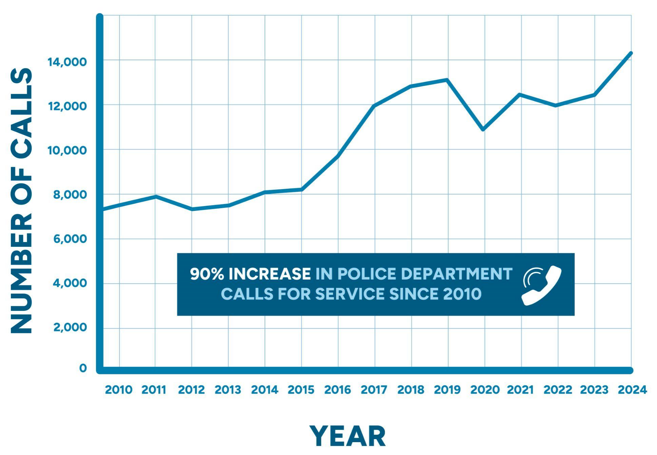
“While index crimes are an important consideration when determining the safety of a community, noting solely those statistics does not paint a holistic picture. Here in Whitewater, only 3% of our calls for service ultimately result in a incident that will be tallied by the FBI as an index crime. The larger impact for our community has been the increase in overall call volume, up 90% from 2010 to 2024, with no increase in staffing during that time. That has significantly decreased our ability to proactively police. As our staff becomes increasingly reactive, we become less capable of preventing crime, and it becomes more challenging to form the types of positive relationships necessary for a highly functioning police department. Police presence or lack thereof, more than anything else, is what determines the relative feeling of safety in a community.”
Editor’s note: Per the following graph, which was provided by the police department, their calls for service were increasing significantly before the surge of immigrants into the city. It is noteworthy that the COVID-19 pandemic began in the United States in 2020. Studies indicate that crime declined that year nationally overall, with the notable exception of violent crime, especially homicides. UW-Whitewater student local residency was also reduced. Our significant increase in immigration is generally believed to have begun in late 2021 to early 2022.