


Rock Lake is a popular destination for many fishermen – both in the summer and during the ice cover. The fishery is in good condition because of the variety of habitat in Rock Lake such as the bulrush bed in Korth Bay, the variety of native aquatic plants, and rocks that are found mostly on the eastern shore. However, there is a shortage of one type of habitat in the lake: wood. In order to change this situation, trees must be installed in the water at various locations around Rock Lake. Rock Lake Improvement Association members along with the local Department of Natural Resources (DNR) Fish Biologist and Jefferson County Water Resource Specialist worked to install fish sticks on February 9, 2026. (Fish sticks consist of multiple whole trees, including branches, bundled together and anchored to shore or the lake bed, partially to fully submerged under water.) More fish sticks are planned in the future.
Fish sticks are recommended where the density of trees in a lake is less than 200 trees per mile of shoreline. A 2016 wood survey on Rock Lake found 55 trees in the water, amounting to just 7.5 trees per mile. In order to improve this number, the Jefferson County Land and Water Conservation Department (LWCD) obtained a DNR grant to install fish sticks in Rock Lake adjacent to the Glacial Drumlin Trail. The Rock Lake Improvement Association helped to provide funds and coordinate the project.
The DNR approved installation of the fish sticks along the shore and the City of Lake Mills Parks Staff agreed to supply the trees that would be used. The trees are ones that the City was planning to take down anyway.
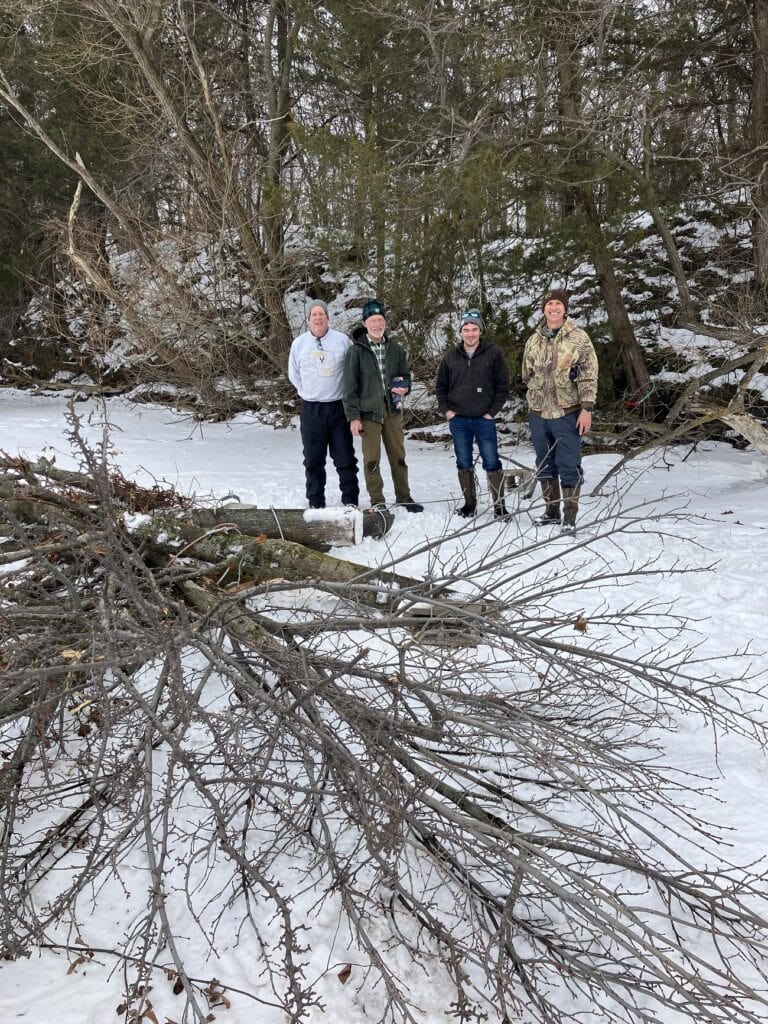
The fish and wildlife of Rock Lake will benefit greatly from the partnership between the Rock Lake Improvement Association, the City of Lake Mills, the County, and the DNR. Almost all of the fish species in the lake use woody habitat for a portion of their lifecycle. Depending on the species, the habitat provides areas for spawning, shelter, and feeding. The fish sticks can also benefit creatures that use the parts of the trees that will be above the water by providing nesting and sunning areas for birds and turtles.
The contractor, Forest Landscaping & Construction, Inc., helped to transport and place the trees at the installation location. A total of five trees varying in size were placed and connected to form this fish stick. When the ice melts, the trees will drop into the water so that the majority of the trees are underwater and a small portion is above water. Please note, it is always a good idea when in shallow waters near shore to watch for structures under water to prevent damage to boat propellers and hulls.
In order to further improve the woody habitat in lakes, we recommended that homeowners leave the trees that naturally fall into the water in place if possible, and plant native shrubs and trees that will become fish habitat in the distant future. For more tips on improving fish habitat or to learn more about the fish stick projects on Rock Lake, contact Colton Hutchinson (CHutchinson@jeffersoncountywi.gov, 920-674-7111).
Editor’s Note: The above was provided by the Jefferson County Land and Water Conservation Department.