


Kyong Pyun – An Immigrant Story

Editor’s Note:  The following interview was done by Marjorie Stoneman on behalf of Whitewater Unites Lives (WUL).

Kyong was born in Uljin in the Kyung-Buk Province of South Korea, a small town like Whitewater, where everyone knew everyone. 

Her older sister came to the United States in 1982 to open a grocery store and then later run a hotel in Washington State.  Kyong was seven at the time.  In 1990, her sister sponsored their mom to come to the U.S., and then her mom was able to get her green card and sponsor Kyong just before Kyong turned 21.  In the interview at the American Embassy in South Korea, the Korean American agent who interviewed her wanted to make sure Kyong’s mom could support herself and Kyong financially.

 “I understood that because I felt that if you come to the U.S., you should be able to support yourself and not expect a free ride,” said Kyong.

For two years, Kyong lived by herself in South Korea – both her sister and her mom were in the U.S.  During that time, she attended the English Institute to learn English in preparation for her move to the U.S.

Kyong received her green card one month after arriving. She spent her time learning to drive and working at her sister’s grocery store. She later attended the local community college to learn more English. She was able to take her general education requirements so that she could attend Washington State University.

When she became a U.S. citizen in 1997, she was required to give up her South Korean citizenship.  While it was difficult to give up citizenship in her homeland, it was imperative to Kyong that she do so.  She needed to be able to vote and make her voice heard, so becoming a U.S. Citizen was crucial.
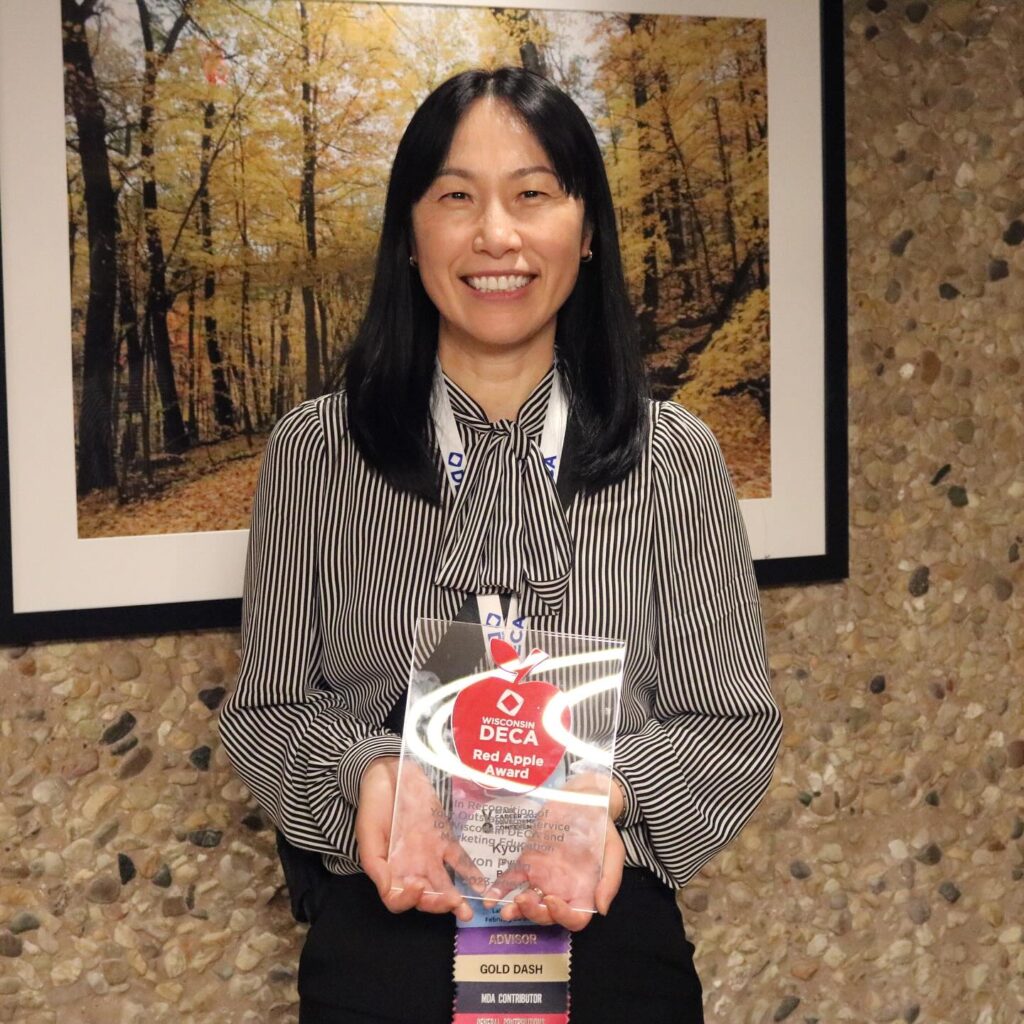
Kyong Pyun was awarded the Red Apple Award from DECA for her excellence in advising.

She lived in the dorms on campus at Washington State University and earned her Bachelor’s Degree in Apparel Merchandising and Textile with a minor in Business. 

 “I knew I had to study and work hard to get an education.  My mother moved to the U.S. at age 60 so I could get an education,” said Kyong.  She knew how important the education was for her mom and how much she sacrificed to support her.

Sleeping only a few hours each night, Kyong attended school and worked at a fast-food restaurant and dining halls.

Kyong’s advisor recommended that Kyong continue on to graduate school for her degree.  She was a teaching assistant and taught four classes as an instructor while earning her Master’s Degree in Apparel Merchandising and Textiles.

Kyong met her husband, Praveen Parboteeah, at the university, and they married during her senior year.  At the same time, Praveen was in the process of earning his PhD in Business. 

Kyong’s first job after graduation was at a department store in Moscow, Idaho. There, she was in charge of 50 staff, many of whom had worked there for 20 or more years, making it challenging for a young leader. 

Once Praveen was hired at the University of Wisconsin-Whitewater, Kyong could stay home with their daughter and work as a freelancer, writing instructor manuals for International Business, International Management, and Business Ethics textbooks. 

Kyong’s move to Whitewater was a shock. “I had more cultural shock from the move to Whitewater from Washington than I did with the move from South Korea to Washington.”  She said everyone knew everyone, so it was hard to integrate and make friends at first.

But Kyong and Praveen eventually made lifelong friends in Whitewater.  “Whitewater is a great place to raise kids.  It is safe, and everyone knows everyone is not a bad thing when you are raising kids,” she said.

Twenty-five years later, Kyong and Praveen still live in Whitewater and have raised two children.  Alisha graduated from UW-Madison, and Davin is currently attending.

 “The University of Wisconsin-Whitewater has treated Praveen well, and our family has thrived here,” said Kyong.

After the instructor-manual job ended, Kyong pondered pursuing a PhD, but one of her friends, Sara Coleman, who is also a teacher at the public school in Whitewater, asked her to consider being a substitute teacher.  Kyong then earned her license and was a substitute teacher for five years, helping to fill an important need in the schools.

By then, Kyong had a good grasp of the public school system in the U.S., which is very different from that in South Korea. In South Korea, the goal of Korean-based learning was primarily memorizing for test-taking. Kyong prefers the U.S. version of public schools, where the focus is more on learning and student growth than memorizing. 

During her five years as a substitute teacher, she felt she could better help and support students as a full-time teacher. Most importantly, she saw a need for a minority teacher, so she earned her second Master’s in Business Education from the University of Wisconsin-Whitewater in 2021 and has taught Business Education at Badger High School in Lake Geneva ever since.

At Badger High School, she is known for her high standards and tough classes, but students know she provides continuous support and is there for them.

Although it is a tough profession, teaching at high school, Kyong feels very rewarded when students show their appreciation by stopping by and sending her cards and emails, especially from her former students. She shared one of the emails that she got from her former students. He credits Kyong with his success.  He wrote in the email, “I’m currently attending Gateway, and I’m pursuing an associate’s degree in Business management. You are part of why I felt confident enough to attend college and pursue this degree. I also just finished my first semester with As and Bs, which I never thought I’d be capable of achieving. Without your encouragement and support, I never thought I would be good enough to go to college.” Kyong also said he was the first in his family to attend college.

She is also an advisor for the DECA, a business organization that prepares student leaders and entrepreneurs for marketing, finance, hospitality, and management careers.  She recently won the Red Apple Award for her excellence in advising.  A Badger High School site said, “This (Red Apple Award) is given to advisors who have gone above and beyond in their dedication to students at the local level.”

Determination, hard work, and perseverance drove Kyong to success, and she continues to pass those qualities on to her students.   

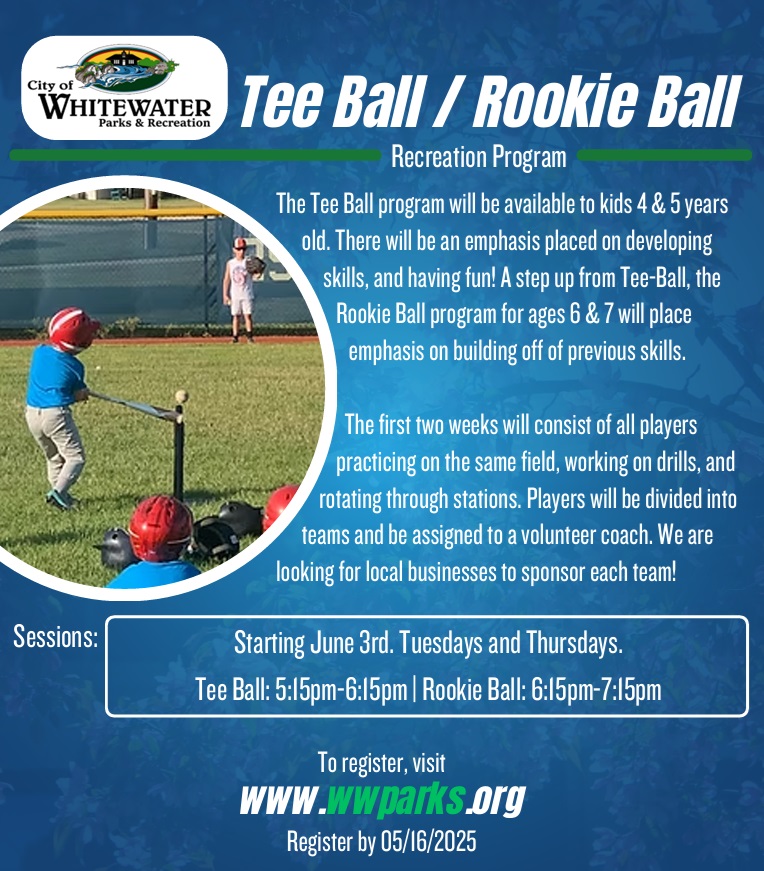
Youth Tee & Rookie Ball, Baseball & Softball, Registration Now Open

Get ready to hit the field! The Quad County League is excited to announce the 2025 Youth Baseball and Softball Recreation Program. This program provides a fantastic opportunity for kids to stay active, learn new skills, and build friendships while enjoying America’s favorite pastime.

Program Details:
The Quad County League includes teams from surrounding communities, offering opportunities for players at the following grade levels:

  • 2nd Grade Softball (participating in the Windmill League, based in Lake Mills)
  • 3rd & 4th Grade Baseball
  • 5th & 6th Grade Baseball
  • 7th & 8th Grade Baseball

    Key Information:
  • Practices: Held twice a week in April and at least once a week during the May season.
  • Games: Approximately 12 regular-season games, culminating in an end-of-season league tournament (typically the third week of July).
  • Sessions: Mondays and Wednesdays, 4:30 PM – 7:30 PM (based on availability).


  • Baseball & Softball:
  • Included Gear: Players receive a hat/visor, jersey, and drawstring bag.
  • What to Bring: Players must purchase their own pants, and baseball cleats are recommended (no metal spikes allowed).
  • Teamwork and Development: Kids will develop social skills, learn to work as a team, and compete in a supportive environment.
  • Registration deadline: March 28, 2025
  • How to Register: Visit www.wwparks.org to sign up today!


  • Tee Ball & Rookie Ball:
  • Focus on Fun and Learning: Young players will learn the basics of the game, improve their skills, and have fun working with teammates.
  • Included Gear: Players receive a shirt (baseball cleats are optional).

    Registration Deadline: May 16, 2025
    How to Register: Visit www.wwparks.org to sign up today!
  • Volunteers Needed:
    A successful season depends on the support of volunteer coaches. If you’re passionate about helping kids learn and grow, consider becoming a coach for the season!

    Don’t miss this opportunity to get your child involved in a fun and enriching program.
    Let’s make this season a home run!

#FlashbackFriday with the Historical Society: South side of east block of downtown Main St. c.1910

It’s time once again for #FlashbackFriday with the Whitewater Historical Society.

This week is another snowy winter view, this time of Main Street looking at the south side of the east block of the downtown. Note the old-fashioned snow shovel in the foreground and the man with his dog to the right. Although somewhat remodeled, all of the buildings shown in this c.1910 photograph are still standing. The building on the corner is the old First National Bank, later First Citizens State Bank, located here until the 1950s.

Join us next week for more from the Whitewater Historical Society.

(2479PC, Whitewater Historical Society)

Walworth St. House Sustains Major Damage in Fire – No Injuries

836 W. Walworth Street [Lynn Binnie photo]

Whitewater Fire and EMS reports that on January 21 at 1:07 p.m. the department received a report of smoke in a kitchen at the house located at 836 W. Walworth Street. Personnel arrived in less than four minutes after dispatch, finding smoke issuing from the home. Everyone had escaped from the residence. It was determined that the fire had originated in the basement. The department indicates that, “Despite an aggressive interior attack, flames had breached wall and ceiling material and entered a confined crawl space. This allowed fire to travel along void spaces throughout the entire structure requiring extensive overhaul efforts….Deteriorating structural conditions caused by fire and water damage necessitated the use of a backhoe to assist during the overhaul process.” Mutual aid was requested related to the extreme cold temperatures, with resources coming from Walworth, Rock and Jefferson Counties. The press release describes the estimated loss as “pending total.”

“Whitewater Fire/EMS encourages everyone to ensure you have working smoke detectors on every floor of your home,” the release states.

Chuck & Barb Taylor Protect 330 Acres of Farmland in Perpetuity

(L-R) Barb Taylor, GLC Executive Director Karen Yancey, Chuck Taylor

LaGrange residents Chuck and Barb Taylor were honored with the Conservation Stewardship Award at Geneva Lake Conservancy’s 2024 Holly Ball gala in December for protecting 330 acres of agricultural land. The organization indicates that agricultural land is disappearing at an alarming rate in Walworth County, with almost 10 percent of family farms developed for other uses since 2017. The Taylors’ land has been in Chuck’s family since the 1800’s, and it is the couple’s desire to ensure that it continues to be devoted to farming in perpetuity.

The farmland in the greater Whitewater area has sometimes been described as some of the best in the country. Much of it is categorized as A-1 prime agricultural land, which means that it has the best combination of soil properties, growing season and moisture supply needed to produce high yields of crops in an economic manner. Nearly all of the Taylor property is included in that classification.

“Southeastern Wisconsin has some of the country’s prime farmland needed to feed the nation,” said Kiera Theys, the Conservancy’s Director of Land Protection. “When we lose this land to inappropriate development, the prime soils that are essential for growing crops are paved over and gone forever.”

The 330-acre farm protected by the Taylors through a conservation easement held by the Geneva Lake Conservancy (GLC) ensures that the land is never subdivided and that it will be used for agriculture in perpetuity. Should an alternative purpose ever be proposed, it would be GLC’s responsibility to defend the easement, including legal action if necessary. “We want to work with more farmers to help protect the scenic beauty and conservation values that farmland provides to Walworth County residents and visitors,” said Theys. “We will be expanding our farmland protection program beginning in 2025.

To date, the Conservancy has protected than 1,300 acres of farmland in Walworth County preventing it from being subdivided and ensuring that it continues to be farmed forever.

Also receiving recognition at the gala were Charles and Jill Haubrich, who were given the Honorary Land Steward Award. The Haubrich family owns another land type that is disappearing in Southeastern Wisconsin – oak woodlands and oak savannas. Less than 20 percent of the oaks that once dominated the landscape in parts of Southeast Wisconsin remain, according to a study completed by the Morton Arboretum/Chicago Wilderness project.

For more information on how you can protect your agricultural land or oak woodlands or savannas, contact the Geneva Lake Conservancy at 262-325-4923.

The Geneva Lake Conservancy is an accredited land trust that has protected more than 3,500 acres of open land in Walworth County. Formed in 1977, it offers six public nature preserves for hiking and other recreational activities as well as other programs and educational activities for children and adults, including its Conservation@Home program. For more information, go to genevalakeconservancy.org.

Ron Binning is a Hometown Hero

Editor’s Note: The following was provided by Whitewater Unites Lives (WUL).

Ron Binning is a WUL Hometown Hero, and he was nominated by Kelly Davis, Sharon McCullough and Marjorie Stoneman, “For his many years of supporting Whitewater public schools through his leadership in Whitewater YES For Education.”

Ron Binning has worked to share information about many referendums and has provided his expertise, knowledge and support in reaching out to the community about the impact and importance of our schools for our children and our community.  He served in several leadership roles, including most recently as treasurer. 

Ron is well-known for his statement, “Strong schools make a strong community.”

He has also served on a variety of nonprofits serving Whitewater and has dedicated much of his time to those efforts. In addition to volunteering at MakerSpace, Ron has reviewed Whitewater High School student portfolios, served on the Dean’s Committee at the University of Wisconsin-Whitewater, volunteered on the Board of Directors of the Whitewater Grocery Co., and worked with youth golfers.

Ron Binning is a Hometown Hero

WUL (Whitewater Unites Lives) is a locally-focused civil and human rights group that works to connect the people in our community and to create opportunities for all people to learn and support each other in our common humanity.   

Anyone who would like to nominate a local hero of any age should send their nomination, with a short description, to whitewaterunites@gmail.com 

City Placing Police & Fire/EMS Referendum on April Ballot

City voters to consider increase in property tax levy to fund increased public safety service needs

On January 7, the City of Whitewater Common Council voted to place a public safety referendum question on the April 1, 2025 ballot. Voters will be asked whether or not to support an increase in the City’s annual tax levy to fund five additional police officers, a dispatcher, two cross-trained firefighters/EMTs, and their necessary equipment to help meet the growing needs of the Whitewater community. 

This referendum comes as a response to the City’s growing need for police and fire services, as current public safety funding levels and staffing models are insufficient to meet the growing demands and needs of the community. 

The Whitewater Police Department has seen a 90% increase in calls for service since 2010, while staffing has remained flat. There were 14,245 calls for service in 2024 – representing a nearly 90% increase in demand from 2010. 

“The need to increase police and fire staffing in Whitewater is not new — it has persisted for years and has now reached a critical point,” said Whitewater Police Chief Dan Meyer. “Current staffing levels are too low to enable police officers to balance proactive and reactive duties. It is essential that we secure additional funding to hire the staff necessary to meet our community’s service needs. Effective public safety services are vital, and we remain committed to delivering quality services to Whitewater residents.”

Similarly, the Whitewater Fire Department has also seen an increase in calls for service and a decrease in available staff. Since 2022, there has been a 32% increase in calls for service while paid-on-call staffing continues to decrease, requiring full-time fire/EMS personnel to meet the growing needs.

“The safety of our community is our top priority, and the increase in calls for service paired with the decrease in available paid-on-call staff has created significant challenges for the Whitewater Fire Department,” said Whitewater Fire Chief Kelly Freeman. “Since the City passed a referendum to meet acute Fire/EMS needs in 2022, calls for service have continued to grow, and the number of available paid-on-call staff has further decreased. While we are in a better spot today than we were before the referendum, we need additional resources to meet the current and prospective needs of the community.”

If Whitewater residents approve the referendum, the tax levy would increase by approximately $1.3 million, beginning with bills issued in [December] 2025, to cover the cost of five additional police officers, a dispatcher, two cross-trained firefighters/EMTs, and their necessary equipment.

If the referendum passes, a homeowner in the City of Whitewater who lives in Jefferson County will see an annual property tax increase of approximately $92 annually or $1.77 weekly per $100,000 of assessed property value, and in Walworth County, will see an increase of $118 annually, or $2.27 weekly per $100,000 of assessed property value.

The referendum question will appear on the Tuesday, April 1, 2025 ballot as follows: 

Under state law, the increase in the levy of the City of Whitewater for the tax to be imposed for the next fiscal year, 2026, is limited to 2.166% (based on the City’s best estimate), which results in a levy of $6,600,275. Shall the City of Whitewater be allowed to exceed this limit and increase the levy for the next fiscal year, 2026 for the purpose of funding increased staffing, and continuing to operate police and fire/EMS services, by a total of 18.29% (based on the City’s best estimate), which results in a levy of $7,906,057, and on an ongoing basis, include the increase of $1,305,782 for each fiscal year going forward?

The City of Whitewater will share more information about the referendum online, through direct mail and by holding public information sessions ahead of the April election. Additional information is already available on the City’s website https://www.whitewater-wi.gov/615/Police-and-Fire-EMS-Referendum.

Editor’s note: The above press release was provided by the City of Whitewater.

Presidential Executive Order Cites Whitewater

Editor’s note: The following executive order was signed by President Donald Trump on January 20, 2025. Whitewater is cited in the second paragraph.

REALIGNING THE United States REFUGEE ADMISSIONS PROGRAM

By the authority vested in me as President by the Constitution and the laws of the United States of America, including the Immigration and Nationality Act (INA), 8 U.S.C. 1101 et seq., and section 301 of title 3, United States Code, it is hereby ordered:

Section 1.  Purpose.  Over the last 4 years, the United States has been inundated with record levels of migration, including through the U.S. Refugee Admissions Program (USRAP).  Cities and small towns alike, from Charleroi, Pennsylvania, and Springfield, Ohio, to Whitewater, Wisconsin, have seen significant influxes of migrants.  Even major urban centers such as New York City, Chicago, and Denver have sought Federal aid to manage the burden of new arrivals.  Some jurisdictions, like New York and Massachusetts, have even recently declared states of emergency because of increased migration.

The United States lacks the ability to absorb large numbers of migrants, and in particular, refugees, into its communities in a manner that does not compromise the availability of resources for Americans, that protects their safety and security, and that ensures the appropriate assimilation of refugees.  This order suspends the USRAP until such time as the further entry into the United States of refugees aligns with the interests of the United States.

Sec. 2.  Policy.  It is the policy of the United States to ensure that public safety and national security are paramount considerations in the administration of the USRAP, and to admit only those refugees who can fully and appropriately assimilate into the United States and to ensure that the United States preserves taxpayer resources for its citizens.  It is also the policy of the United States that, to the extent permitted by law and as practicable, State and local jurisdictions be granted a role in the process of determining the placement or settlement in their jurisdictions of aliens eligible to be admitted to the United States as refugees.

Sec. 3.  Realignment of the U.S. Refugee Admissions Program.  (a)  I hereby proclaim, pursuant to sections 212(f) and 215(a) of the INA, 8 U.S.C. 1182(f) and 1185(a), that entry into the United States of refugees under the USRAP would be detrimental to the interests of the United States.  I therefore direct that entry into the United States of refugees under the USRAP be suspended — subject to the exceptions set forth in subsection (c) of this section — until a finding is made in accordance with section 4 of this order.  This suspension shall take effect at 12:01 am eastern standard time on January 27, 2025.

(b)  The Secretary of Homeland Security shall suspend decisions on applications for refugee status, until a finding is made in accordance with section 4 of this order.

(c)  Notwithstanding the suspension of the USRAP imposed pursuant to subsections (a) and (b) of this section, the Secretary of State and the Secretary of Homeland Security may jointly determine to admit aliens to the United States as refugees on a case-by-case basis, in their discretion, but only so long as they determine that the entry of such aliens as refugees is in the national interest and does not pose a threat to the security or welfare of the United States.

(d)  The Secretary of Homeland Security, in consultation with the Attorney General, shall examine existing law to determine the extent to which, consistent with applicable law, State and local jurisdictions may have greater involvement in the process of determining the placement or resettlement of refugees in their jurisdictions, and shall devise a proposal to lawfully promote such involvement.  In all cases, the Secretary of State and the Secretary of Health and Human Services shall ensure that the State and local consultation requirements in 8 U.S.C. 1522(a)(2) are carried out with respect to all refugees admitted to the United States.

Sec. 4.  Resumption of the U.S. Refugee Admissions Program.  Within 90 days of this order, the Secretary of Homeland Security, in consultation with the Secretary of State, shall submit a report to the President through the Homeland Security Advisor regarding whether resumption of entry of refugees into the United States under the USRAP would be in the interests of the United States, in light of the policies outlined in section 2 of this order.  The Secretary of Homeland Security, in consultation with the Secretary of State, shall submit further reports every 90 days thereafter until I determine that resumption of the USRAP is in the interests of the United States.

Sec. 5.  Revocation.  Executive Order 14013 of February 4, 2021 (Rebuilding and Enhancing Programs To Resettle Refugees and Planning for the Impact of Climate Change on Migration), is hereby revoked.

Sec. 6.  Severability.  If any provision of this order, or the application of any provision to any person or circumstance, is held to be invalid, the remainder of this order and the application of its other provisions to any other persons or circumstances shall not be affected thereby.

Sec. 7.  General Provisions.  (a)  Nothing in this order shall be construed to impair or otherwise affect:

(i)   the authority granted by law to an executive department or agency, or the head thereof; or

(ii)  the functions of the Director of the Office of Management and Budget relating to budgetary, administrative, or legislative proposals.

(b)  This order shall be implemented consistent with applicable law and subject to the availability of appropriations.

(c)  This order is not intended to, and does not, create any right or benefit, substantive or procedural, enforceable at law or in equity by any party against the United States, its departments, agencies, or entities, its officers, employees, or agents, or any other person.

THE WHITE HOUSE,     January 20, 2025.

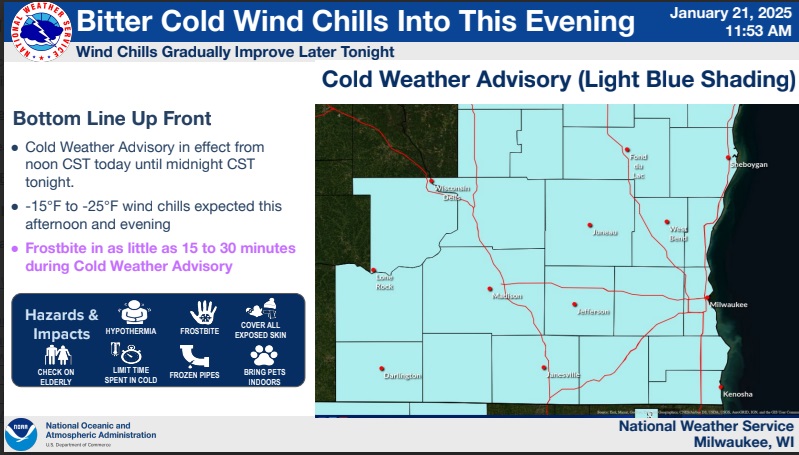
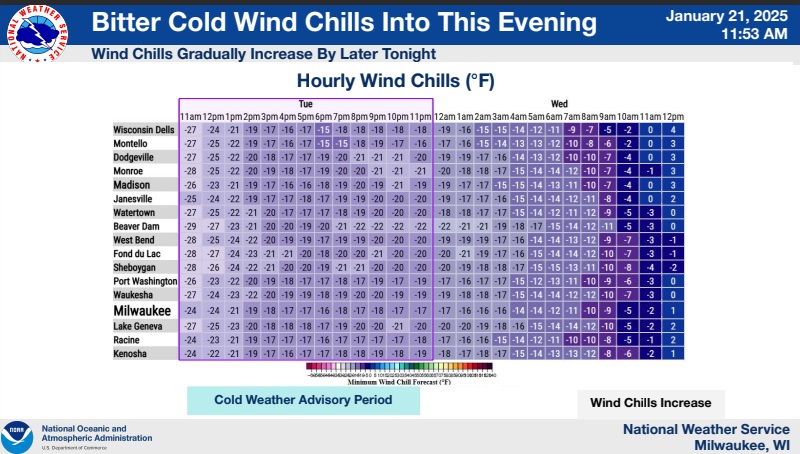
Extreme Cold Warning Expires, but Cold Weather Advisory Continues till Midnight

The National Weather Service Milwaukee/Sullivan Weather Forecast Office has allowed the Extreme Cold Warning to expire at noon on Tuesday, as anticipated. However, now there is in place a Cold Weather Advisory, indicating that bitterly cold air temperatures and wind chills will continue until midnight. Wind chills of -15 to -25 F (-26 to -32 C) are expected.