On Friday, September 26, 2025, at 11:47 pm, Whitewater Police received a report of shots fired near the intersection of S. Summit Street and W. Highland Street in the City of Whitewater. No injuries were reported. Officers found multiple .40 caliber casings in that intersection. Upon further investigation, officers identified Pablo J. Vasquez Brittain, 19, of Delavan, as the suspect responsible for discharging the firearm from a vehicle due to an altercation. Associates of Vasquez Brittain were also identified. Vasquez and the other subjects were believed to be located in a residence in the City of Delavan.
Whitewater PD detectives subsequently executed a search warrant at the Delavan location. Assisting in the search warrant were the Walworth County Sheriff’s Office SWAT team, Rock County Sheriff’s Office SWAT team and the Delavan Police Department. Multiple individuals were found to be in possession of firearms as the search warrant was executed, and all were taken into custody without incident. The firearm believed to have been fired from the vehicle in Whitewater was recovered at the Delavan residence. Illicit drugs were also located and turned over to the Delavan Police Department for prosecution.
Pablo Vasquez Brittain was confined in the Walworth County Jail. The Walworth County District Attorney’s Office has formally charged Vasquez Brittain with First Degree Recklessly Endangering Safety (Wis. Stat. 941.30(1)). Matthew J. Conrad, 18, of Elkhorn, and Lamar N. Early, 19, of Delavan, were also confined in the Walworth County Jail; however, formal charges have not been filed by the Walworth County District Attorney’s Office at this time.
Investigation continues into the circumstances of this incident as well as additional confrontations involving the suspects that were reported to have occurred at approximately the same time. Anyone with pertinent information is encouraged to contact the Whitewater Police Department at 262-473-0555 option #4. Anonymous tips can also be submitted using P3tips.com.
The Whitewater Police Department would like to thank the UW-Whitewater Police Department, Walworth County Sheriff’s Office, Rock County Sheriff’s Office and the Delavan Police Department for their assistance in this investigation. It is noted that this case has not been concluded. Unless a judgment of conviction is entered, the defendants are presumed innocent of all charges.
Editor’s note: The above press release was received from the Whitewater Police Department.
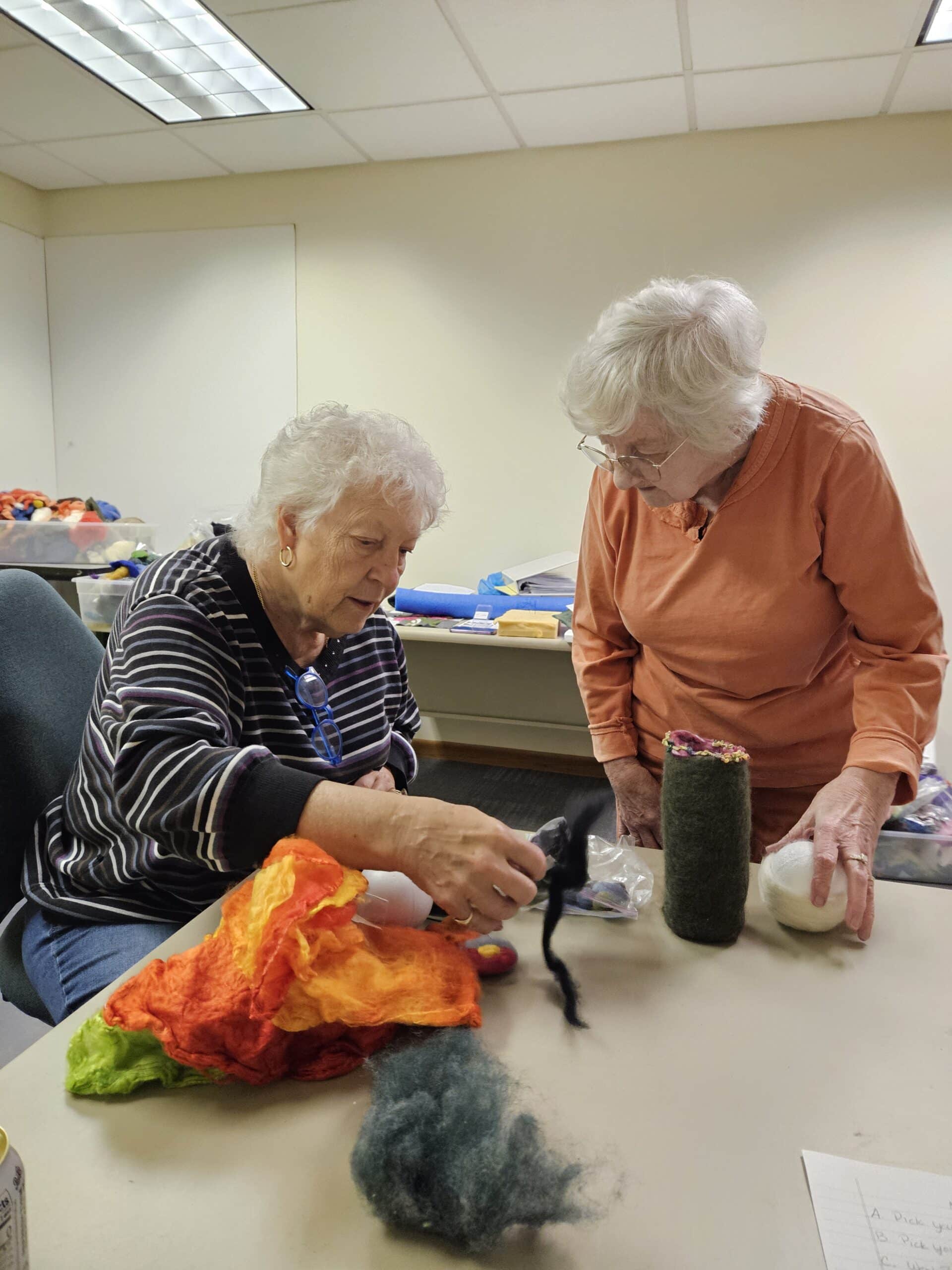
Needle felting and copper enameling workshops are being offered at Wisconsin Makers in October. Leani Schoor will teach “Copper Enameling for Beginners and Beyond” on Monday, Oct. 6. The fee is $25 and includes a copper dish. “Needle Felting” for all skill levels will take place Monday, Oct. 13. The fee is $20.
Both workshops will take place from 5 to 8 p.m. at Wisconsin Makers, 200 E. Clay St., Whitewater. Payment may be made at the workshops, which are geared toward ages 10 and up. Register by calling Schoor at (608) 421- 4078 or emailing her at leanischoor@gmail.com.
Copper enameling is a traditional technique that involves fusing powdered glass to a copper surface at high heat to create a permanent, colorful coating. Needle felting is a craft in which specially designed notched needles are repeatedly stabbed into loose wool fibers, compressing them to create firm, 3-D shapes.
Schorr earned her bachelor of science degree in art education and master’s degree in curriculum and instruction from the University of Wisconsin-Whitewater. She taught art at Jefferson High School for 38 years. The owner of Studio 2154 in Madison, Schorr teaches wet and needle felting, beadwork, glass fusing, cement yard art, ceramics, copper enameling, metal work and quilting.
Located at the corner of East Clay and Wisconsin streets in Whitewater, Wisconsin Makers is a makerspace that creates an affordable, collaborative and educational environment. The facility houses machine, welding/fabrication, electronics, automotive, 3-D printing, laser engraving and woodworking shops. It also offers pottery, ceramics, metal art, quilting, fabric arts, matting/framing and more.
For more information about the makerspace or workshops, contact Chris Spangler at (920) 728-2960.
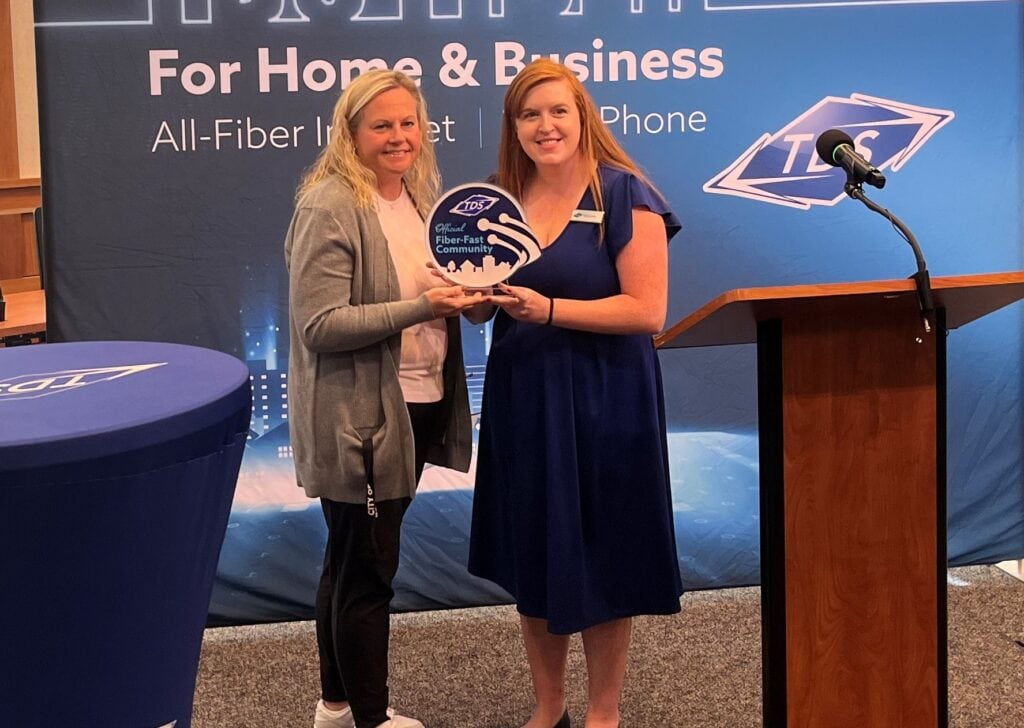
Becky Magestro, City of Whitewater Chief of Staff (L) receiving the award from Anna Jensen
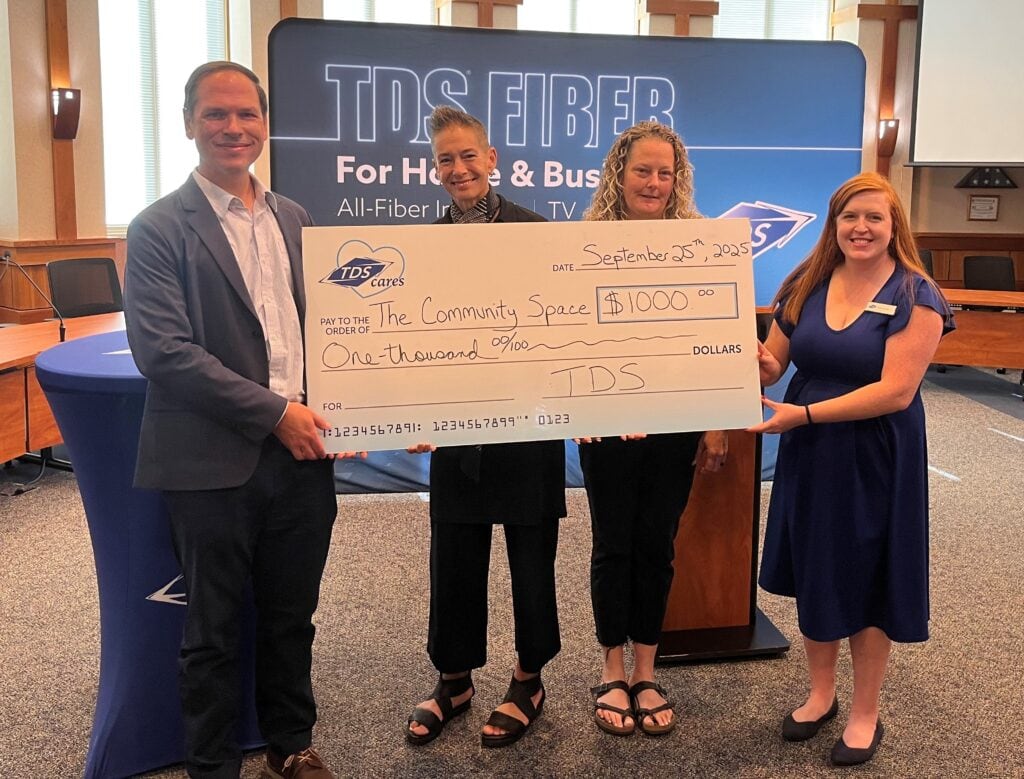
TDS representatives presenting a donation to The Community Space, represented by Kristine Zaballos, co-founder, and Cindy Wendt, general manager
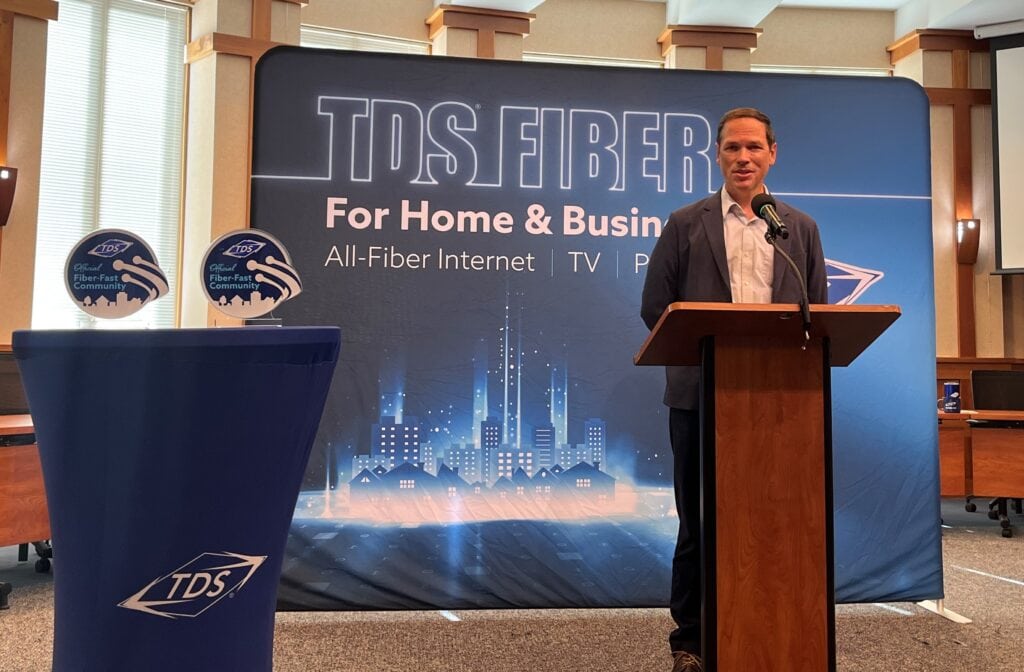
TDS Telecommunications LLC (TDS®) has officially marked the end of major construction activities on its all-fiber internet network in Whitewater, Wisconsin. The company designated Whitewater as a “TDS Fiber-Fast Community” at an event on Sept. 25, featuring representatives from the City of Whitewater and Whitewater Chamber of Commerce.
The TDS Fiber-Fast Award certifies the community is home to some of the fastest internet speeds in the world – a huge benefit for current residents and businesses and a signal for others looking for new locations to consider. More than 5,300 City of Whitewater addresses have access to TDS’ network, which features speeds up to 8 Gigabit.
After starting construction in 2023, TDS crews and contractors buried over 50 miles of fiber-optic cable. TDS has made a total capital investment in Whitewater of more than $5 million. The project, which was 100 percent funded privately, is part of TDS’ transformation into a fiber-centric company, with high-speed networks under construction throughout the country.
“We’re proud to have made a significant investment in the city’s future,” said Steve Mathesius, TDS Vice President of Data Management and Chief Information Security Officer. “Having a robust internet connection has never been more important. TDS fiber is a reliable and future-proof technology, and we’re pleased to provide world-class service that’s critical to residents’ day-to-day life.”
Also, as part of the Fiber-Fast event, TDS made a donation to The Community Space to help the organization continue connecting residents with needed resources.
“As we reach this great milestone, we look forward to continue helping make Whitewater a better place by working side-by-side with great local nonprofits,” said Anna Jensen, TDS associate manager of field marketing.
With the project in Whitewater now finished, TDS is redoubling its efforts to bring fiber to other area communities including Fort Atkinson, Jefferson, and Watertown. For more information on TDS and to find out if fiber is available at your address, visit TDSFiber.com.
Editor’s note: The above press release was provided by TDS.
Two members of the faculty at the University of Wisconsin-Whitewater further burnished the university’s reputation for great teaching by being named Fulbright Scholars.
Andrew Hurie, an assistant professor of curriculum and instruction who teaches bilingual education and English as a second language (ESL), was awarded a Fulbright to teach and conduct research in Colombia during the 2024-25 academic year. Stephen Levas, an associate professor of biology and geography, geology and environmental science, will teach and conduct research in Belize during the 2025-26 academic year.
“We are so proud to see these faculty members being rewarded for their commitment to research and teaching,” said Robin Fox, interim provost and vice chancellor of academic affairs. “It’s this commitment that consistently has UW-Whitewater lauded as a College of Distinction, and it’s the kind of experience — exemplified by our Great Teaching stories — that makes a difference to our students every day.
The Fulbright Program is the U.S. government’s flagship international educational and cultural exchange program, providing about 8,000 competitive, merit-based grants to U.S. citizens to study, research, or teach abroad and to foreign nationals to study or teach in the U.S. every year.
Professor of bilingual education and ESL taught in Colombia
Andrew Hurie, an assistant professor of curriculum and instruction who specializes in bilingual education and ESL, was in his third year of teaching at UW-Whitewater when he learned he would be shifting his focus to the University of Nariño in Pasto, Colombia. Born in Madison, he has a longtime connection to Pasto, where his wife and son were born.
In addition to teaching a series of research workshops at the university in Pasto and traveling to Ecuador to give a talk on teaching English at the University of Cuenca, Hurie worked with Los Ángeles Children’s Hospital in Pasto and UNIPA, or Unidad Indígena del Pueblo Awá, a political organization by and for the Awá people living in 32 Indigenous reservations across Nariño, Colombia.
Andrew Hurie speaking at the University of Cuenca in Cuenca, Ecuador, about “Teaching English in a Multipolar World” in April 2025. (Submitted photo)
With UNIPA’s support, Hurie conducted dozens of interviews at the children’s hospital in Pasto, half in Awapit, the language of the Awá people, with an interpreter, and the rest in Spanish. The idea to do so stemmed from pediatric doctors at the hospital, who wanted to offer services more aligned to the 30% of patients who identify as Indigenous, the largest percentage being Awá. In the interviews he asked Awá families how they conceived of health and well-being.
“These mothers, fathers, aunts, and grandparents from 10 different Indigenous reservations in Nariño, expressed an expansive understanding of community health centered on collective self-determination and caring for the land, which contrasts with the individual and mechanistic frame that dominates Eurowestern medicine,” said Hurie. “The families also valued diverse healing traditions and reported receiving good care at the hospital, yet leaving their rural homes to seek care in the city was a jarring experience for many. Feeling listened to made a great difference in their well-being.”
Some of the changes in practice suggested by the interviews include providing access to traditional foods not grown with pesticides and allowing multiple family members to visit children at the same time.
Since returning from Colombia in August, Hurie continues to meet with representatives from UNIPA and the hospital, and share the research results with different audiences.
Andrew Hurie speaking at the University of Nariño in Pasto, Colombia. (Submitted photo)
“I see my role as coordinating conversations and uplifting the voices of the families. The hospital didn’t have the time to do the interviews. It was helpful to have a researcher and educator like me to facilitate the conversations, because it hadn’t happened before.”
“The Fulbright Scholarship really brings home the fact that local connections and international connections are both meaningful,” said Hurie. “Recognizing Indigenous people who have been and continue to steward the land, and their ongoing, shared struggles throughout the globe, reinforce the value of international education experiences — something I hope to bring back to the classroom at UW-Whitewater.”
Biology and geography professor to teach in Belize
Stephen Levas, associate professor of biology and geography, geology, and environmental science, will teach and conduct coral reef research in the Central American country of Belize in January through May 2026.
Levas will be teaching a coral reef ecology class and embedding his research to get the students to work with a large data set from a coral reef station that measures several different metrics. He has already started working with some of them, including one person working on their master’s defense.
“It’s a way to build relationships — that’s one of the fundamental reasons I applied,” Levas said. “When you hear the name ‘Fulbright,’ for me, it means a high level of success. It’s pretty prestigious in the academic realm. I was interested in building something between UW-Whitewater and other places where we don’t already exist.”
Steven Levas, left, an associate professor of geography, geology, environmental science and biology, during class with students in a summer STEM Boot Camp program at UW-Whitewater.
A father of two sons, Levas is also excited to experience Belize with his family present. “This could be a really great experience for them to live outside of their comfort zone,” he said.
Levas identified Belize based on his interests in environmental science, ecosystems, and the natural world. His current research focuses on both seawater chemistry and freshwater ecosystems. He has conducted coral reef research in Australia, Mexico and Hawaii over the past two decades.
Levas’s interest in looking at the changes in coral reefs over the last 20 years is only exceeded by his passion for working with students interested in the marine biology field.
“What’s more important, beyond the research, is that experience of mentoring students and getting the next cohort of marine biologists in Belize going,” he said. “I truly believe in education, I believe in mentorship because I am a product of all of that, and I know it works, and I want to do that for students at the University of Belize.”
Steven Levas, left, an associate professor of geography, geology, environmental science and biology, during class with students in a summer STEM Boot Camp program at UW-Whitewater.
Levas, who joined the Warhawk family in 2016, said there are parallels between his work as a Fulbright Scholar and the work he does with UW-Whitewater students through undergraduate research. It’s that kind of work with the students — and the atmosphere of the campus community — that have kept him in Whitewater for nearly a decade.
“It’s the students, it’s the faculty, it’s the administrators who believe in Whitewater and what we do,” Levas said. “I have never been to a place where the faculty believe in the mission and what we do, which is getting students ready for the next step and help them get to wherever they want to be. The students understand why they’re here, they get why they’re here, and they believe in what we are trying to do.”
The man who fatally shot a newlywed couple at an Elkhorn bar last year has been sentenced to life in prison without the possibility of parole. Thomas Routt, 58, was sentenced in Walworth County Circuit Court on September 26 on two felony counts of first-degree intentional homicide for the deaths of Emerson and Gina Weingart at the Sports Page Barr, 29½ S. Wisconsin St., on Feb. 1, 2024, online court records show. The couple had been married the previous summer. Gina Weingart was tending bar while Emerson kept her company. Routt stole less than $150 from the bar. He claimed that he believed the safety was engaged on the gun.
Routt was convicted on June 26, 2025 of six charges, including murder, attempted murder and robbery after about two hours of jury deliberation. Details regarding the trial may be found in this article from WGTD. This brief video from TMJ4 depicts the scene in court as Routt is addressed by family members of the victims and by the judge.
Previous Whitewater Banner stories on this subject may be found at the following links:
A new Universities of Wisconsin (UWs) policy would ensure that all core general education courses can transfer between each of the 13 UWs.
The proposed Board of Regents policy, now being shared for comment at the UWs, is a student-friendly approach to transfer that will guarantee that core general education credits earned at one UW university will transfer and apply towards graduation requirements at another UW university. Core general education requirements would range from 30 to 36 credit hours in 10 to 12 courses in six curricular categories at all the UWs.
“The success of our students is paramount,” said Universities of Wisconsin President Jay Rothman. “Nothing should keep students from pursuing their dreams, and this policy puts students first.”
Establishing core general education courses and ensuring their transferability across the UWs would:
Provide broader consistency and transparency in the core general education requirements across all of the UWs.
Reaffirm that college credit earned in high school through statewide dual enrollment opportunities transfers and applies the same as credit earned while in college.
Strengthen existing transfer pathways for students transferring not only between UWs but also from the Wisconsin Technical College System.
Ensure general education credit mobility and course applicability.
Reduce the time to degree completion and the cost of attendance following transfer between UWs.
The UWs have taken steps in recent years to smooth out credit transfers between universities. This new effort is the result of provisions in the 2025-27 state budget.
Core general education courses are the courses students must take for graduation outside of their major and minor requirements, and the credit hour requirements currently vary widely depending upon the university.
While the credits associated with the core general education courses transfer between the UWs, the applicability of the courses has been uneven. The new policy is designed to ensure courses transfer and apply to new graduate requirements consistently.
Rothman said students should have clear expectations that core general education courses will easily transfer. The policy will be reviewed by the Board of Regents this fall and, if approved, will go into effect for undergraduate students who first enroll in fall 2026.
The Universities of Wisconsin serve approximately 164,400 students. Awarding more than 37,000 degrees annually, these 13 public universities are Wisconsin’s talent pipeline, putting graduates in position to increase their earning power, contribute to their communities, and make Wisconsin a better place to live. Nearly 90 percent of in-state Universities of Wisconsin graduates stay in the state five years after earning a degree. The universities provide a 23:1 return on state investment. The Universities of Wisconsin also contribute to the richness of Wisconsin’s culture and economy with groundbreaking research, new companies and patents, and boundless creative intellectual energy. Learn more at wisconsin.edu.
City of Whitewater Urban Forestry Commission – Monday @ 5:30 p.m. Agenda includes Discussion and possible action on what to do with wood from Territorial Oak. Cravath Lakefront room 2nd floor 312 West Whitewater St *In Person and Virtual Citizens are welcome (and encouraged) to join our webinar via computer, smart phone, or telephone. Citizen participation is welcome during topic discussion periods. Join Zoom Meeting https://us02web.zoom.us/j/89592911936?pwd=1wZ4pxV2jTv6NCSjH4ZooxLJnW0ObW.1 Meeting ID: 895 9291 1936 Passcode: 004861 — One tap mobile +16469313860,,89592911936#,,,,004861# US +19292056099,,89592911936#,,,,004861# US (New York) Join instructions https://us02web.zoom.us/meetings/89592911936/invitations?signature=L4hFmDvIN404 KQSva3ad6bMq7y5bOew5u_P6ryeL9GY
City of Whitewater Landmarks Commission – Wednesday @ 6:00 p.m. Agenda includes Discussion and possible action on concerns related to the Birge Fountain. Cravath Lakefront room 2nd floor 312 West Whitewater St *In Person and Virtual Citizens are welcome (and encouraged) to join our webinar via computer, smart phone, or telephone. Citizen participation is welcome during topic discussion periods. Please join the meeting from your computer, tablet or smartphone. https://meet.goto.com/446696309 You can also dial in using your phone. Access Code: 446-696-309 United States: +1 (408) 650-3123 Get the app now and be ready when your first meeting starts: https://meet.goto.com/install
The Whitewater Historical Society is joining the trend of thinking about Christmas in October! Like the stores that start putting up Christmas products at the same time as Halloween products, the historical society is presenting an early Christmas program, “Whitewater Recollects: Downtown Christmas Shopping.” The program will take place at the Starin Park Community Building on Sunday, October 5 at 1:00 p.m.
Join community members to reminisce about Christmas Shopping in downtown Whitewater during the late 1940s, 1950s, and 1960s. During these years, downtown merchants promoted Christmas shopping with special product displays, added toys, and events like Santa visits. The historical society program is free and open to the public!
Editor’s note: The above press release was received from the Whitewater Historical Society.
By Lynn Binnie Whitewater Banner volunteer staff whitewaterbanner@gmail.com
The Public Service Commission of Wisconsin [PSC] voted unanimously on September 25 to approve the application of Whitewater Solar, LLC for a Certificate of Public Convenience and Necessity to Construct Solar Electric Generation Facilities located within the City of Whitewater and Township [Town] of Cold Spring, Jefferson County, and the Townships [Towns] of Whitewater and LaGrange, Walworth County, Wisconsin. The agenda for the meeting, which was held at the Hill Farms State Office Building in Madison, was only posted the previous day, and it is only known that three residents of the affected area were in attendance. Their opinions were not expressed, as there was no opportunity for public comment.
Following the hearing, Yvette Loiselle, a scientist and one of the twenty intervenors whose properties are adjacent to the proposed project, told The Whitewater Banner that she is certain that the group will redouble their year-long efforts to oppose the massive “solar farm.” She stated that in her opinion the “bigger fight” than the impact on non-participating property owners is for the more than two thousand acres of prime farmland that would be lost. Loiselle expects that contacts will be made with the town boards of Cold Spring, LaGrange and Whitewater, asking them to take a position on the application, and specifically encouraging them to join as parties in the attempts to overturn the decision. She is urging residents to contact their town supervisors, the PSC, and their legislators with their views. According to Loiselle, the group’s response is expected to start with filing for a second hearing with the PSC. The grounds for this request would include that the Supplemental Environmental Assessment that the commission was required to produce due to revisions in the project plan was not completed prior to the hearing that took place with the intervenors.
Loiselle further told The Banner, “This project will have an impact on our community for the next forty years. Our natural community, tourist community, farming community, and rural homeowners are all standing to be negatively impacted by this project. It’s critical that we spread the word and get as many community members activated as possible. We will be holding a meeting in the coming weeks to share what position the local towns have taken, and our next steps as a community to fight this 2800-acre utility. In the final decision matrix, the PSC disenfranchised and marginalized the arguments of the local Whitewater intervenors. Your local intervenors stepped up and pushed back at this injustice and filed motions to the judge. The PSC reinstated our comments but filed a response to our motions basically ridiculing and marginalizing our work. Our voices have been reduced to ‘unsubstantiated rhetoric,’ and they do not acknowledge the impact this will have on our local tourism area or local landowners who will be forced to bear the burden of this project without any compensation while a handful of local landowners become wealthy from this. We and four generations of local citizens get to pay the tab for that enrichment.”
The Public Service Commission consists of three full-time members, all of whom were appointed by Governor Tony Evers: Chairperson Summer Strand, Kristy Nieto, and Marcus Hawkins. Since Strand was participating virtually, Nieto chaired the nearly two-and-a-half-hour agenda item and took the lead in providing background and raising the issues that the commission needed to decide. Nieto clarified that the requested status of Whitewater Solar is that of a Wholesale Merchant Plant. It is not unusual for such an entity to ultimately be purchased by a regulated utility such as WE Energies (which owns the power substation in the city to which the project would be connected), but if such a sale is proposed, another proceeding which would consider additional factors such as need and cost would be required.
Nieto indicated that there had been “broad public participation” regarding the application by both participating and non-participating parties. Both intervenors and PSC staff had put in a great deal of effort, resulting in a “huge record.” Nieto expressed appreciation for everyone who had participated in the process. “Our job,” she stated, “is to sift through the evidence as to which arguments as persuasive. We reviewed every argument. Ultimately our job is to focus on what are the laws that apply and the facts in the case” per the regulatory purview under state law. A decision matrix that PSC staff had developed would be used in the discussion to make legal determinations. (Some of the interventors had objected to the initial version of the decision matrix. The PSC made some changes in the matrix, while stating “Intervenors in this proceeding were afforded a full opportunity to be heard through their prefiled testimony, party hearing participation, and legal briefs. The proceeding complied with Wis. Stat. Ch. 227, Wis. Admin. Code ch. 2, and due process. Throughout, Commission staff and the Administrative Law Judge went to great lengths to accommodate the landowner intervenors, who did not retain legal counsel and demonstrated unfamiliarity with public utility regulation and Commission procedure and practice.”)
Nieto added that “The laws attempt to balance various individual and private interests versus the public interest in order to ensure reliable energy,” considering safety and environmental as well as human environmental concerns. “If we find that it’s permissible, we will vote for approval with conditions,” she concluded. Hawkins added that there are still many requirements on a “merchant” application, with a host of permits being required. “It doesn’t make an easy lane for approval,” he contended.
The project was initially proposed by Ranger Power but was then assumed by DE Shaw Renewable Investments. The New York City based company indicates on its website that since 2010 it has “built a diversified portfolio across 22 states with over 11 GW [gigawatts] of generation capacity, enough to power nearly 2 million homes.” Nieto indicated that the application was unique, in that the applicants had made significant changes to the proposal, creating some challenges. She acknowledged that there had been issues around the lack of communication with affected parties, with a “higher bar” having been reached by other applicants regarding outreach. Due to confusion about changes in the application an administrative law judge had ordered an open house for the developer to provide new information about the proposal, which she said was not required but a good idea.
The discussion followed the following decision matrix. In each case, a question is posed first, followed by discussion in italics, and the decision in bold.
Are any Energy Priority Law options cost-effective, technically feasible, and environmentally sound alternatives to building the proposed project….? It was indicated that this item was uncontested (as a no), and the commissioners agreed.
Would the proposed project have a material adverse impact on competition in the relevant wholesale electric service market….? It was indicated that this item was uncontested (as a no), and the commissioners agreed.
If approved, would the proposed project comply with Wis. Stat. 196.491(3)(dc)6 and not unreasonably interfere with the orderly land use and development plans for the area involved? The intervenors referenced the Jefferson County land use plan, which includes a goal of preserving agricultural land. They also maintained that they will be subject to many disturbances both during and after construction, that their peaceful rural life will be disrupted, and their property values will fall. The commissioners acknowledged that such a project usually has some impact on land use and development. They appreciated the concerns of the landowners, particularly the transfer of land from agriculture to solar. However, they also took seriously that the new use is agreed to by the participating owners , and stated that after decommissioning the land could be returned to agricultural use. Strand emphasized the importance of “unreasonable.” Hawkins said the record didn’t indicateunreasonable interference and noted that energy production is an acceptable use of “ag” land. He added that after the project went live, the overall percentage of non-ag in the counties would only be .03%. PSC voted that the project would not unreasonably interfere.
Has Whitewater Solar, LLC considered the use of brownfield sites to the extent practicable as required by statues….? PSC concluded there are no sites that meet the criteriain the area.
Is the design and location of the proposed project in the public interest considering the siting criteria of statues, or should the Commission modify the proposed siting areas? Intervenors, among other concerns, indicated that the siting of the project would harm the nearby Kettle Moraine State Forest and the Ice Age Trail. One commissioner acknowledged that these are precious areas to the state but couldn’t find beyond-speculative evidence that they will be harmed or in conflict of any legal requirements related to the area. While acknowledging that the developer had some shortcomings, it was felt that they have had a willingness to make some changes related to particular adjacent properties, and it was expected that collaborative work would continue with the community, particularly where arrays were now coming closer than originally plotted. PSC did not find unreasonable harm.
What standard conditions should be attached to the proposed project, if approved? PSC found that all conditions are necessary as modified. Project- specific Conditions:
(a) Is the following project-specific condition pertaining to vegetation density progress reports reasonable to impose as a condition of approval? A DNR witness advocated for vegetative density management in an effort to stabilize the soil, and the applicant agreed voluntarily. PSC determined that this condition is necessary. (b) Is the project-specific winter stabilization plan condition proposed by DNR reasonable to impose as a condition of approval? DNR proposed that bare soil needs to be stabilized to reduce runoff/erosion as snow melts and the ground thaws. The applicant didn’t object. PSC determined that this condition is necessary. (c) Are the following project-specific environmental resource conditions related to wetlands and waterways reasonable to impose as a condition of approval? DNR advocated for this requirement; the applicant did not object, and it must receive several permits from DNR. PSC determined that this condition is necessary. (d) Is the following project-specific condition pertaining to DNR land, proposed by the DNR, reasonable to impose as a condition of approval? The project crosses two DNR easements; DNR advocated for redoing fence lines and solar arrays to ensure public access to public lands. The applicant has had discussion regarding changing to a single easement. PSC determined that this condition is necessary. (e) Is the following project-specific fencing condition proposed by DNR reasonable to impose as a condition of approval? DNR staff recommended that there should be bottom apertures of all arrays a minimum 8″ high by 12″ wide in order to accommodate movement in/out by small animals including turtles. PSC determined that this condition is necessary. (f) Is the following project-specific condition pertaining to vegetative screening proposed by Commission staff reasonable to impose as a condition of approval? This condition would require vegetative screening to extent reasonable to alleviate visual impacts to adjacent non-participating residents to the extent possible without impacting sunlight access. Some agreements address this but have not yet been signed.PSC determined that this condition is necessary. (g) Is the following project-specific condition pertaining to historic resources proposed by the applicant reasonable to impose as a condition of approval? An alternate project area has medium to high potential for unrecorded archeological sites. This would normally have been done already but the area is currently under sod production. PSC determined that this condition is necessary. (h) Is the following project-specific condition pertaining to updates on the project’s interconnection rights proposed by Commission staff necessary for approval of the proposed project? It was indicated that this would provide a faster way to interconnect more cheaply. PSC determined that this condition is necessary. (i) Is the following project-specific condition proposed by intervenor Loiselle reasonable to impose as a condition of approval? Intervenor Loiselle proposed moving arrays preferably 1/2 mile from her property to protect from sound/glare. PSC indicated that setbacks from this property are farther back than provided in other cases. The record demonstrates that glare/sound impacts across imprint are minimal at most pursuant to threshold levels. If experienced as a disturbance, applicant has committed to mitigation measures to address. PSC determined that this condition is not necessary. (j) Are the following project-specific conditions proposed by intervenor W. Tillet reasonable to impose as a condition of approval? Intervenor requested larger setbacks. Setbacks already exceed 175′ from the home; request of 650′ would give this landowner control of two football fields of neighbor’s property. Applicant made a commitment regarding the laydown yard. PSC determined that this condition is not necessary. (k) What, if any, additional actions are appropriate for the Commission to take based upon the evidence in the record? Discussion included requests for compensation to adjacent homeowners, a bond to issue payments to specific properties losing value, coverage of costs for animal nuisance and deer collisions. PSC determined that no additional measures are necessary. (l) Are there any other project-specific conditions or modifications proposed in the record that the Commission wishes to adopt?Proposed for PSC consideration: (1) The applicant shall work with Anne and Wade Tillet to relocate the laydown yard or staging area currently adjacent to the Tillet residence to a location farther from the residences. The applicant shall notify Commission staff of the change in work agea…. (2) The applicant shall file with the Commission copies of signed JDAs [joint development agreements] upon execution. (3) The applicant shall develop a complaint process by which those affected in the project area are able to easily contact the applicant to seek resolution of a complaint. The complaint process should be provided to those living in the project area, prior to the start of construction, to address potential landowner impacts. The complaint point of contact should have sufficient knowledge and authority to resolve complaints. The applicant shall file documentation of this process with the Commission prior to the start of construction.PSC adopted all three additional conditions.
Wisconsin Environmental Policy Act (WEPA) and other environmental considerations: (a) Has the Commission complied with WEPA pursuant to Wis. Stat. 1.11 and Wis. Admin. Code ch. PSC4? Staff properly analyzed, providing initial Environmental Assessment and supplemental. Staff finding was unlikely to have significant impact on human environment. PSC found staff analysis to be sufficient. (b) Will the proposed project have undue adverse impacts on other environmental values as provided under Wis. Stat. 196.491(3)(d)(4)? Staff finding was that the project won’t have adverse impact on other environmental values given the several mitigation conditions. Whitewater Fire Department had expressed concern about possible battery fires; however, no batteries are planned for the project.Applicant is working with local snowmobile club regarding impacts. Other parts of Ice Age Trail haven’t had an uptick in complaints or loss of usage. Displacing need for more fossil fuel generation improves public health. Project will decrease agricultural runoff into waterways.PSC found that the proposed project will not have adverse impacts on other environmental values.
Should the Commission grant a CPCN [Certificate of Public Convenience and Necessity (CPCN) for the proposed project? PSC voted unanimously to “approve Whitewater Solar with conditions consistent with our discussion today.”
Whitewater Solar has targeted the first quarter of 2026 for going live with the project.
Editor’s note: Previous Whitewater Banner articles on this subject may be found at the below links.
There’s no business like show business, for Buddy (Bryan Cranston) and Macy Smart (Allison Janney) and their unpredictable life in regional theatre, while trying to raise their two radically different teenage sons. A touching, quirky charmer of a film.
Seniors in the Park is located in Starin Park, 504 W. Starin Road. Although there is no charge to attend, regular participants are encouraged to join Seniors in the Park. The annual fee for residents of the Whitewater Unified School District is $10 and non-residents is $15. The funds support about half of the cost of our front desk staff person for 15 hours per week. The rest comes out of our fundraising monies. If you cannot afford the fee, we have a fund that will cover it for you. Fees are accepted at the Starin Park Community Building or online at https://schedulesplus.com/wwtr/kiosk/